"Improving Adoption Rate of US Recycling Waste Sorting Centers
Addressing Labor Shortages and Increasing Recycling Rates
But Incurs Purchase and Maintenance Costs... 'Long-term Investment'"
Recycling companies across the United States are rapidly increasing the deployment of robots for sorting recyclable waste. Amid labor shortages, robots equipped with artificial intelligence (AI) use deep learning to detect the shape, size, and even brand of waste items, sorting them directly and effectively contributing on-site.
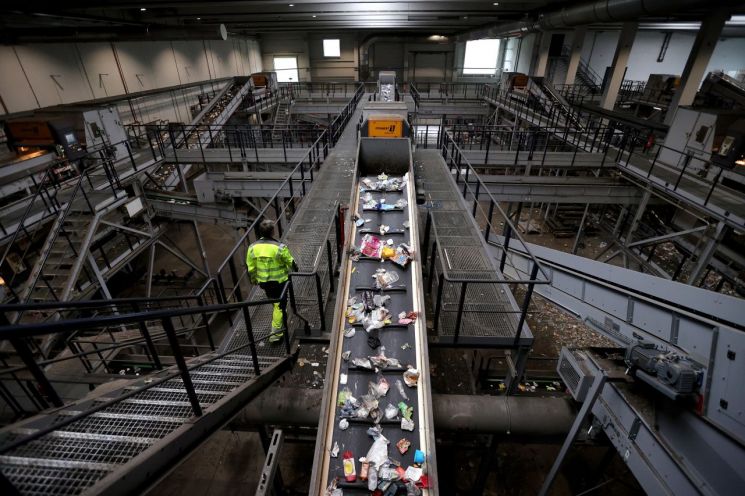
The Wall Street Journal (WSJ) reported on the 7th (local time), citing sustainability consulting firm Resource Recycling Systems, that currently 32% of recycling waste sorting centers in the U.S. employ robots for sorting tasks. The adoption rate, which was less than 5% in 2019, has rapidly increased in recent years.
AI-based robotic systems use deep learning to identify the shape, size, and brand of recyclable waste, detecting recyclable items such as plastics, paper, glass, and metals. Based on this, they identify recyclable materials and separate them from waste using robotic arms and suction devices attached to the robots.
According to WSJ, using robots reduces the time required for sorting recyclable waste. While one employee sorts 50 to 80 items per minute, AI-based robots sort 80 items per minute. Furthermore, WSJ reported that optical sorters equipped with advanced AI technology can sort up to 1,000 items per minute.
Optical sorters are deployed in large recycling centers in the U.S., requiring a separate space in addition to the conveyor belts where employees stand to work.
U.S. recycling companies have started deploying AI-equipped robots on-site to address labor shortages. Additionally, using AI and robots is evaluated to enable the identification and collection of more recyclable parts from waste.
Boulder County Recycling Center, one of the largest recycling companies in Colorado, U.S., introduced a robotic system three years ago to sort plastic bottles, milk cartons, and other items on conveyor belts. Susan Jones, an executive at the company, said they assign tasks that employees do not want to robots, adding, "They (robots) do not need breaks or vacations and can work twice as much."
Waste Management, the largest waste disposal company in the U.S., is investing in AI to raise the recycling rate to 60% by 2030. Since last year, the company has committed over $1 billion to recycling infrastructure, including 40 recycling centers by 2026. Most of the investment focuses on AI and automation.
The company stated that while non-automated centers may have up to 50 employees, automated centers typically have only 4 to 6 employees.
However, investing in AI and robots requires substantial capital, inevitably increasing cost burdens. Besides initial purchase costs, funds are needed to maintain, manage, and upgrade each robot. The industry estimates that such costs amount to $150,000 to $300,000 per robot, and optical sorters require $1 million to $2 million each to operate.
Considering these cost issues, some companies opt to rent robots rather than purchase them. Martha Horowitz, CEO of AMP Robotics, the largest recycling robot manufacturer in the U.S., introduced that clients pay rental fees for robots amounting to 20% to 50% of the hourly wages paid to employees.
JD Lindberg, president of Resource Recycling Systems, said that in the long term, sorting machines cost less than labor and that investments in robotic systems typically pay off within two years.
© The Asia Business Daily(www.asiae.co.kr). All rights reserved.
![User Who Sold Erroneously Deposited Bitcoins to Repay Debt and Fund Entertainment... What Did the Supreme Court Decide in 2021? [Legal Issue Check]](https://cwcontent.asiae.co.kr/asiaresize/183/2026020910431234020_1770601391.png)
















