Sudokwon Landfill Site Under Incheon City Jurisdiction
Metropolitan Incineration Plant Faces Opposition from Incheon Citizens
As Gimpo City pushes for incorporation into Seoul, the metropolitan landfill site and the regional waste incineration plant have become new sources of conflict. Initially, it was expected that waste disposal issues would be a major bargaining chip in the incorporation negotiations, but Incheon City, which holds the key, strongly opposes this. This issue could also affect Seoul citizens' understanding of the necessity of incorporation, drawing attention to how Gimpo City can persuade Incheon City.
'Bargaining Chip' Metropolitan Landfill Site, Under Incheon City's Jurisdiction
The problem began when Kim Byung-su, Mayor of Gimpo City, stated in a recent media interview that "the 4th landfill of the metropolitan landfill site is on Gimpo land, so if Gimpo is incorporated into Seoul, the waste problem can be solved." However, after a meeting with Seoul Mayor Oh Se-hoon on the 6th, Mayor Kim said, "The metropolitan landfill site has no authority in Gimpo." His position reversed 180 degrees within a few days.
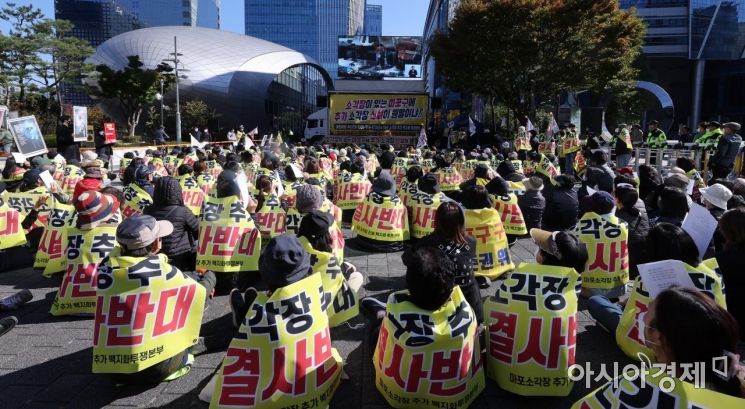 On the 18th, residents of Mapo-gu in front of Nurikkum Square, Mapo-gu, Seoul, are urging the withdrawal of the incinerator construction plan. On this day, the Seoul Metropolitan Government's residents briefing session was canceled due to residents' opposition. Photo by Hyunmin Kim kimhyun81@
Established in 1992, the metropolitan landfill site consists of four landfills covering a total of 16.36 million square meters. Among these, landfills 1 to 3 are administratively located in Incheon City, with landfills 1 and 2 no longer in use. At the time of establishment, it was expected that all four landfills would be full by 2016, but due to the introduction of a volume-based waste fee system and increased recycling in 1995, parts of landfill 3 and landfill 4 (3.89 million square meters) remain unused.
The controversial 4th landfill is divided by area with Incheon City holding 85% and Gimpo City 15%. However, despite the administrative division, the metropolitan landfill site’s ownership and jurisdiction have been held entirely by Incheon City since a four-party agreement in 2015 between the Ministry of Environment, Seoul City, Gyeonggi Province, and Incheon City. There is also a clause stating that landfill operations cannot proceed without Incheon City's consent.
Incheon City strongly opposes this. On the 6th, Yoo Jung-bok, Mayor of Incheon, said, "The metropolitan landfill site issue should be discussed based on consultations among the four-party council including Incheon and Seoul, and should not be linked to the unrealistic proposal of Gimpo's incorporation into Seoul." In response, Mayor Kim retorted, "The Mayor of Incheon should not interfere with Gimpo."
'Regional Waste Incineration Plant' Faces Resident Opposition
While the metropolitan landfill site draws opposition from Incheon City, the regional waste incineration plant that Gimpo City is promoting faces resistance from Incheon residents. This is because Gimpo City selected candidate sites for the regional incineration plant, which will be jointly used with Goyang City in accordance with the '2026 Ban on Direct Landfilling of Waste' policy, in areas adjacent to Incheon City.
Since early this year, Gimpo City has formed a site selection committee and chosen three candidate sites for the regional incineration plant: Daebyeok-ri 797 area and 690-61 area in Daegot-myeon, and Hakun-ri 923-4 area in Yangchon-eup. The final decision is scheduled for June next year, with construction starting in 2026 and operation targeted for 2028.
Incheon residents strongly oppose Gimpo City's decision. All candidate sites are adjacent to Incheon City, and in the case of the Hakun-ri site, it is only about 1 km in a straight line from Geomdancheon Stream, which flows along the boundary between Incheon and Gimpo. Additionally, the Daegot-myeon site is approximately 11 km from Geomdan in Incheon’s Seo-gu district, where the population is concentrated.
Incheon residents oppose not only the pollution damage from the regional incineration plant but also the possibility that the transportation routes for waste to the Gimpo incineration plant may pass through Geomdan. On the 7th, six Incheon city councilors from the Democratic Party's Seo-gu district held a press conference in front of Gimpo City Hall, stating, "Gimpo City selected only three candidate sites on the Geomdan border without considering other areas such as northern Gimpo," and added, "The reason Gimpo chose these three sites on the Geomdan border appears to be a trick to transport waste using Geomdan area roads." Although Gimpo City held a public viewing of the draft strategic environmental impact assessment and a residents' briefing session for the regional incineration plant at the Oryu Wang-gil-dong Administrative Welfare Center in Seo-gu, Incheon, the briefing ended in disruption due to strong resident opposition.
The capacity of the new regional incineration plant is also an issue. The incineration plant promoted by Gimpo City is designed to process 500 tons per day. Currently, Seoul City is pushing to install a municipal waste incineration plant in the Sangam-dong area that processes 1,000 tons per day, so even if Gimpo is incorporated into Seoul, the new regional incineration plant is unlikely to significantly help Seoul’s waste disposal.
© The Asia Business Daily(www.asiae.co.kr). All rights reserved.

















