Improved Business Conditions in Car and Shipbuilding Sectors but Risks Remain
Long-term Demand Decline Due to China's Real Estate Slump
The steel industry is expected to remain under the shadow of China's economic slowdown next year as well. Although the automotive and shipbuilding sectors improved this year, providing some relief, concerns remain that these are only short-term positive factors.
At the '2024 Steel Industry Outlook Seminar' held on the 7th at the POSCO Center Yeoksam, Gong Moon-gi, a research fellow at POSCO Research Institute, pointed out, "Global steel demand increased by only 0.1% year-on-year until September this year," adding, "Even considering growth in the fourth quarter, steel demand is likely to be lower than initially expected."
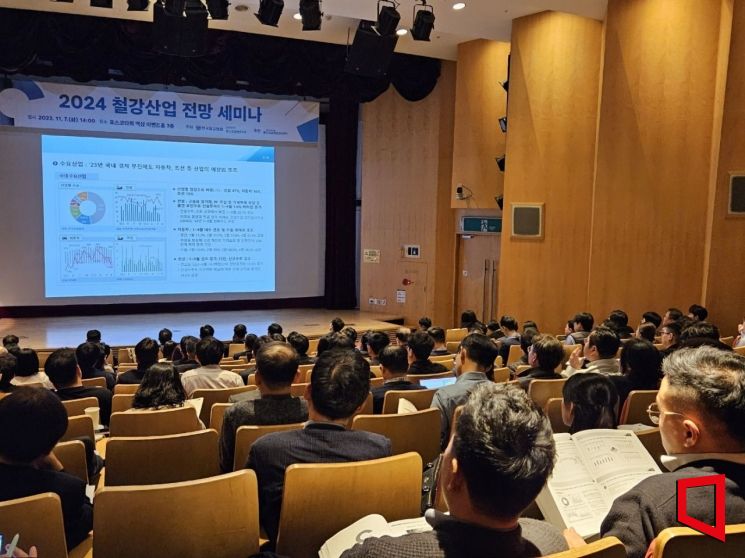 The Korea Iron & Steel Association (Chairman Choi Jung-woo) held the "2024 Steel Industry Outlook Seminar" on the 7th at POSCO Tower Yeoksam, with stakeholders from the steel industry, demand sectors, and related organizations in attendance.
According to the forecast released last month by the World Steel Association, global steel demand this year was expected to increase by 1.8% to 1.815 billion tons compared to the previous year. This means there was an error of more than 1 percentage point between actual demand and the forecast. The World Steel Association's outlook for next year, predicting 1.849 billion tons (a 1.9% increase), is also expected to be difficult to achieve.
Research fellow Gong identified China as the biggest cause of weak demand. He analyzed, "Due to the impact of the real estate slump in China, long-term steel demand will decrease," but added, "Although China's steel demand has peaked, based on past cases in developed countries, the possibility of a sharp drop in steel demand is low."
Looking at the share of steel consumption by industry in China, real estate accounts for 32%. Adding infrastructure (social overhead capital) investment, which accounts for 25%, means that real estate and construction make up more than half. Gong explained, "While the area of real estate construction starts in China has been declining since last year, the area of completed construction has been steadily increasing," adding, "This is because the Chinese government has focused on completing unfinished projects rather than implementing aggressive stimulus policies."
He continued, "The increase in completed volume is supporting steel demand in the short term," but forecasted, "With current construction starts decreasing, completed volumes will sharply decline after 2025, leading to a long-term decrease in steel demand." He also predicted that if real estate investment in China decreases by 10%, steel demand will drop by 3%.
The Chinese government's lukewarm attitude toward steel production cuts is also affecting the deterioration of the steel market. Gong pointed out, "Last year, China controlled steel production at the central government level, but this year the trend has changed," adding, "If production cuts are implemented, tax revenue immediately decreases and employment issues arise, causing a sense of burden."
As the Chinese government does not actively pursue production cuts, the possibility of Chinese steel companies aggressively expanding exports increases. This poses a threat to lowering steel prices within the Asian region. However, Gong added, "Even if China's exports increase, if demand from emerging countries remains firm, prices within the Asian region could stabilize and domestic inflows may decrease."
The domestic steel market is expected to grow by around 1% due to sluggish construction amid a slowdown in automotive and shipbuilding demand, which led demand this year. Domestic steel demand in 2024 is expected to be 53.4 million tons, similar to this year's 53 million tons. Chu Ji-mi, a senior researcher at POSCO Research Institute, said, "With simultaneous slowdowns in domestic demand and exports and stabilization of facility operations, steel production next year will increase by only about 1%."
There are also forecasts that steel raw material market conditions will remain sluggish for the time being amid the global high-interest-rate environment. Kim Yoon-sang, director at Hi Investment & Securities, said, "The higher the inflation expectations, the stronger the prices of commodities such as steel and non-ferrous metals," adding, "Next year, as inflation expectations decrease, raw material prices are bound to fall."
He further explained, "Even if the U.S. Federal Reserve (Fed) cuts interest rates in the first half of next year, considering that historically raw material prices rebound with a lag of 9 to 16 months, improvements in the steel market can be expected only after next year." He also predicted, "Considering the slump in China's real estate market and local government debt, the trend of expanding steel exports to overcome domestic sluggishness will continue."
© The Asia Business Daily(www.asiae.co.kr). All rights reserved.

















