Patient organizations expressed support for the government's plan to expand medical school quotas but showed a negative stance on fee increases and easing penalties for medical personnel.
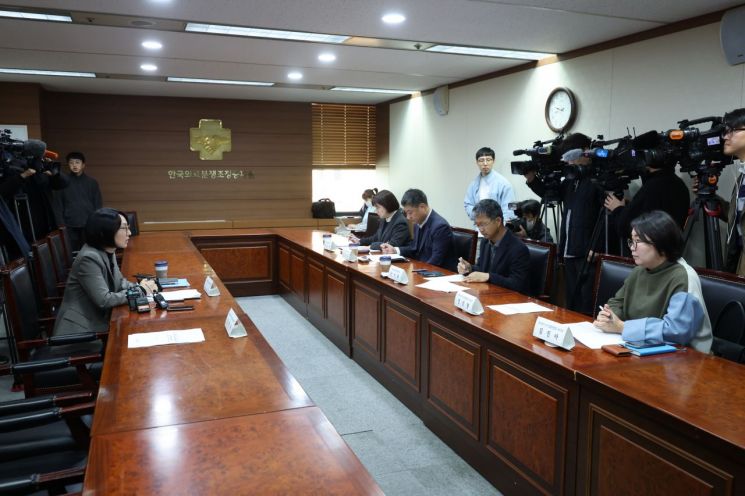
On the 7th, at a meeting organized by the Ministry of Health and Welfare in the conference room of the Korea Medical Dispute Mediation and Arbitration Agency in Jung-gu, Seoul, the Korea Patient Organizations Coalition emphasized, "We should prioritize increasing medical school admissions by predicting the number of doctors needed in future medical fields through social discussions." They added, "To ensure that trained doctors work in essential and regional healthcare, the regional talent selection criteria for medical schools outside the metropolitan area should be strengthened, and the mandatory selection ratio should be significantly increased."
While promoting the expansion of medical school quotas, the government is also preparing measures to increase fees paid from the National Health Insurance finances. Regarding this, the coalition pointed out, "Indiscriminately introducing or increasing National Health Insurance fees could cause disparities in revenue among medical specialties, potentially leading to the collapse of other medical sectors."
Concerning the government's plan to ease criminal penalties for doctors involved in medical accidents, they criticized, "Focusing solely on easing the legal criminal liability of medical personnel who cause medical accidents, without improving the grievances and trauma experienced by victims or their families, the burden of proof, high litigation costs, and lengthy trial periods, is inconsistent with public sentiment and only breeds resentment."
Furthermore, the coalition stated, "Although patients are the greatest victims of gaps and collapse in essential medical care, the claims of medical organizations and the government's promotion process create the misconception that the greatest victims are medical personnel. Even if it is a reform measure that medical personnel might oppose, such as increasing medical school quotas, if it can save essential medical care, it should be brought onto the agenda and discussed."
In addition to the Korea Patient Organizations Coalition, medical consumer groups such as the Korea Consumer Federation, the Korea Federation of Consumer Organizations, and the Korea Rare and Intractable Disease Association participated in the meeting hosted by the Ministry of Health and Welfare.
The Ministry plans to continue social discussions with various sectors to ensure that the voices of the public, who have high medical demand, as well as the medical community, are reflected.
Jeon Byung-wang, Director of Health and Medical Policy at the Ministry of Health and Welfare, said, "Innovation in regional and essential medical care is to protect the lives and health of the ultimate consumers, the public. We will do our best to continuously listen to and reflect the opinions of consumer and patient organizations representing the public in the policy process."
© The Asia Business Daily(www.asiae.co.kr). All rights reserved.