"Gallium, Germanium, and Graphite Controls Followed by Rare Earth Concerns"
China has strengthened control over key raw materials such as rare earths, crude oil, and iron ore. Concerns are emerging that rare earths might be next.
On the 7th, major foreign media reported that China's Ministry of Commerce announced it would require importers of crude oil, iron ore, copper concentrate, and potassium carbonate fertilizer?items that need import licenses?to submit real-time transaction information to stabilize trade. The Ministry also stated that exporters of rare earths would be required to submit export information.
The new regulations update the list of commodity reporting regulations announced by China last year, took effect on the 31st of last month, and will be maintained for two years.
The Ministry of Commerce explained, "This is to quickly and accurately grasp the export and import status and flow of large-scale commodities, make scientific judgments, guide foreign traders to export and import in an orderly manner, provide a basis for risk avoidance, and play a firm role in stabilizing foreign trade."
It also stated that buyers and sellers of newly added commodities must provide real-time shipping information, origin, contract date, quantity, and arrival time.
Major foreign media noted, "These information reporting regulations are already applied to agricultural products such as soybeans, powdered milk, pork, and beef," adding, "It is not immediately clear how much these regulations will impact trade."
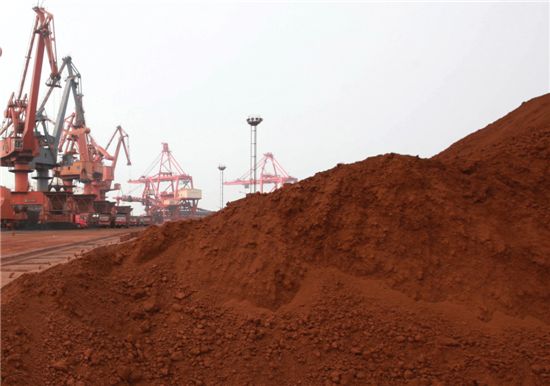 Rare earths being loaded at Lianyungang Port, Jiangsu Province, China.
 [Photo by Asia Economy DB]
Cheng Feng, an iron ore analyst in Beijing, told major foreign media, "It does not seem that this will significantly affect customs clearance speed." He added, "Many other agricultural products are already on the list of these regulations, which means the system is quite developed."
Another analyst, who requested anonymity, pointed out that data collection may be the first step by the Chinese government ahead of greater control over key raw materials. Earlier, Chinese authorities announced on the 3rd that they would promote the high-quality development of the rare earth industry.
According to state-run Xinhua News Agency, Premier Li Chang presided over a State Council executive meeting that day, stating, "Rare earths are strategic mineral resources," and emphasized the need to oversee exploration, development, utilization, and standardized management of rare earths.
Major foreign media highlighted, "China announced export controls on gallium and germanium in July and on graphite in October, sparking concerns that rare earths might be next."
This move draws attention as it comes ahead of the Asia-Pacific Economic Cooperation (APEC) summit scheduled to be held in San Francisco from the 11th to the 17th, where a bilateral meeting between President Joe Biden and President Xi Jinping is expected.
Some interpret this as a subtle message from China that it may use the rare earths card in response to U.S. export control measures in the future.
© The Asia Business Daily(www.asiae.co.kr). All rights reserved.
















