Japan's Real Wages Decline for 18 Consecutive Months
Kishida: "Economic Circles Will Take the Lead in Persuasion"
Efforts to Revive Livelihood Economy Amid Falling Approval Ratings
Tripartite Wage Increase Meeting Expected This Month
As Japan's real wages have declined for 18 consecutive months, Prime Minister Fumio Kishida has stepped forward, saying he will "persuade the business community at the forefront." With real wages barely rising despite inflation, he has taken direct responsibility. It is analyzed that Prime Minister Kishida, facing a reappointment crisis due to falling approval ratings, is seeking a breakthrough by restoring the people's economy.
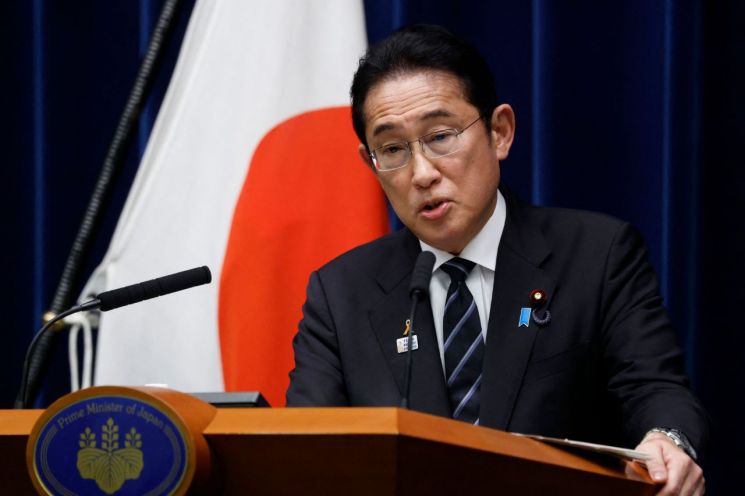 Japanese Prime Minister Fumio Kishida is holding a press conference on economic stimulus measures at the Prime Minister's Official Residence in Tokyo on the 2nd. [Image source=AFP Yonhap News]
On the 7th, Japan's Ministry of Health, Labour and Welfare announced through the 'September Labor Statistics Survey' that the average cash earnings per employee at companies with five or more employees was 279,304 yen, a 1.9% increase compared to the same month last year. However, considering inflation, real wages decreased by 2.4%, marking an 18-month consecutive decline. Wages should rise in line with inflation, but since wage growth has not kept pace, Japanese households have been forced to manage increasingly tight budgets.
As the burden on households due to high inflation intensified, Prime Minister Kishida declared that the government would step in to resolve the issue. At the Economic and Fiscal Advisory Council the day before, he stated, "I will take the lead in persuading the business community to raise wages," and added, "After that, we will implement support payments and tax reduction policies, including cuts in income and resident taxes." On the same day, during a meeting with Masakazu Tokura, chairman of the Japan Business Federation (Keidanren), he urged companies to cooperate, saying, "If wages do not catch up with the pace of inflation, we could return to deflation." Jiji Press reported that Prime Minister Kishida has begun coordinating to hold a tripartite labor-management-government meeting within this month ahead of the spring labor negotiations scheduled for April next year.
For the Kishida Cabinet, which has positioned economic stimulus as a core task of the administration, the issue of stagnant wages is a prerequisite that must be resolved. Wages must rise at the same pace as inflation to increase household purchasing power and stimulate the domestic economy. For 30 years, Japan's wage growth rate has stagnated, making it difficult to escape deflation. For this reason, on the 2nd, Prime Minister Kishida announced an economic stimulus package worth 17 trillion yen (approximately 152 trillion won). The budget includes tax reduction policies to increase household purchasing power and funds to promote wage increases for small and medium-sized enterprises.
Economic recovery is also necessary to boost approval ratings. Last month, the Kishida Cabinet's approval rating was recorded at 25% according to Mainichi, the lowest since the cabinet's launch in October 2021. The ruling Liberal Democratic Party's support rate was only 23%. In Japanese politics, it is considered a signal that regime maintenance is impossible if the combined approval ratings of the cabinet and ruling party fall below 50%. Despite a cabinet reshuffle in September aimed at revitalizing the government, approval ratings did not rebound, making the economic stimulus package Prime Minister Kishida's last card to regain support.
The Nihon Keizai Shimbun explained, "Prime Minister Kishida's term as LDP president expires in September next year," and added, "(Kishida) appears to be pursuing a strategy to quickly show results through (economic) policies rather than paving the way for re-election through a dissolution of the House of Representatives."
© The Asia Business Daily(www.asiae.co.kr). All rights reserved.

















