Transported to Anyang Dongan Police Station After Arrest
Lower Face Covered with White Mask
"Publicly Wanted Criminal" Sparks Criticism
Kim Gilsu (36), who was detained at Seoul Detention Center on suspicion of special assault and escaped while receiving hospital treatment, was apprehended by the police and covered his face with a mask at the time of transfer. Kim, who had been on the run for three days, was already publicly identified through a wanted notice. Under the current system, even if a criminal’s identity has been disclosed, forcibly revealing their face is not possible, leading to criticism that this contradicts the purpose of the wanted notice and identity disclosure system.
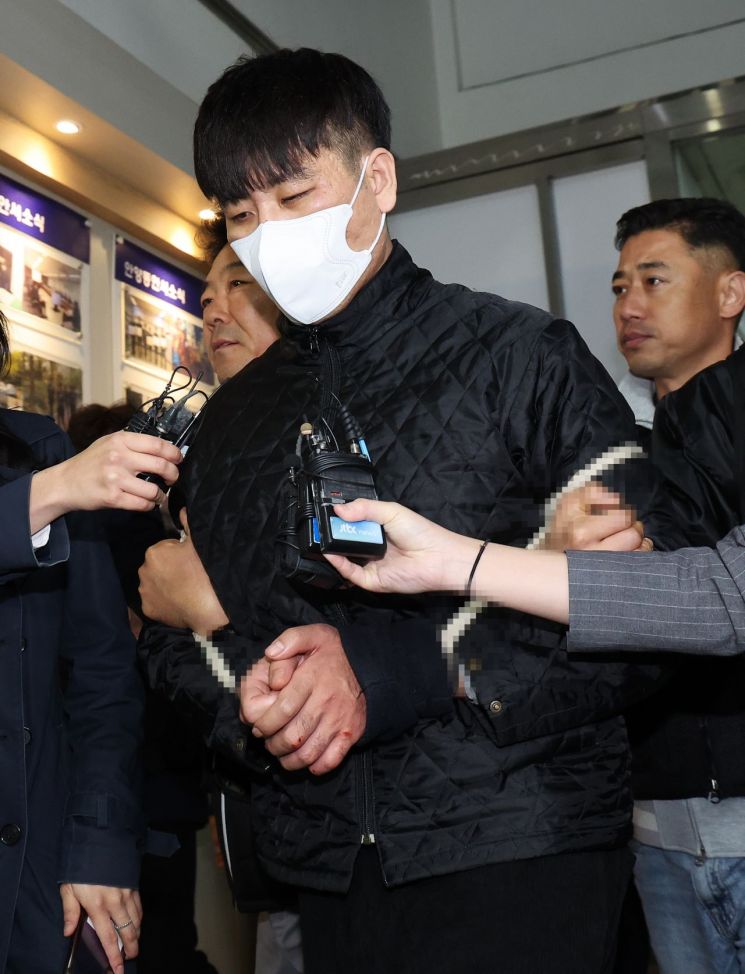 The appearance of Mr. Kim at the time of being transferred to Anyang Dongan Police Station in Gyeonggi after his arrest on the 6th. Mr. Kim was transferred while wearing a mask.
 [Image source=Yonhap News]
According to investigative authorities on the 7th, the police arrested Kim near a public phone booth in Ganeung-dong, Uijeongbu-si, Gyeonggi Province the previous day. On the morning of the 4th at 6:20 a.m., Kim escaped from Hallym University Sacred Heart Hospital in Anyang-si, Gyeonggi Province, where he was receiving inpatient treatment, by temporarily removing his protective equipment under the pretext of going to the restroom and evading Seoul Detention Center officials. After three days on the run, he was caught by police who traced a call he made to an acquaintance from a public phone.
On the same day at 11:52 p.m., Kim was transferred to Anyang Dongan Police Station wearing a mask covering his face. During his escape, he was publicly wanted, and his mugshot taken upon detention and CCTV footage during his flight were released to the public. However, at the time of transfer, the mask covered the lower half of his face, making it difficult to recognize the face shown in the wanted posters. According to footage obtained by Channel A, Kim was wearing a black mask just before being caught near the public phone booth, but it was changed to a white mask when he was transferred to the police station.
Under the current system, investigative or judicial authorities cannot forcibly reveal the face of suspects whose charges have not yet been proven, nor of criminals whose crimes have been confirmed, during the transfer process. This is because there is no clear regulation requiring face disclosure during transfer. The presidential decree titled “Regulations on the Transfer of Prisoners, etc.” only stipulates transfer methods, transfer times, and transfer costs. Instead, the police effectively follow recommendations from the National Human Rights Commission of Korea (NHRCK) as internal guidelines. In 2009, the NHRCK recommended that the faces of detainees handcuffed and shackled during transfer to external hospitals should not be exposed. In 2018, the NHRCK also advised that handcuffs should not be visible during external transfers of detainees.
Public demand for accurate disclosure of criminals’ identities is growing. Since the enforcement of the “Special Act on the Punishment of Specific Violent Crimes” in 2010, which regulates identity disclosure, a total of 43 heinous criminals have had their faces publicly revealed. However, criticism has continued that the released photos are outdated or digitally altered, differing from the actual faces of the criminals. In June, a heavily edited photo was released of Jeong Yujeong, who was indicted for killing a peer, which bore little resemblance to her real face. Online, a mocking trend emerged where people edited Jeong Yujeong’s face to avoid revealing her actual appearance.
A representative case of a suspect or criminal covering their face during transfer is Go Yujeong. In June 2019, the Jeju Police Agency held a public identity disclosure review committee and decided to reveal Go Yujeong’s real name, age, and face after she murdered her ex-husband. However, Go Yujeong effectively nullified the identity disclosure by covering her face with long hair, known as the “curtain hair” style, whenever she was moved to the detention center or court. This led to calls for measures such as “tying up her hair” and prohibiting the wearing of masks or hats during transfer. The police obtained a legal interpretation from the Ministry of Justice allowing the release of suspects’ mugshots, but with the condition that “the consent of the violent criminal must be obtained,” resulting in only partial disclosure of mugshots. In reality, only two individuals have had their identities publicly disclosed through mugshots with consent: Lee Seokjun, involved in the 2021 murder case in Songpa-gu, Seoul, and Choi Yoonjong, involved in the August rape-murder case in Sillim-dong, Seoul this year.
The identity disclosure system is continuously being revised. On the 6th of last month, the National Assembly passed the “Act on the Disclosure of Personal Information of Suspects of Specific Serious Crimes,” also known as the “Mugshot Disclosure Act,” in a plenary session. The law requires investigative agencies to disclose the faces of suspects within 30 days of the decision to release personal information. Previously, the consent of the criminal was required to release mugshots, but this is no longer necessary. Additionally, the scope of crimes subject to identity disclosure has been expanded to include not only specific violent and sexual crimes but also treason, foreign exchange crimes, organized crime, illegal drug trafficking, and sexual crimes against children and adolescents.
There are suggestions that while expanding identity disclosure is important for crime deterrence and the public’s right to know, a cautious approach is needed regarding face disclosure during transfer. Kim Dowoo, a professor of police studies at Gyeongnam National University, said, “The identity of criminals is part of investigative data and should be disclosed as information included in the public’s right to know. However, forcibly revealing a suspect’s face during transfer may infringe on the suspect’s right to decide, so when revising the system, careful consideration is needed to prevent human rights violations or private sanctions.”
© The Asia Business Daily(www.asiae.co.kr). All rights reserved.

















