Ministry of Science and ICT Establishes 'Digital Technology Standardization Strategy'
Major Countries Utilize Technology Standards to Strengthen Competitiveness
"Key to Success in Commercializing Technology Development Outcomes"
The government has established a standardization strategy to secure future leadership in 12 digital technology fields, including mobile communications (6G), artificial intelligence (AI), and quantum information communications.
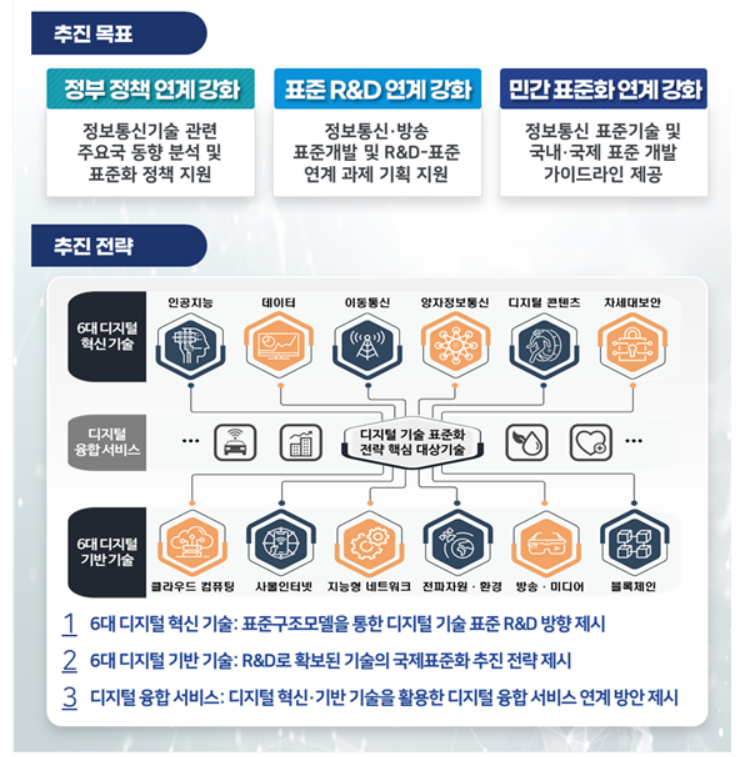
The Ministry of Science and ICT announced on the 7th that it has formulated the "Digital Technology Standardization Strategy" (hereinafter referred to as the Standardization Strategy). The Standardization Strategy outlines a comprehensive promotion direction linking government policies, research and development (R&D), and industry and services centered on standards to secure future technology leadership.
Recently, major countries around the world have been utilizing technology standards as strategic resources to enhance international competitiveness.
As the race to dominate technology hegemony among nations intensifies, securing standards has rapidly emerged as a key battleground, prompting major countries to establish national standard policies and strengthen standardization support.
South Korea is also enhancing cooperation with allied and friendly countries, including international standardization, through consultative bodies such as the Korea-US Next-Generation Core and Emerging Technologies Dialogue. In September, it announced the Digital Bill of Rights, a universal digital order norm for the deepening digital era, participating in the establishment of the international digital economic order.
The Standardization Strategy presents a strategy for standard R&D in core technology fields and the promotion of international standardization of secured technologies so that South Korea can play a central role in international standardization cooperation.
The core technology fields are a total of 12 technology areas selected based on an analysis of domestic and international ICT standard status: ▲Digital Innovation Technologies (AI, mobile communications, quantum information communications, digital content, next-generation security) and ▲Digital Foundation Technologies (cloud computing, Internet of Things, intelligent networks, radio resources and environment, broadcasting and media, blockchain).
To promote standardization of digital innovation technologies, a standard structure model was introduced to select 75 standardization target technologies requiring proactive response.
Subsequently, according to technology maturity, a roadmap was established classifying technologies into △R&D promotion △simultaneous R&D-standard R&D promotion △standard R&D promotion technologies, providing directions for government and private sector standard research and development.
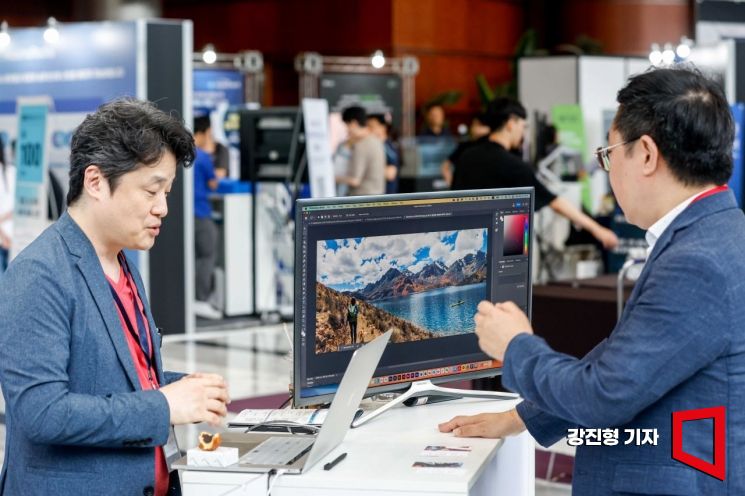 On the 13th, a participant is experiencing Adobe's generative AI at 'AI Summit Seoul 2023' held at COEX in Gangnam-gu, Seoul. Photo by Jinhyung Kang aymsdream@
In digital foundation technologies, through SWOT analysis of market, technology, and standards, 81 key standardization items were selected to secure international standard leadership for technologies obtained through R&D.
According to the stages of international standardization progress, a strategy map was established classifying approaches into △next-generation targeting △leading competition targeting △catch-up/cooperation targeting △sustaining/spreading targeting △strategic adoption, presenting an international standardization strategy.
Additionally, by analyzing domestic and international service standards utilizing the 12 core technologies, 12 digital convergence service fields were derived. A utilization map suggesting ways to apply digital convergence service standards was also developed.
The Ministry of Science and ICT and the Korea Information and Communication Technology Association formed a technical standards subcommittee with 189 experts participating since March, preparing the standardization strategy through a total of 92 meetings.
Jeon Young-su, Director of the Information and Communications Industry Policy Bureau at the Ministry of Science and ICT, emphasized, "Standards are a strategic means to capture the global market and a key driver determining the success or failure of commercializing technology development outcomes."
He added, "In the rapidly changing competition to secure international standards, it is crucial to design meticulous plans for discovering standardization targets to select and focus on, linking with technology development, securing standard patents, and global cooperation methods, as well as strategic investment and proactive activities on the international standardization stage."
The report is scheduled to be published on the Korea Information and Communication Technology Association website.
© The Asia Business Daily(www.asiae.co.kr). All rights reserved.
![User Who Sold Erroneously Deposited Bitcoins to Repay Debt and Fund Entertainment... What Did the Supreme Court Decide in 2021? [Legal Issue Check]](https://cwcontent.asiae.co.kr/asiaresize/183/2026020910431234020_1770601391.png)
















