Klaus GRABINSKI, President of the Unified Patent Court (UPC) Court of Appeal, which was launched in June this year and has brought a turning point to the European patent industry, stated at the 2023 International Patent Court Conference that "from the perspective of being able to receive patent protection in 17 countries at a certain cost, (handling cases at the UPC) will be economically very helpful to the parties involved."
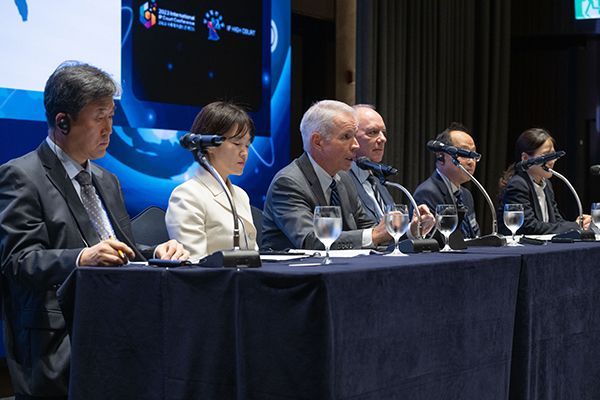
"UPC, an Integrated Role for European Patents"
The Patent Court (President Kim Yong-seok) held the 2023 International Patent Court Conference under the theme "Court, IP and New Perspectives" on June 1-2 at the Lotte City Hotel in Doryong-dong, Yuseong-gu, Daejeon, and the Patent Court building in Dunsan-dong, Seo-gu, Daejeon.
Klaus GRABINSKI, President of the UPC Court of Appeal, gave a presentation at this conference on the topic "Launch and Vision of the Unified Patent Court, Achievements in the Past Five Months ? Implications for the Future of Patent Litigation," and held a dialogue with Baek Gang-jin (54, Judicial Research and Training Institute class 23), Chief Judge of the Jeonju Branch of the Gwangju High Court.
President Klaus GRABINSKI explained, "With the implementation of the Unitary Patent (UP) system and the launch of the UPC, patent applicants and patent holders can now obtain unitary patents," adding, "The UPC plays an integrated role in the jurisdiction over European patents."
He continued, "Going through the UPC can reduce the costs incurred in each contracting state," and stated, "When comparing patent maintenance fees and renewal fees, the cost of obtaining approval in 17 specific member states individually was about 29% higher than the cost of a unitary patent."
He added, "Although the arbitration center has not yet been established, it is expected to be set up soon," and noted, "So far, 47 infringement-related cases and 23 revocation actions have been filed at the UPC, with a total of 90 cases underway."
Addressing concerns about whether the system would become more complicated than existing litigation systems, he said, "We are currently in a transitional period," and explained, "The idea now is that when litigation is to be conducted in more than one country, it can be done in a single court. Patent holders or parties can choose to use the UPC system during a seven-year transitional period." He further explained, "While utilizing the UPC system, it is also possible to use national patent litigation," and added, "If you consider that you can receive patent protection in 17 countries at a more efficient cost than filing in each country individually, it will be a great help in terms of cost reduction."
Regarding the situation where a strong patent protection decision can be obtained at the UPC but, conversely, a decision invalidating the patent in multiple countries at once can also be made, President Klaus GRABINSKI stated, "If an invalidation decision is received, it could cause financial problems and be a risky situation, but even now, patents revoked in one or more major jurisdictions cannot be respected in the market."
Launched in June, the UPC holds multinational jurisdiction over European patent litigation. The effect of judgments made by the UPC applies equally in all countries where the European patent is registered. However, during the seven-year transitional period, if a patent holder files an 'Opt-out' application for a general patent that has been validated through litigation in individual European countries, the patent can be excluded from UPC jurisdiction. This provision is a measure to prepare for potential confusion if companies lose UPC litigation and the patent's effect is suspended across all jurisdictions.
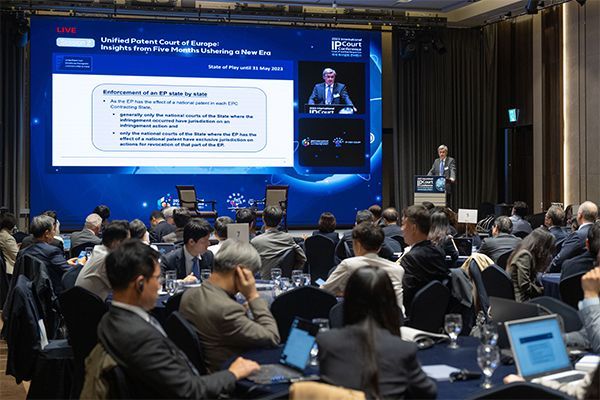
All IP Big 5 Specialized Judges Attend... Discussion on Injunction Requirements, etc.
In addition, the conference discussed the jurisdiction over intellectual property litigation in various countries and the operation status of specialized intellectual property courts. It also examined trade secret infringement lawsuits and continued discussions on the requirements, scope, and enforcement methods of injunctions, which are actively debated as one of the remedies for patent holders.
Kim Yong-seok (60, class 16), President of the Patent Court, said, "Living in the Fourth Industrial Revolution era, where artificial intelligence, big data analysis, and advanced information and communication technologies converge, it is very meaningful for us to discuss various intellectual property issues based on deep reflection on science, technology, and law, and furthermore, to explore the desirable direction for IP specialized courts to take." He added, "I hope that going forward, IP judges and experts worldwide will share their excellent insights and rich experiences, becoming a center for exchange and communication that can enable further advancement."
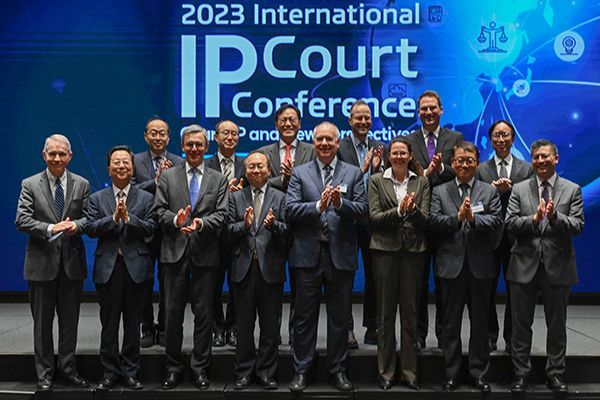
Now in its ninth year, the International Patent Court Conference has been held annually since 2015 to present visions on the role of specialized intellectual property courts in international dispute resolution, along with practical discussions on major issues in global intellectual property litigation.
All specialized intellectual property judges from the IP Big 5 (United States, EU, China, Japan, Korea) attend, and the conference is conducted in a manner that avoids unilateral presentations by encouraging prior questions, sharing, and re-questions to foster in-depth discussions on each topic.
Han Su-hyun, Legal Times Reporter
※This article is based on content supplied by Law Times.
© The Asia Business Daily(www.asiae.co.kr). All rights reserved.



















