'Avoiding Jeonse, Preferring Wolse' Is a Thing of the Past
Jeonse Prices Drop and Apartments Seen as Safe for Jeonse
Moving Season Demand Rises, Jeonse Prices Increase for 24 Consecutive Weeks
The volume of apartment jeonse listings in Seoul has plummeted by 30% in one year. This contrasts sharply with the record high of over 80,000 sales listings piling up day by day. In the first half of this year, concerns about a 'reverse jeonse crisis' were high due to the impact of high interest rates. However, as the autumn moving season has fully started, more people are choosing jeonse over sales or preferring apartment jeonse to villas, which carry a higher risk of deposit non-return, causing listings to disappear rapidly. As a result, Seoul's jeonse prices are also rising, maintaining an upward trend with increasing gains.
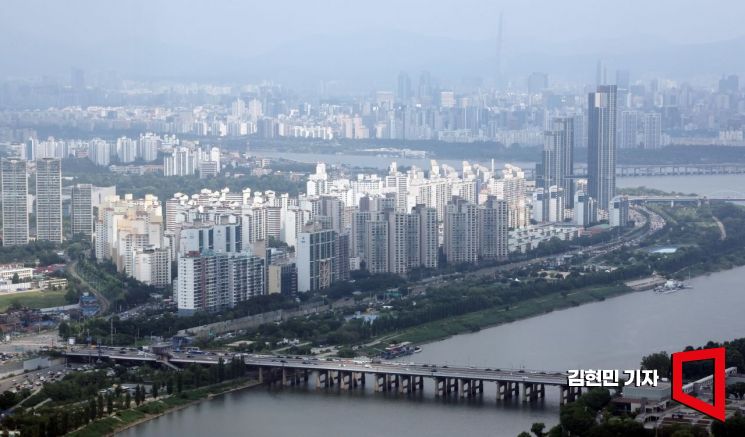 View of apartments in Ichon-dong, eastern Seoul, from the 63 Building observatory. Photo by Hyunmin Kim kimhyun81@
According to the real estate big data platform Apartment Real Transaction Price on the 6th, as of the previous day, the total number of apartment jeonse listings in Seoul was 34,499, a 29.7% decrease compared to 49,051 one year ago. Among the 25 autonomous districts in Seoul, nine districts?Seodaemun, Gangseo, Gangbuk, Seongbuk, Mapo, Eunpyeong, Dongjak, Yangcheon, and Gwanak?have seen a decrease rate of over 50%. In Ahyeon-dong, Mapo-gu, a representative area close to workplaces, listings dropped 70.4%, from 898 to 266.
The volume of jeonse listings in Seoul surged to the 50,000 range from November last year to February this year due to the US-originated high interest rates, which intensified the preference for monthly rent over jeonse. Consequently, in the first half of the year, the reverse jeonse crisis?where landlords could not fully return deposits to existing tenants with the deposits from new contracts?was considered a major market instability factor.
However, as fatigue from rising monthly rents increased and jeonse prices decreased, along with a growing perception that apartment jeonse is safer than villa jeonse, jeonse listings began to be gradually depleted. Moreover, with the autumn moving season recently underway and a growing tendency to wait on sales, more people are choosing to rent, accelerating the decline in jeonse listings.
Accordingly, Seoul apartment jeonse prices are naturally trending upward. According to the Korea Real Estate Board, in the fifth week of October, Seoul apartment jeonse prices rose 0.19% from the previous week, continuing an upward trend for 24 consecutive weeks. The rate of increase is also growing. Gangnam-gu rose 0.08% from 0.07% the previous week, and Songpa-gu increased from 0.18% to 0.22% during the same period.
A Korea Real Estate Board official explained, “Due to concerns over interest rate hikes and uncertainties in the sales market, the preference for jeonse among actual demanders continues. Rental demand is concentrated in areas with good residential conditions such as those near subway stations and large complexes, which has expanded the rate of increase.”
© The Asia Business Daily(www.asiae.co.kr). All rights reserved.

















