The 24th 'Korea-China-Japan Environmental Ministers Meeting'
"Information Must Be Transparently Shared and Disclosed"
Cooperation to Develop Measures to Reduce Yellow Dust Damage
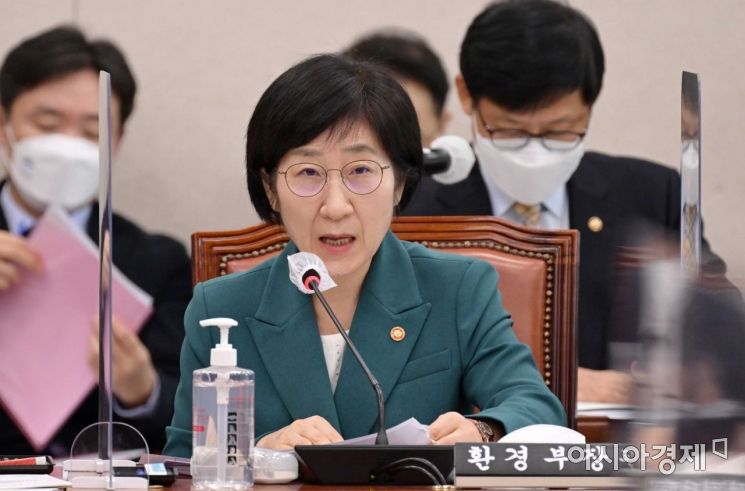
Han Hwa-jin, Minister of Environment, conveyed the public's concerns to Japan regarding the discharge of contaminated water from the Fukushima nuclear power plant into the ocean.
At the 24th Korea-China-Japan Environment Ministers Meeting (TEMM24) held on the 4th in Nagoya, Japan, Minister Han stated, "Japan must carry out the discharge according to the plan announced to the international community in compliance with scientific and international standards."
She added, "The contaminated water must be treated so that there is no adverse effect on people and the environment," and emphasized, "Relevant information should be shared and disclosed transparently."
In this regard, Japanese Environment Minister Ito Shintaro reportedly said, based on monitoring results of the ocean around the nuclear power plant, that "it has been confirmed that there is no impact on people or the environment," according to Japan's Kyodo News.
Minister Ito explained, "When discharging, tritium, a radioactive substance, is diluted with seawater to remain well below the standard set by the Japanese government, and Chinese experts are also participating in the International Atomic Energy Agency (IAEA) investigation," adding, "We will continue to enhance the reliability and transparency of monitoring."
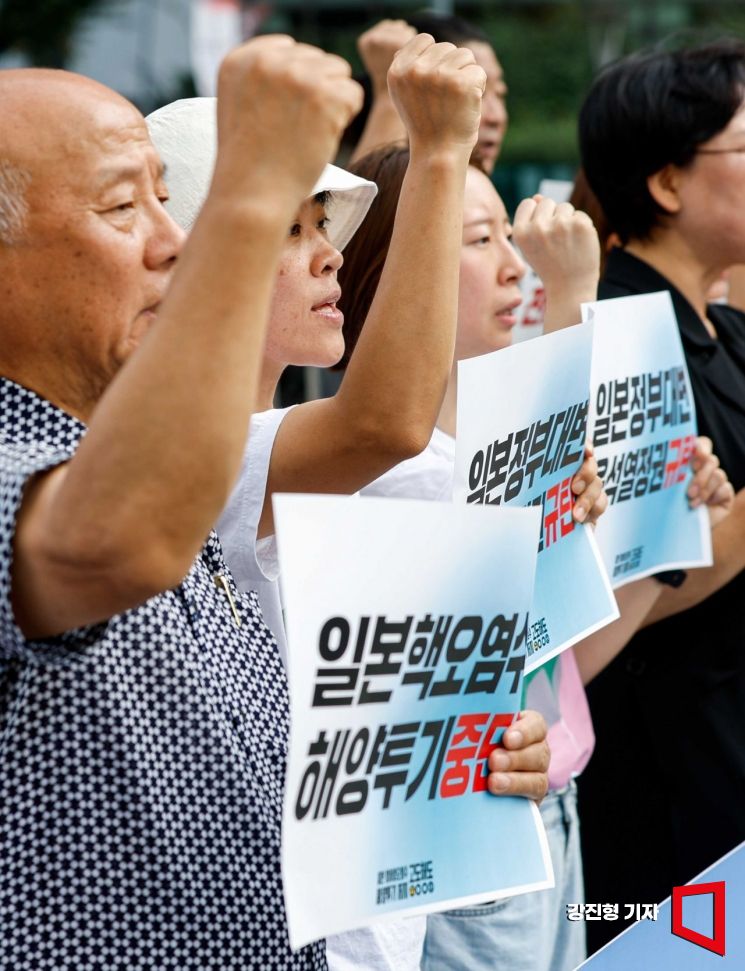 On the 19th, officials belonging to the Joint Action to Stop Japan's Radioactive Contaminated Water Ocean Dumping held a press conference urging a complete ban on the import of Japanese seafood at Gwanghwamun Square, Jongno-gu, Seoul. Photo by Jinhyung Kang aymsdream@
However, Huang Runqiu, Minister of Ecology and Environment of China, referred to the water called treated water by the Japanese government as 'nuclear contaminated water' and insisted, "It must be handled responsibly through sufficient consultation with neighboring countries and other stakeholders."
Unlike Minister Huang, who demanded "consultation with other stakeholders, especially neighboring countries," regarding the discharge of contaminated water, Minister Han is reported not to have officially mentioned the participation of monitoring organizations from neighboring countries.
During this meeting, a 'Joint Agreement' was also adopted, which outlines cooperation directions in areas such as air quality improvement and biodiversity conservation.
According to the agreement, the three countries agreed to cooperate in establishing measures to reduce damage from yellow dust in addition to the joint air quality survey being conducted with Mongolia since June this year.
Minister Han emphasized, "As neighboring countries, the three nations affect each other's environment, so close cooperation is essential," and added, "We intend to review the implementation results of cooperation in areas such as yellow dust, fine dust, climate change, and biodiversity, and seek solutions."
© The Asia Business Daily(www.asiae.co.kr). All rights reserved.


















