Remote Queueing Service Becomes Routine
Low Usage Rate Among Elderly
"Easy App Development and Digital Education Must Go Hand in Hand"
Mr. Baek (62) belongs to the digitally marginalized group. He cannot properly use now-common services like mobile banking and delivery applications, so it was only natural that he did not know about remote queueing. Mr. Baek said, “Even if I want to go to a restaurant that’s supposed to be good, waiting is too hard, so I just give up,” and added, “This is the first time I’ve heard about queueing through a phone.”
Recently, the introduction of waiting apps has become commonplace, following kiosks, especially at popular restaurants and cafes. By using these apps, customers can enter the restaurant at their desired time without physically standing in line. However, usage rates among the elderly are significantly low, and the digital divide is deepening.
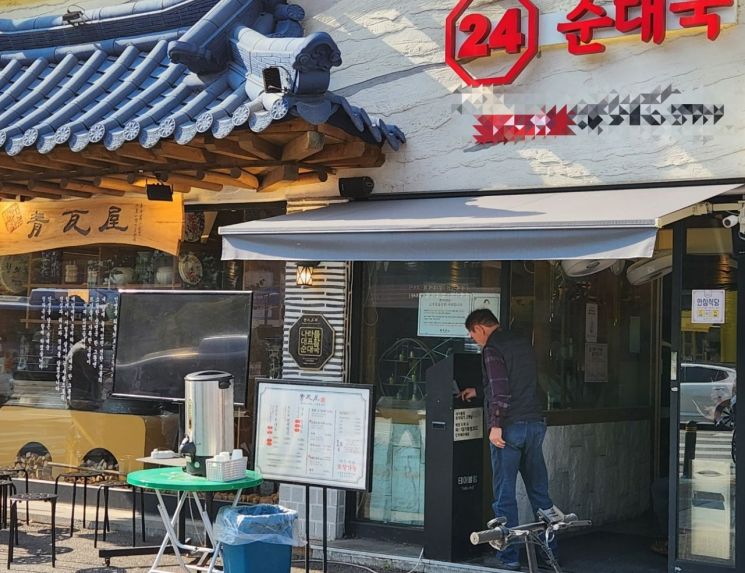
At around noon on the 3rd, about a dozen people were waiting in front of a famous Sundaegukbap (Korean blood sausage soup) restaurant in Dongjak-gu, Seoul. Not all of them were simply waiting. It is possible to register on the waiting device in front of the restaurant or apply for remote queueing through an app. The number of waiting teams during lunchtime consistently ranged from 8 to 10. Mr. Lee (67) said, “I just came and registered, now I’m waiting,” but added, “I don’t really know about those (waiting apps).”
Looking at the nationwide ranking of popular restaurants on the Tableling app, it’s not only 'hot places' favored by people in their 20s and 30s. Popular eateries serving dishes like Jjamppong Sundubu (spicy seafood soft tofu stew), pork soup, and Sundaegukbap also rank high. However, waiting apps are predominantly used by younger generations, and those aged 60 and above practically do not use them. According to WiseApp, an app analytics service, as of May, users in their 20s to 40s accounted for nearly 90% of the main waiting app users. Usage was highest among women in their 20s, followed by men in their 20s, and women in their 30s. Conversely, the number of users sharply decreases with age. For those aged 50 and above, usage rates were 7.1% for KTable and 11.7% for Tableling, while for those 60 and older, the rates were 2.8% for KTable and 1.3% for Tableling.
According to the ‘2022 Digital Information Gap Survey’ by the National Information Society Agency, the comprehensive digital informatization level of the elderly was 69.9 on average. This is the lowest among vulnerable groups such as farmers and fishermen (78.9), people with disabilities (82.2), and marriage immigrants (90.2). The digital informatization level is measured on a scale where the general population is set at 100, and it comprehensively assesses the ability to use digital devices, usage skills, and degree of utilization.
Experts advised that easy-to-use app development and repeated digital education should be carried out simultaneously. Professor Seol Dong-hoon of the Department of Sociology at Jeonbuk National University said, “Teaching the elderly how to use difficult apps does not solve the problem,” and added, “Apps that anyone can easily use need to be developed, and the level of technology must improve.” Professor Lee Min-ah of the Department of Sociology at Chung-Ang University said, “If digital technology limits what people want to do, they inevitably become psychologically withdrawn,” and emphasized, “One or two training sessions are not enough for the elderly. A repetitive learning environment must be created, and it is important to actually experience it in the field.”
© The Asia Business Daily(www.asiae.co.kr). All rights reserved.
![Clutching a Stolen Dior Bag, Saying "I Hate Being Poor but Real"... The Grotesque Con of a "Human Knockoff" [Slate]](https://cwcontent.asiae.co.kr/asiaresize/183/2026021902243444107_1771435474.jpg)











