Announcement of On-site Inspection Results for the Third Discharge of Contaminated Water from Fukushima Daiichi Nuclear Power Plant
The International Atomic Energy Agency (IAEA) announced that the concentration of radioactive nuclides at the site of the third discharge of contaminated water from the Fukushima Daiichi Nuclear Power Plant in Japan is below the standard level.
On the same day, the IAEA stated, "IAEA experts on site confirmed that the tritium concentration in the contaminated water (referred to as treated water by the IAEA) discharged for the third time is much lower than the operational standard set by Japan." They added, "The IAEA task force (TF) reviewing the safety of the contaminated water discharge reported that the discharge operation is proceeding as planned without any issues."
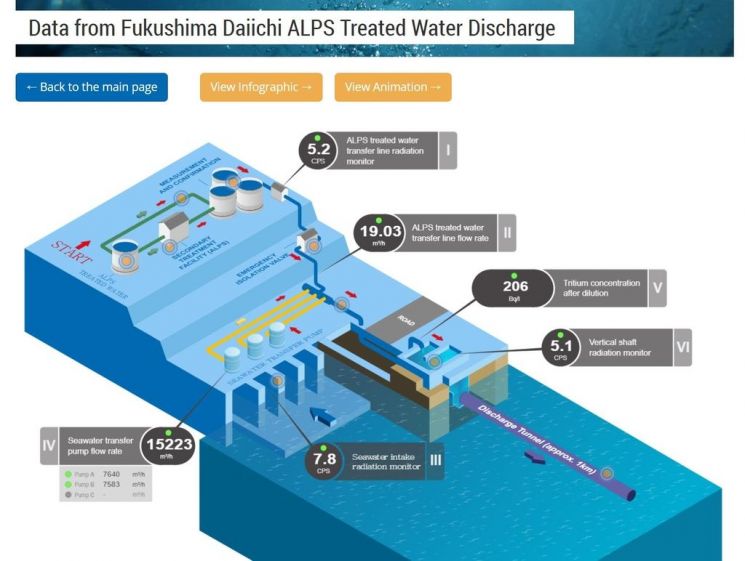
According to the discharge data provided in real-time to the IAEA by Tokyo Electric Power Company (TEPCO), the tritium concentration in the diluted contaminated water was 188 becquerels (Bq) per liter (ℓ) as of 7:50 PM local time. This is lower than Japan’s operational standard of 1500 Bq/ℓ. It is also below the tritium concentration guideline for drinking water quality set by the World Health Organization (WHO), which is 10,000 Bq/ℓ.
Japan has been discharging contaminated water stored in tanks at the Fukushima Daiichi Nuclear Power Plant into the ocean since August after processing it through the ALPS (Advanced Liquid Processing System) to remove multiple radionuclides and diluting it with seawater.
Meanwhile, the Nuclear Regulation Authority of Japan pointed out on the 1st that Tokyo Electric Power Company was "negligent in operational management" regarding an accident on the 25th of last month, during cleanup work at Fukushima Daiichi, where a worker was splashed with liquid containing radioactive material.
The authority also noted issues with information disclosure related to TEPCO’s initial announcement that the amount of liquid released on the day of the accident was "about 100 ml," which was later corrected to "several liters," tens of times more. The Nuclear Regulation Authority was established in 2012 as Japan’s nuclear regulatory body.
TEPCO stated that although they required a work supervisor to be present when contracting with subcontractors, the rules were not followed at the time of the accident and that they will investigate the related circumstances.
© The Asia Business Daily(www.asiae.co.kr). All rights reserved.
![Clutching a Stolen Dior Bag, Saying "I Hate Being Poor but Real"... The Grotesque Con of a "Human Knockoff" [Slate]](https://cwcontent.asiae.co.kr/asiaresize/183/2026021902243444107_1771435474.jpg)
















