KMA Claims "World's Best Medical Accessibility"
Government Says "Will Listen to All Medical Sectors"
The government and the Korea Medical Association (KMA) attempted to discuss the issue of expanding medical school quotas but remained at an impasse due to persistent differences in opinion.
On the afternoon of the 2nd, the Ministry of Health and Welfare and the KMA held the 16th Medical Issues Consultative Body meeting at Conference House Dalgaebi in Jung-gu, Seoul. This meeting was the second face-to-face meeting with the KMA since the government announced its policy to expand medical school quotas on the 19th of last month.
At the meeting, the KMA argued that "Korea's medical accessibility is already at the world's highest level" and claimed that pushing for an increase in quotas based solely on public opinion is risky.
On the other hand, the government stated that it would "gather opinions from the medical community" and listen to various views beyond the KMA.
Jung Kyung-sil, Director of Health and Medical Policy at the Ministry of Health and Welfare, said in her opening remarks, "The government and the KMA have reached a consensus that we must seriously consider the reasons why medical professionals avoid regional and essential medical care." She added, "We will prepare a systematic roadmap so that Korea's healthcare can faithfully fulfill its role as the guardian of the people's health 10 years from now," and stated, "Along with discussions in the (medical issues) consultative body, we will sincerely listen to opinions from all sectors of the medical community, from veterans to residents and medical students, and reflect them in policy."
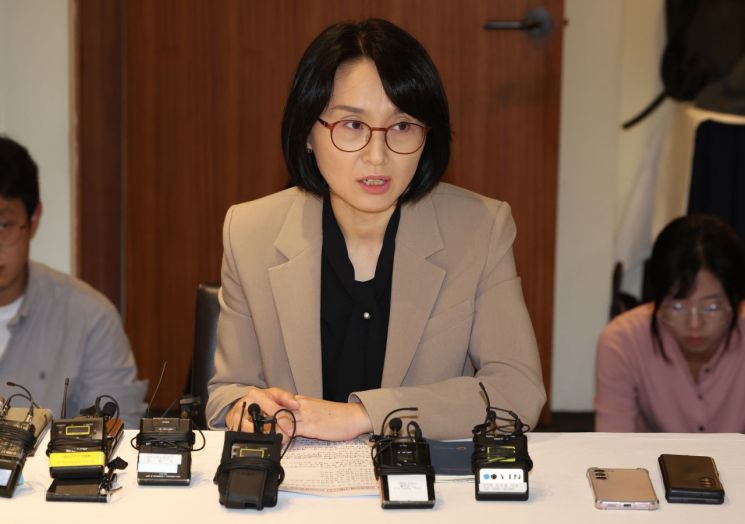 On the afternoon of the 2nd, at Dalgaebi in Jeong-dong, Jung-gu, Seoul, Jeong Gyeong-sil, Director of Health and Medical Policy at the Ministry of Health and Welfare, explained the government's position during the 16th Medical Issues Council meeting held to discuss the expansion of medical school quotas.
 [Image source=Yonhap News]
The KMA is an organization centered on private practitioners, while the government is also utilizing the Health and Medical Policy Deliberation Committee (HMPDC), composed of other medical professions besides doctors, patient groups, consumer organizations, and experts, as a key axis for gathering opinions on the expansion of medical school quotas.
The KMA denied the research results presented as evidence for increasing medical school quotas, insisting that discussions should be based on scientific evidence.
At the meeting, Lee Kwang-rae, President of the Incheon Medical Association, said in his opening remarks, "Many citizens, including examinees aspiring to medical schools, parents, academies, and those wanting medical schools established in their residential areas, are calling for an increase in medical school quotas according to their own interests," and questioned, "Should we increase medical school quotas and establish medical schools based on public opinion gathered in such an environment?"
He also stated, "The average distance between doctors and patients in Korea is 0.86 km, making medical accessibility the highest in the world." This means that considering the country's land area and population density, the distance between doctors and patients in Korea is closer than in other countries.
President Lee argued, "Are issues like pediatric open-run emergency room rotations and myocardial infarction patients on islands really grounds for increasing medical school quotas?" and insisted, "Medical school quotas must be determined solely based on scientific evidence."
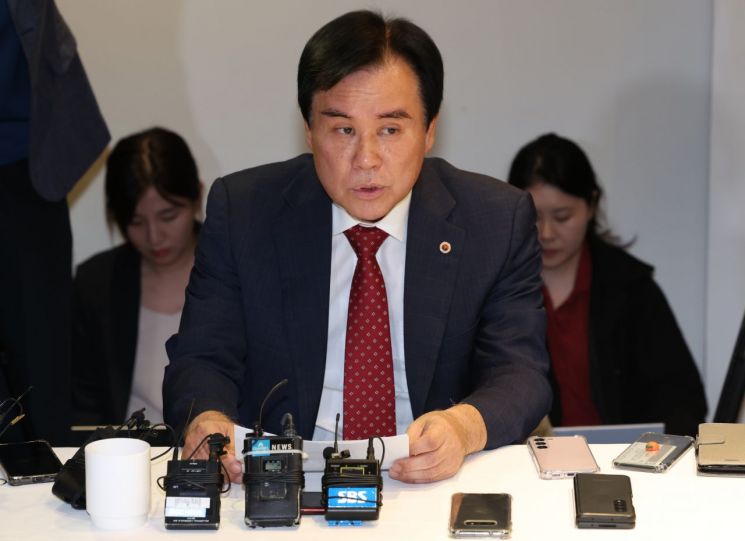 On the afternoon of the 2nd, at Dalgaebi in Jeong-dong, Jung-gu, Seoul, Lee Kwang-rae, President of the Incheon Medical Association, is speaking at the 16th Medical Issues Council meeting held by the Ministry of Health and Welfare to discuss the expansion of medical school quotas.
 [Image source=Yonhap News]
© The Asia Business Daily(www.asiae.co.kr). All rights reserved.


















