Professor Ki-Joo Park of the Department of Biomedical Engineering at Kyung Hee University and Dr. So-Yeon Kim of the Chemical and Life Convergence Research Center at the Korea Institute of Science and Technology (KIST) announced on the 2nd that their joint research team has discovered for the first time in the world that ultrasound changes the physical properties of the cytoplasm.
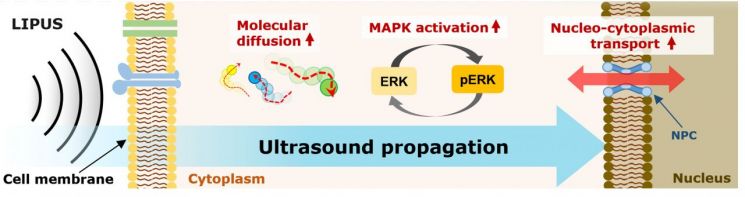
Through live cell imaging experiments based on confocal microscopy, the research team discovered for the first time in the world that low-intensity ultrasound changes the physical properties of the cytoplasm. This study was published in the international journal Ultrasonics Sonochemistry (IF=8.4, JCR top 1.6%).
Low-intensity pulsed ultrasound or low-intensity focused ultrasound is an ultrasound technology that non-invasively stimulates cells using low-intensity ultrasound energy. It is used in various fields as a treatment method that induces bone fracture healing, soft tissue regeneration, inflammation suppression, and nerve modulation, but its exact mechanism of action has not been elucidated.
The research team proposed a new hypothesis that ultrasound propagating through the cytoplasm, which has the properties of a viscoelastic fluid, directly affects the diffusion of biomolecules that cause biochemical reactions. Using osteosarcoma (SaOS-2) and cervical cancer (HeLa) cells, they measured changes in the diffusion of biomolecules inside the cytoplasm and the nucleocytoplasmic transport coefficient at pre-, during-, and post-ultrasound stimulation under various ultrasound stimuli.
Experimental results confirmed that the diffusion of biomolecules present in the cytoplasm increased due to ultrasound. The higher the ultrasound pressure and the larger the polymer size, the faster the diffusion. Nucleocytoplasmic transport also increased due to ultrasound. The research team demonstrated for the first time in academia that ultrasound directly affects the cytoplasmic environment and explained that changing ultrasound irradiation conditions means it is possible to control specific biochemical reactions dependent on the diffusion rate of particular biomolecules.
Professor Park stated, "This can be developed as a new non-invasive cell stimulation technology that can non-invasively activate specific cellular processes or induce specific cell signaling pathways." Dr. Kim explained, "If this technology can be controlled more precisely, it could be applied as a technology to control the fate or function of specific cells such as stem cells or senescent cells."
© The Asia Business Daily(www.asiae.co.kr). All rights reserved.
![Clutching a Stolen Dior Bag, Saying "I Hate Being Poor but Real"... The Grotesque Con of a "Human Knockoff" [Slate]](https://cwcontent.asiae.co.kr/asiaresize/183/2026021902243444107_1771435474.jpg)
















