Less Than 10% of Institutions Have Male Parental Leave Usage: 13 Institutions
Highest Parental Leave Rate Institution: MFDS 55.6%
Corruption Investigation Office Leave Rate 4.3%... Male Applicants '0'
Statistics on parental leave rates among national public officials revealed that the application and usage rates for parental leave differ by more than three times between men and women. There were 13 institutions where the male parental leave rate did not exceed 10%, and the High-ranking Officials' Crime Investigation Agency had zero male parental leave users.
According to the 'National Public Officials Parental Leave Usage Status' received by Representative Yong Hye-in of the Basic Income Party from the Ministry of Personnel Management on the 2nd, among the eligible parental leave candidates in 2022, 10.6% were male public officials and 37% were female public officials.
Analyzing the usage rate by gender among eligible parental leave candidates, out of 61,485 male public officials eligible for parental leave in 2022, 6,524 applied for parental leave. Among 26,045 female public officials, a total of 7,657 used parental leave.
Eligible parental leave candidates refer to those raising children aged 8 or younger or in the second grade or below of elementary school.
Comparing the parental leave usage rates of 50 central administrative agencies, the agency with the highest parental leave usage rate was the Ministry of Food and Drug Safety (hereafter MFDS). Among 259 eligible candidates in 2022, 144 used parental leave, meaning 55.6% of public officials took parental leave.
In contrast, agencies with low parental leave application rates were ▲ High-ranking Officials' Crime Investigation Agency (4.3%) ▲ Korean Intellectual Property Office (10.8%) ▲ National Fire Agency (12.8%) ▲ Rural Development Administration (13.1%) ▲ National Police Agency (13.5%) ▲ Ministry of Oceans and Fisheries (14.2%) ▲ Korea Forest Service (14.3%), in that order. Notably, the High-ranking Officials' Crime Investigation Agency had only one person who actually used parental leave.
Among the total eligible parental leave candidates, places where the male parental leave rate was less than 10% included ▲ High-ranking Officials' Crime Investigation Agency (0 out of 23, 0%) ▲ Financial Services Commission (3 out of 103, 4.8%) ▲ Korea Communications Commission (2 out of 70, 5.6%) ▲ National Human Rights Commission (1 out of 40, 5.6%) ▲ Rural Development Administration (16 out of 367, 6.7%) ▲ Korean Intellectual Property Office (22 out of 398, 7.7%) ▲ Ministry of Oceans and Fisheries (57 out of 901, 8.5%) ▲ Ministry of Science and ICT (391 out of 6,317, 8.6%) ▲ National Fire Agency (1,230 out of 15,917, 8.8%) ▲ Ministry of Patriots and Veterans Affairs (12 out of 296, 8.8%) ▲ National Police Agency (2,143 out of 29,001, 9.1%) ▲ Public Procurement Service (15 out of 254, 9.1%) ▲ Ministry of Foreign Affairs (25 out of 505, 9.1%), totaling 13 institutions.
Multi-child Public Officials Preferential Treatment Plan Facing 'Reverse Discrimination' Criticism... What Is the Solution?
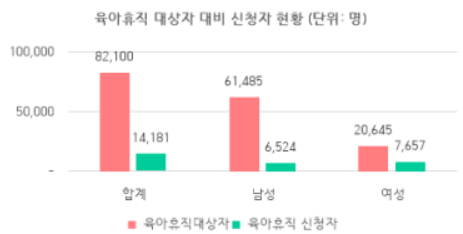 Status of applicants compared to eligible childcare leave recipients.
 [Photo by Yong Hye-in's office]
The Ministry of Personnel Management is opening opportunities for multi-child parent public officials to apply for public official career recruitment up to 10 years after retirement to respond to low birth rates. They are also considering giving additional points for promotion preference to multi-child public officials at grade 8 or below.
However, this preferential treatment plan for multi-child public officials by the Ministry of Personnel Management has been criticized as discriminatory by public officials without children or those experiencing infertility.
Representative Yong said, "There is a significant difference in parental leave usage rates between men and women," pointing out that "this reflects the reality where the prejudice that women should be responsible for childcare and caregiving still remains."
He added, "Policies that offer benefits only after having children reinforce the outdated view of women as tools for childbirth and discriminate against many citizens who choose not to have children. To solve the low birth rate problem, it is essential to ensure that caregivers can take parental leave at work comfortably without income loss or disadvantages."
He also urged the Ministry of Personnel Management to take the lead and prepare incentives to increase male parental leave usage in institutions where male parental leave usage is low, stating, "To address the core cause of low birth rates such as women's career interruptions, men and women should be able to use parental leave equally."
Automatic Parental Leave System to Be Introduced, Allowing Immediate Parental Leave After Maternity Leave?
Currently, under the Equal Employment Opportunity Act, workers with children aged 8 or younger or in the second grade or below of elementary school who apply for parental leave for childcare must be approved by their employer. However, during the approval process, there have been many cases where applicants faced pressure such as resignation or salary reduction, or disadvantages like being passed over for promotion. According to the Ministry of Employment and Labor's 2021 'Work-Family Balance Survey,' 34.2% of workers said they felt burdened applying for parental leave and found it difficult to apply.
In response, on the 30th, the Presidential Committee on Ageing Society and Population Policy (hereafter Low Birthrate Committee) is promoting the introduction of an 'automatic parental leave system' that allows workers to take parental leave immediately after maternity leave without a separate application. The purpose is to eliminate the procedure of obtaining supervisor approval when applying for parental leave, enabling workers to take up to one year of parental leave automatically without worrying about company pressure.
The Low Birthrate Committee stated that to reverse the record low total fertility rate (0.7) recorded in the second quarter of this year, parental leave will be automatically granted to workers, with exceptions only for those who submit a 'non-use application' due to economic reasons or other difficulties in using parental leave.
A senior government official said, "To overcome low birth rates, it is necessary to first create an institutional environment where parents can raise their children stably for a certain period," adding that if parents take parental leave alternately, a stable environment will be created where they can directly raise their children for up to two years.
© The Asia Business Daily(www.asiae.co.kr). All rights reserved.



















