The Korea Institute of Ocean Science and Technology (KIOST) signed a business agreement on October 31 at the headquarters of Korea Western Power with Korea Western Power and Daeryuk Energy Technology to commercialize the "Coal Ash Utilization K-Marine Structures" project.
This business agreement aims to promote the commercialization of "Coal Ash Utilization K-Marine Structures" based on the technologies and infrastructures mutually held by each institution, and to contribute to enhancing the safety of domestic and international coastal port facilities in response to climate change.
According to the Energy Economics Institute's "2022 Energy Statistical Yearbook," currently, a total of 57 coal-fired power plants (35,829 MW) are operating at 13 sites in Korea, including Taean, Samcheok, and Hadong.
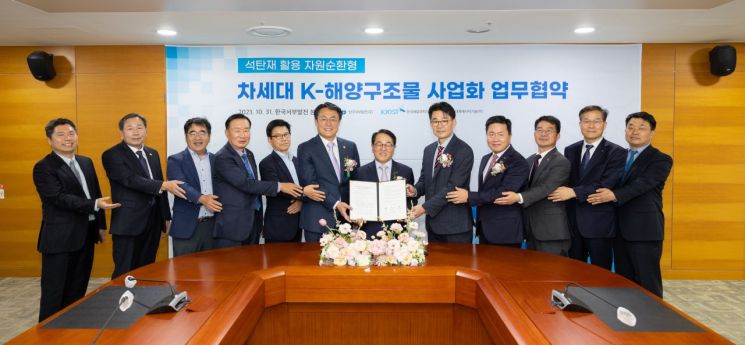 The Korea Institute of Ocean Science and Technology (KIOST) is taking a commemorative photo with representatives from Korea Western Power and Daeryuk Energy Technology to celebrate the signing of an agreement.
Byproducts are generated during the process of burning coal to produce electricity, which are classified into fly ash and bottom ash.
Fly ash is used as a substitute for cement, but bottom ash is difficult to recycle and is stored or landfilled.
Accordingly, KIOST, Korea Western Power, and Daeryuk Energy Technology are developing marine structures utilizing bottom ash.
An example of marine structures developed using coal ash is the "K-Block." It meets the required strength of 30 MPa (megapascals) for marine structures and can replace 50% of fine aggregate with bottom ash. Additionally, the stability coefficient, which indicates the performance of the armor block, is 12 or higher, enabling it to withstand high waves.
The research team of KIOST's Marine Spatial Development and Energy Research Department is conducting numerical and hydraulic model experiments and field demonstrations to develop marine structures such as new armor blocks with global competitiveness using purely domestic technology.
Since 2021, research has been conducted on utilizing bottom ash in marine structures, and domestic patents have been registered for related outcomes such as the "Manja-type artificial reef using industrial byproducts."
Director Kang Do-hyung stated, "Due to recent sea level rise caused by climate change, high waves are occurring, increasing the need for high-efficiency armor blocks that can respond to them," and added, "We will strengthen our capabilities to advance related technologies and promote commercialization through this business agreement."
© The Asia Business Daily(www.asiae.co.kr). All rights reserved.

















