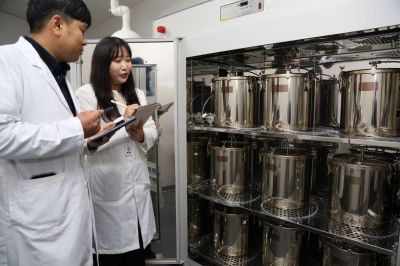
Hanssem announced on the 1st that it has relocated the ‘Hanssem Research Institute’ to its Sangam office building in Seoul.
The Hanssem Research Institute is an R&D organization responsible for proactive testing and regular assurance of product safety, harmfulness, and reliability. It began as the Production Technology Development Team at the Ansan factory in 1991 and was officially approved as a corporate-affiliated research institute by the Korea Industrial Technology Association, a delegated agency for corporate research institute recognition and support under the Ministry of Science and ICT, in January 2005.
The Hanssem Research Institute conducts quality safety tests and standard management of specifications for all products released by Hanssem, as well as harmful substance evaluations for the production of eco-friendly products.
The institute has a total of 58 testing devices, conducting about 3,000 tests annually across fields such as physical properties, safety, and harmfulness.
The types of tests are also diverse. To prepare for safety accidents that may occur when using furniture in daily life, the institute uses 47 testing devices in the physical properties and safety fields, including ▲door opening and closing repetition tests ▲stability tests against tipping for wall-mounted furniture ▲chair repeated impact tests ▲mattress durability tests, to examine the physical durability and sturdiness of products. For doors used in kitchen furniture, built-in wardrobes, and bookshelves, the door is opened and closed more than 40,000 times to verify sagging, noise, and detachment, and products are only released if no issues are found.
Hanssem also strictly operates tests on the use of eco-friendly materials through the research institute. To minimize harmful substances emitted from furniture raw materials and building materials such as formaldehyde (Formaldehyde·CH2O), toluene (Toluene·C7H8), total volatile organic compounds (TVOC), heavy metals, and plasticizers, the institute monitors emission levels during product development, release, and production processes to ensure quality. Using 11 harmfulness testing devices including constant temperature and humidity chambers, small chambers, gas chromatography-mass spectrometers (GC-MS), and inductively coupled plasma optical emission spectrometers (ICP-OES), the institute conducted about 1,300 product harmfulness tests this year alone.
In 2019, Hanssem renewed the research institute by expanding its functions and organization, strengthening R&D and verification processes for environmentally friendly living spaces. Based on this, in July 2020, it was recognized as an internationally accredited testing institution by KOLAS (Korea Laboratory Accreditation Scheme), a Korean accreditation body under the National Institute of Technology and Standards of the Ministry of Trade, Industry and Energy.
KOLAS accreditation means international recognition of testing capabilities in specific fields. Hanssem is the only company in the furniture industry recognized as an internationally standardized testing institution in the fields of chemistry and mechanics, securing international credibility for furniture quality safety assurance and eco-friendly R&D. In 2020, it was recognized as a chemical testing institution related to ‘Indoor and Other Environments,’ and in 2021, it additionally obtained recognition in the mechanics field for furniture raw materials (PB, MDF, PW), household sinks, and storage furniture.
A Hanssem official stated, “We are advancing our expertise in quality safety through eco-friendly product R&D, technology acquisition, and testing assurance to improve customers’ living environments. Through this relocation of the research institute, we will expand communication among research, development, and quality organizations to develop more reliable products.”
© The Asia Business Daily(www.asiae.co.kr). All rights reserved.

















