Statistics Korea Announces September Industrial Activity Trends
Semiconductor Export Shipments Up 69.4% from Previous Month
Government Indicates "Improvement Trend Continues in Q4"
Consumption Slows, Construction Orders Also Remain Weak
Last month, industrial production, consumption, and investment all increased. It is the first time in four months since May. As the economy recovers centered on semiconductors, there is an assessment that the 'low in the first half and high in the second half' trend emphasized by the government is gradually emerging. However, the consumption sector remains relatively sluggish, and construction orders are still frozen.
According to the industrial activity trends announced by Statistics Korea on the 31st, total industrial production (seasonally adjusted, excluding agriculture, forestry, and fisheries) in September increased by 1.1% compared to the previous month. After rising by 2.0% last month, it recorded positive growth for two consecutive months. Industrial production showed sluggish performance in June (0%) and July (-0.8%), but shifted to a slight upward trend since August.
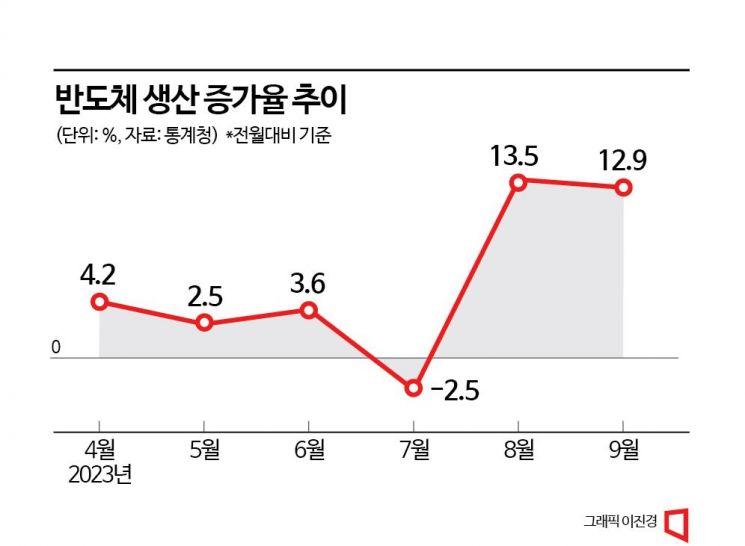
The increase in production was led by the semiconductor sector. In September, manufacturing production decreased in automobiles (-7.5%), but thanks to semiconductor production such as DRAM and flash memory, it increased by 12.9%, resulting in a 1.8% increase compared to the previous month. Manufacturing production increased for two consecutive months following a 5.2% increase in August. This two-month consecutive increase is the first since January last year. Semiconductor production significantly increased due to growth in memory semiconductors and semiconductor assembly equipment production. Semiconductor export shipments in September also rose by 69.4% compared to the previous month. This shows a clear recovery trend following July (-32.1%) and August (4.8%).
The manufacturing inventory ratio (inventory/shipment) was 113.9%, down 10.4 percentage points from the previous month. Inventories decreased in semiconductors (-6.7%), machinery equipment (-9.0%), and primary metals (-2.7%). Previously, the manufacturing inventory ratio was 124.0 in July and 124.3 in August. Although production decreased in arts, sports, and leisure (-4.2%), production increased in wholesale and retail (1.7%) and transportation and storage (2.2%), resulting in an increase in service sector production compared to the previous month.
The government emphasized that signs of economic rebound are becoming more pronounced along with the recent improvement in exports. The Ministry of Economy and Finance stated, “Industrial activity indicators have shown expanding recovery in July, August, and September, and exports are expected to turn positive in October,” adding, “This suggests the possibility of continued improvement in the fourth quarter.” The decline in exports has steadily improved from -16.2% in July, -8.3% in August, to -4.4% in September.
Consumption Remains Sluggish and Construction Orders Continue to Decline
However, consumption recovery remains relatively sluggish. Retail sales, which indicate consumption, increased by 0.2% compared to the previous month due to increased sales in food and beverages and cosmetics, but recorded -1.9% compared to the same month last year. Retail sales have decreased for three consecutive months on a year-on-year basis, following -1.7% in July and -4.7% in August. Kim Bo-kyung, Economic Trend Statistics Officer at Statistics Korea, explained, “Consumption increased compared to the previous month due to increased sales of nondurable goods such as food and beverages influenced by Chuseok last month, but consumption of goods should be seen as sluggish compared to last year.”
Facility investment increased, but construction orders remained weak. Facility investment in the previous month increased by 8.7% compared to the previous month, marking two consecutive months of growth since August (4.0%). On the other hand, orders decreased in housing and other construction (-54.8%) and civil engineering such as machinery installation (-2.4%), resulting in a 44.1% decrease compared to the same month last year. Construction orders have been steadily declining since May (18.8%). In August, they also decreased by 53.4%. The Ministry of Economy and Finance pointed out, “It is necessary to pay attention to the relatively moderate recovery in consumption centered on goods and the continued weakness in construction orders.”
© The Asia Business Daily(www.asiae.co.kr). All rights reserved.












