Asan Institute for Policy Studies-Land Research Institute Propose Phased Nuclear Assurance
"Strategic Ambiguity... No Longer Guarantees North Korean Nuclear Deterrence"
4-Stage Nuclear Assurance Plan... US Nuclear Weapons Upgraded for Korea Use
A proposal has emerged that the United States and South Korea should designate some of the U.S. tactical nuclear weapons for the purpose of supporting South Korea's security and deploy them operationally on the Korean Peninsula, thereby exerting gradual pressure to freeze North Korea's nuclear weapons production. This is interpreted as an analysis that the U.S. and South Korea need to raise their level of response in line with the judgment that North Korea's nuclear forces have reached a stage of actual threat.
According to the Asan Institute for Policy Studies on the 31st, the institute and the U.S. RAND Corporation evaluated in a joint research report titled "Measures to Strengthen Nuclear Assurance for South Korea" that "North Korea has already secured nuclear weapons forces that pose a real threat to South Korea and has reached a stage where it poses a serious threat to the United States." The researchers then proposed a four-step approach to counter North Korea's nuclear force enhancement, ranging from "modernizing tactical nuclear weapon storage facilities in South Korea" to "deploying U.S. tactical nuclear weapons in South Korea."
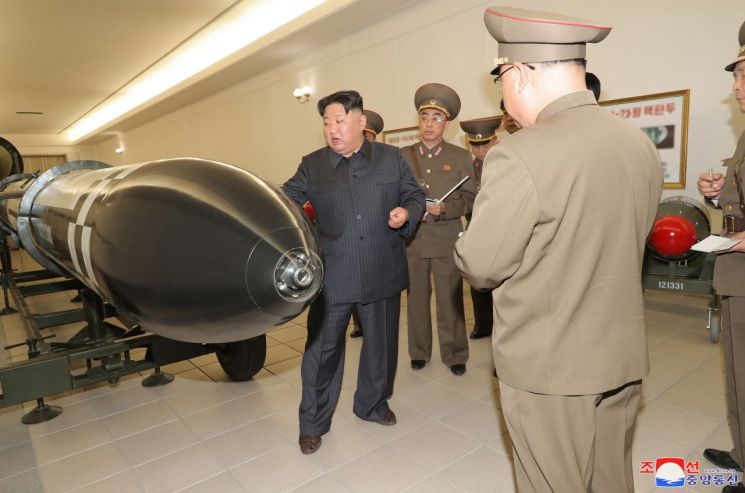 Kim Jong-un overseeing the nuclear weapons development project last March [Image source=Yonhap News]
The researchers forecasted that "by the 2030s, Kim Jong-un will seek to possess up to 300 to 500 nuclear warheads," and that this 'Kim Jong-un vision' could be empowered through North Korea-Russia military cooperation. They particularly raised concerns that North Korea might use nuclear threats against the U.S. to undermine the South Korea-U.S. alliance and attempt to dominate South Korea without direct invasion. They emphasized the need to devise measures that can provide a firm guarantee to South Korea.
Concerns from various experts continued regarding the forecast that North Korea will accelerate its nuclear force enhancement based on Russia's supportive fire. Bruce Bennett, senior researcher at RAND Corporation, mentioned last month that North Korean State Affairs Commission Chairman Kim Jong-un's visit to Russia for a summit with President Vladimir Putin likely included the purpose of obtaining aluminum, a material used in centrifuges.
Choi Kang, president of the Asan Institute for Policy Studies, focused on the possibility that Russia might send scientists and technicians to North Korea, which could accelerate personnel exchanges for military cooperation. Goh Myung-hyun, senior research fellow at the Asan Institute, said, "Russia is a major producer of materials used in centrifuges capable of producing nuclear material," and there is circumstantial evidence that Russia has been providing these materials to North Korea for the past five to six years.
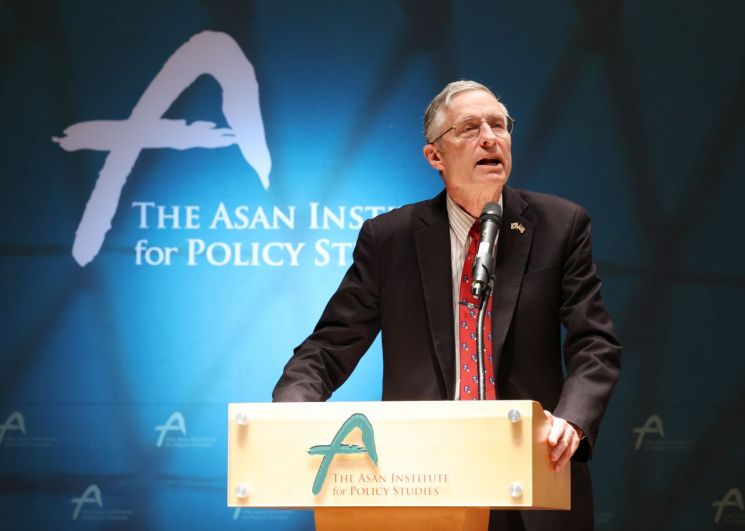 Bruce Bennett, Senior Researcher at the Michigan Land Institute, presenting a report
 [Photo by Yonhap News]
The researchers also paid attention to the possibility that China's nuclear threat could emerge as a regional variable. It is observed that China could use nuclear weapons as one of the means to exert influence over both South Korea and the United States. The report noted that while China has mainly used economic means when situations threatening its interests related to the Korean Peninsula have arisen, "China may gradually consider using military means in the future to shape conditions on the Korean Peninsula and respond to threatening situations."
Cha Doo-hyun, senior research fellow at the Asan Institute, explained, "We did not assume a situation where China directly cooperates with North Korea to threaten South Korea with nuclear weapons or incites North Korea's nuclear threat," but "we focused on the possibility that China might adopt a more threatening attitude or become a negative factor when South Korea uses certain means to strengthen nuclear assurance." Senior researcher Bennett also pointed out that when considering scenarios where China dominates the Northeast Asia region, the possibility of exerting military threats should not be overlooked.
The researchers viewed that the U.S. nuclear umbrella's "strategic ambiguity" is no longer appropriate and that the U.S. should pursue "strategic clarity," as it did with the North Atlantic Treaty Organization (NATO) in the 1960s. Although clarity was enhanced with the "Washington Declaration" adopted by the South Korea-U.S. leaders in April, more "detailed" implementation measures are needed to substantially raise South Korea's level of nuclear assurance. The researchers proposed "a four-step gradual approach to respond to North Korea's nuclear force enhancement and pressure the freeze of nuclear weapons and key nuclear material production."
 Bruce Bennett, Senior Researcher at the MI Land Institute, answering questions [Photo by Yonhap News]
The first step mentioned is to modernize or newly build U.S. tactical nuclear weapon storage facilities in South Korea. Establishing storage facilities would make the future redeployment of U.S. nuclear weapons feasible. This would clearly warn that preparations are underway to redeploy (nuclear weapons in South Korea) if North Korea refuses to freeze nuclear weapons production.
The next step could involve designating some or all of the nuclear weapons loaded on U.S. strategic nuclear submarines operating in the Pacific to target North Korea. The researchers estimated, "An Ohio-class ballistic missile submarine carries 20 ballistic missiles, each with about four warheads," and "deploying one such submarine targeting North Korea would mean deploying up to 80 nuclear weapons."
The third step is for South Korea to bear the cost of modernizing about 100 U.S. B61 tactical nuclear weapons and designate them as "for South Korea's security support." The U.S. has been upgrading the aging B61 bombs to the precision-strike capable B61-12 but faces budget constraints. The researchers believe that South Korea bearing the modernization costs is much less than the potential cost of producing independent nuclear weapons.
As the final step, the researchers proposed that "the U.S. and South Korea could commit to deploying a limited number (8 to 12) of U.S. tactical nuclear bombs and dual-capable aircraft in South Korea." They added, "If such a plan is implemented, about 180 U.S. nuclear weapons would be designated for South Korea's security within a few years, including 8 to 12 B61 air bombs actually deployed in South Korea for operational purposes."
© The Asia Business Daily(www.asiae.co.kr). All rights reserved.
!["The Woman Who Threw Herself into the Water Clutching a Stolen Dior Bag"...A Grotesque Success Story That Shakes the Korean Psyche [Slate]](https://cwcontent.asiae.co.kr/asiaresize/183/2026021902243444107_1771435474.jpg)


















