Byun: "The Cause of the Crash Is Anchor Protocol and External Attacks"
Shin Hyun-sung, former Chief Executive Officer of Chai Corporation (38), who is considered a key figure in the 'Terra·Luna incident' alongside Terraform Labs CEO Kwon Do-hyung, denied all charges in his first trial.
The Criminal Division 14 of the Seoul Southern District Court (Presiding Judge Jang Sung-hoon) held the first hearing at 10 a.m. on the 30th for Shin, who is accused of fraud and unfair trading under the Capital Markets Act, fraud under the Act on the Aggravated Punishment of Specific Economic Crimes, violation of conspiracy regulations and unauthorized business under the Capital Markets Act, and violation of the Act on the Regulation of Conducting Fund-Raising Business Without Permission, among others, along with seven other defendants. In the first trial, Shin’s defense team denied all charges.
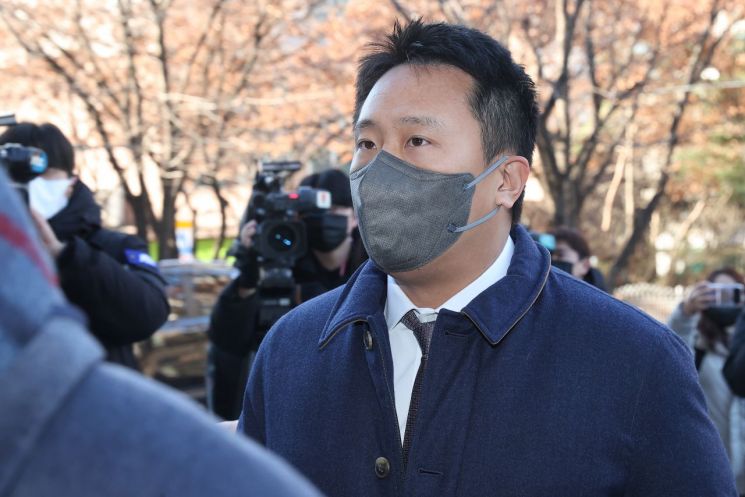
According to the prosecution, Shin and seven others are accused of falsely promoting the 'Terra Project' as successfully progressing and manipulating transactions from July 2018 to May last year, causing Luna and Terra coins to be traded, thereby obtaining approximately 462.9 billion KRW in illicit profits and habitually defrauding about 379.6 billion KRW. They are also charged with creating Luna coins as investment contract securities without submitting a securities registration statement from April 2019 to May 2020, distributing and selling them to investors, thereby soliciting securities and conducting sales activities. Additionally, from March 2021 to May last year, they allegedly accepted deposits of approximately 51.5 billion Terra coins from many people by promising to guarantee the principal and pay 19.56% interest when Terra coins were deposited in the Anchor Protocol.
Shin is also charged with unlawfully leaking 170 million Chai Pay transaction records over three years to make it appear as if the Terra blockchain was used in the general payment method of Chai Pay. Furthermore, he is accused of separately promoting the 'Chai Project' and defrauding 122.1 billion KRW from investors through false promotion and transaction manipulation in a 'series investment' method involving Chai convertible preferred shares. Other charges include breach of trust and embezzlement under the Act on the Aggravated Punishment of Specific Economic Crimes, violation of the Act on Reporting and Using Specified Financial Transaction Information, and breach of trust and mediation of breach of trust in business.
Shin’s defense team argued that the prosecution’s charges deviate from the substance and essence of the case. The defense attorney stated, "The defendant parted ways with CEO Kwon in 2020, and the cause of the crash was due to Kwon’s reckless operation of the Anchor Protocol and external attacks, which are unrelated to the defendant," citing a thesis containing this information as evidence. Another defense attorney for Shin claimed, "Shin parted ways with CEO Kwon in March 2020 due to differing business directions," and "the Anchor Protocol was created in March of the following year." Regarding the prosecution’s claim that the Terra project was initially impossible due to regulations, they countered, "There was no legal regulation prohibiting payment companies, rather than financial institutions, from using virtual currency as a payment method."
The defense also denied the prosecution’s assertion of Luna’s securities nature. Shin’s defense team said, "The reason the securities nature became a key issue is because the prosecution failed to specify the elements of fraud such as deceived parties, victims, financial damage, and causality in this case," adding, "They applied fraud under the Capital Markets Act, which has relaxed strictness, on the premise that Luna coins must be recognized as securities." They further stated, "In 2017, government agencies including the Financial Services Commission and the Ministry of Justice repeatedly announced that virtual assets do not qualify as financial products, i.e., securities. Applying the Capital Markets Act retroactively to operators who relied on this is against the principle of legality." They also noted that the U.S. court ruling submitted by the prosecution as evidence of securities nature was only a lower court decision, not a final judgment. They denied all other applied charges as well.
Before the trial officially began, there was a dispute over the use of a PPT material intended to argue the acceptance or denial of the charges by the defense attorneys. The prosecution argued, "After stating the gist of the charges, it was agreed to explain the defendants’ claims using PPT, but submitting materials that have not undergone evidence examination requires caution." Shin’s defense responded, "There are no parts directly citing evidence, only references." The defense attorney of Choi, who was in charge of management support in the Terra project, countered, "The evidence examination procedure is for using evidence to prove guilt. There is no need for strict procedures for evidence supporting innocence, so there is no problem."
In response, the prosecution reasserted, "Submitting evidence indiscriminately at the first hearing while the authenticity of the submitted evidence is unclear is inappropriate." The court decided that the defense attorneys could present the contents of the PPT containing evidence but should proceed mainly with opinions without individually mentioning the evidence.
© The Asia Business Daily(www.asiae.co.kr). All rights reserved.
![Clutching a Stolen Dior Bag, Saying "I Hate Being Poor but Real"... The Grotesque Con of a "Human Knockoff" [Slate]](https://cwcontent.asiae.co.kr/asiaresize/183/2026021902243444107_1771435474.jpg)











