Announcement of Basic Plan at Social Relations Ministers' Meeting
Recovery of Physical Fitness Declined After COVID-19
Strengthening Support for Students in Mental Health Crisis
Provision of Basic Education Hours on Youth Drug Trafficking and More
The Ministry of Education is considering separating the physical activity component of the elementary school subject 'Joyful Life' into a distinct physical education course to promote students' participation in physical activities. Additionally, efforts will be made to expand the linkage rate with mental health specialized institutions to strengthen support for students' mental health recovery.
On the 30th, Deputy Prime Minister and Minister of Education Lee Ju-ho held a Social Relations Ministers' Meeting at the Seoul Government Complex and announced the '2nd Basic Plan for Student Health Promotion (2024?2028)'.
The Ministry of Education will implement four core tasks to revitalize school sports and increase opportunities for students to participate in physical activities. First, according to the '2022 Revised Curriculum,' the physical activity time for 1st and 2nd-grade elementary students will be expanded from the current level to approximately 144 hours over two years.
The Ministry is reviewing the plan to separate the physical activity area of 'Joyful Life' into a distinct 'Physical Education course' for the first time in over 40 years. Since the 4th Curriculum applied in 1982, the Physical Education course has been operated as an integrated subject with Music and Art.
For middle schools, a plan to increase school sports club activity time by about 30% (236 hours over three years) starting in 2025 is also being pursued. For high schools, improvement measures will be prepared by the end of this year to ensure that the mandatory credit requirement for Physical Education (10 credits) can be implemented alongside the high school credit system starting in 2025.
The Ministry of Education explained, "If the Physical Education course is separated, students will be able to receive support from school sports instructors, and the classes previously conducted by homeroom teachers can be supported by other teachers and instructors. It is expected that this will create a situation where students can be more reliably engaged in appropriate physical activity time compared to when it was part of an integrated subject."
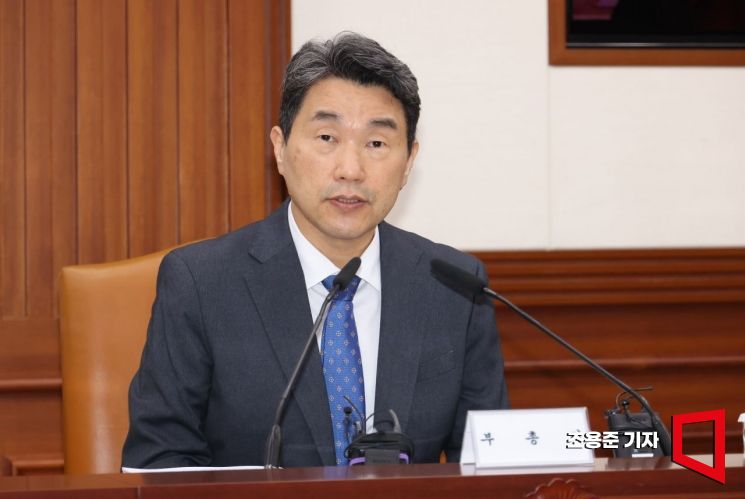 Lee Ju-ho, Deputy Prime Minister for Social Affairs and Minister of Education, is delivering opening remarks at the Social Relations Ministers' Meeting held on the 26th at the Government Seoul Office in Jongno-gu, Seoul. Photo by Jo Yong-jun jun21@
Additionally, support will be provided so that students can participate in exercise independently at school or home. An online physical activity app will be utilized, and sports facilities such as school complex facilities and swimming pools will be expanded. The number of school complex facilities will increase from 39 this year to 200 by 2027, and the current 164 swimming pools will see an additional 300 installations by 2028.
The Ministry will provide focused support to improve physical fitness, which has declined since COVID-19. Not only students with low fitness but also those who are obese or wish to participate will be able to join health fitness classes. Furthermore, student health checkups will be integrated into the national health examination system and entrusted to the National Health Insurance Service.
Accessibility to mental health diagnosis and treatment will also be enhanced. A 'Mental Health Diagnosis App' will be developed, and content to aid recovery through music and art programs will be piloted starting next year. To strengthen support for students in mental health crises, school visits by mental health professionals, counseling, treatment consulting, and linkage with specialized institutions will be promoted. The Ministry of Education stated that it plans to expand the current linkage rate with specialized institutions from 75% to over 90%.
Through cooperation among related ministries, the response system to drug trafficking and advertising will be strengthened. Annual minimum education hours for cyber and drug addiction prevention education by school level will be set at 10 hours, with minimum hours of 6 for kindergarten and elementary, 6 for middle school, and 7 for high school.
In addition, to prevent the spread of infectious diseases within schools, the target for managing national essential vaccination records will be expanded from existing elementary and middle school students to include kindergarten entrants. Guidelines will also be developed and provided to ensure that students with chronic and rare diseases can receive education within schools.
Parts of the basic plan issued by the Ministry of Education that require curriculum revision are expected to be discussed and finalized by the National Education Commission in the future.
© The Asia Business Daily(www.asiae.co.kr). All rights reserved.
![Clutching a Stolen Dior Bag, Saying "I Hate Being Poor but Real"... The Grotesque Con of a "Human Knockoff" [Slate]](https://cwcontent.asiae.co.kr/asiaresize/183/2026021902243444107_1771435474.jpg)
















