Seoul's Songpa-gu, Guro-gu, Seocho-gu, and Others Create 'Barefoot (Hwangtot) Paths' Amid Walking Craze
Walking fever is sweeping the nation.
This is because the perception that there is no better exercise than walking for maintaining health is spreading.
In particular, as the walking craze grows mainly among the elderly, Seoul autonomous districts such as Songpa-gu, Guro-gu, and Seocho-gu are consecutively creating loess barefoot trails.
Songpa-gu Completes 'Citizen Health Loess Experience Zones' at Songpa Naru Park and Ogeum Park
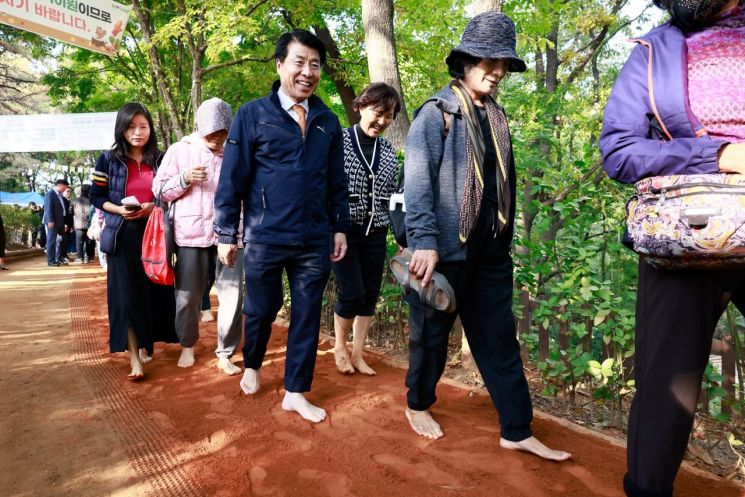
Songpa-gu (Mayor Seo Gang-seok) has completed the creation of 'Citizen Health Loess Experience Zones' at Songpa Naru Park and Ogeum Park to promote residents' health, and opened two barefoot loess trails with an opening ceremony on the 25th.
With the goal of a 'healthy city through community sports,' the district selected ▲ Songpa Naru Park, which has high accessibility in the city center, and ▲ Ogeum Park, which already had demand from barefoot walking users, to promote the barefoot walking trail creation project so that many residents can experience the recently trending barefoot walking exercise.
Especially, reflecting residents' requests for loess trail creation from the 'Dialogue with Residents' held earlier this year, the district used loess, known for its detoxifying effects on the body, to create two 'barefoot loess trails' in these parks.
The two newly created loess experience zones use 100% fine loess, 5mm sieved, sourced from Boryeong, Chungnam, filled to a depth of 20cm to maintain a soft texture. Additionally, foot washing stations were installed right next to the experience zones, and pergolas were set up to allow convenient use even on rainy days.
First, at Songpa Naru Park located by Seokchon Lake, a 107m loess trail was created. Utilizing part of the existing walking path around the west lake of Seokchon Lake to minimize park damage, visitors can experience the loess trail in the forest while overlooking Seokchon Lake. It is expected to become a new healing spot in the city that satisfies both tactile and visual senses.
At Ogeum Park, a 110m loess experience zone was created by utilizing the park terrain where most walking paths are dirt trails. A loess ball pool with acupressure effects was also installed to add fun. Ogeum Park, already recognized as a barefoot walking hotspot, preserves the charm of the natural hills, allowing visitors to enjoy forest bathing and barefoot walking simultaneously. In particular, a foot washing station, a long-awaited project by residents, was installed, transforming it into a barefoot walking specialized park.
Besides these, various barefoot walking paths exist throughout Songpa-gu. The 'Barefoot Park within Jangji Park' is loved by many people of all ages with acupressure paths of varying difficulty levels using materials such as loess balls and cypress cubes. The 'Health Acupressure Path on Hangaram-ro' located behind Jamsil Els Apartment offers diverse barefoot walking experiences with clay paths, loess ball acupressure paths, grass waterways, gravel, and logs.
Seo Gang-seok, Mayor of Songpa-gu, said, “Through this 'Loess Experience Zone,' we hope residents can enjoy a healthier and happier life close to their daily lives.” He added, “We will continue to expand loess trail infrastructure for residents' health and promote barefoot walking to create a ‘Healthy City Songpa.’”
Guro-gu Creates Approximately 500㎡ Loess Trail at Anyangcheon
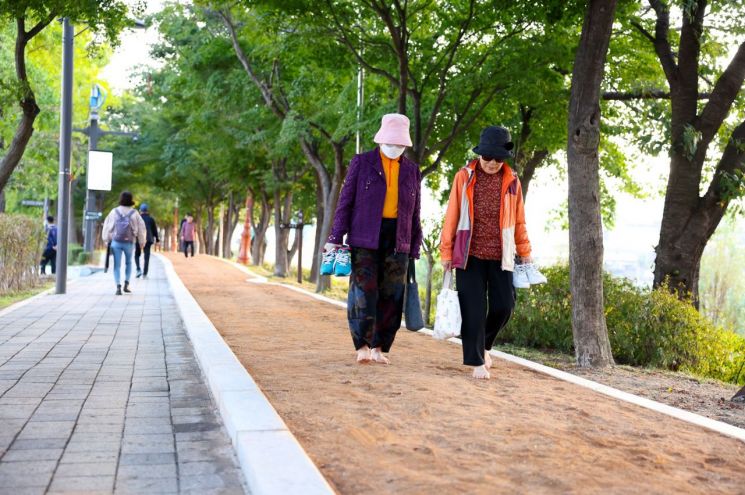
Guro-gu (Mayor Moon Heon-il) announced on the 27th that it has created a loess trail of about 500㎡ at Anyangcheon and opened it to residents.
On the 25th, the district held a completion ceremony for the Anyangcheon loess trail project with about 30 local residents, including Mayor Moon Heon-il, and held an event where participants walked barefoot on the loess trail.
The newly created loess trail is located under Gocheok Bridge on the right bank (621-8 Guro-dong) along Sodang-gil and the embankment path near the Seoul Animal Welfare Support Center.
The 500㎡ loess trail includes foot washing stations for users and safety features such as railings and stairs.
The Anyangcheon loess trail covers about 300m of embankment and Sodang-gil, forming a circular loop.
It is characterized by the ability to enjoy different views of Anyangcheon at eye level while going up and down Sodang-gil and the embankment path.
The district plans to find suitable spaces in urban leftover areas or parks for additional loess trail creation in the future.
Mayor Moon Heon-il of Guro-gu said, “Walking barefoot helps discharge active oxygen in the body and boosts immunity through grounding and acupressure effects.” He added, “We will expand loess trails in various spaces to help residents recover their tired bodies and minds through barefoot walking.”
Seocho-gu Creates Two Barefoot Trails Near Gyeongbu Expressway: ▲ Gilmajung-gil (Near Yongheori Neighborhood Park) 200m ▲ Gilmajung-gil (Jamwon IC to Sinsa 2 Overpass) 150m
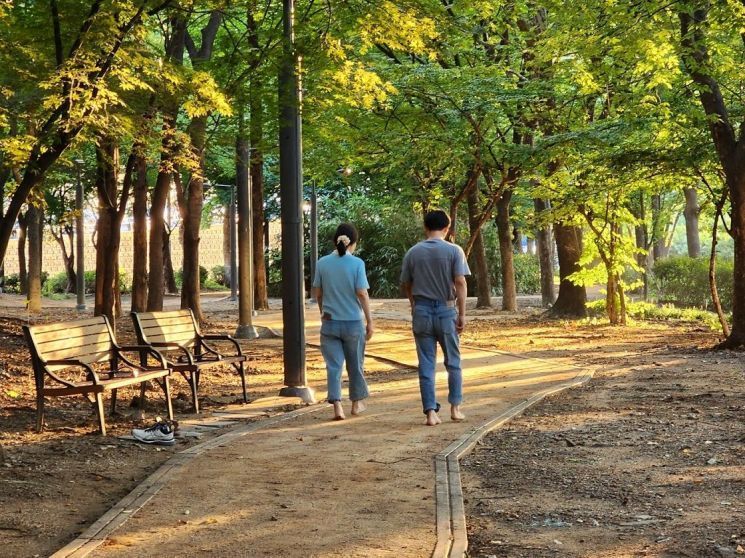
Seocho-gu, Seoul (Mayor Jeon Seong-su) is creating 'barefoot (earthing) trails' with residents to promote health by allowing them to feel the forest and nature with their feet in the city.
'Earthing' means 'healing through contact with the earth,' referring to walking barefoot on forest trails or paths to directly experience the earth's energy. It is known to be effective for smooth metabolism, blood circulation, insomnia, and pain relief.
The barefoot trails total 12 locations with a combined length of 4km. They consist of 7 trails created by the district and 5 trails autonomously created by residents.
First, the two new barefoot trails created by the district near the Gyeongbu Expressway are ▲ Gilmajung-gil (near Yongheori Neighborhood Park) 200m and ▲ Gilmajung-gil (Jamwon IC to Sinsa 2 Overpass) 150m. These loess trails, equipped with foot washing stations and shoe racks, are scheduled to open in December.
In September, two barefoot trails were created: ▲ Banpo Neighborhood Park (green area next to Seocho-gu Sports Center) 195m and ▲ Banpocheon (Banpo Raemian Prestige to Banpo Hillstate) 250m, receiving great responses from residents. The loess was delicately mixed with 50% loess and 50% ceramic stone powder to prevent softening and facilitate humidity control. Various signs explaining the benefits of barefoot walking, resting benches, and foot washing stations were installed throughout.
Next year, three more barefoot trails totaling 1km will be created: ▲ Seoripul Park (around Cheonggwonsa Temple) 600m, ▲ Umyeonsan (around Aqua Overpass) 200m, and ▲ Culture and Arts Park (near The-K Hotel) 200m. The district plans to maintain existing barefoot trails by installing pavement maintenance, foot washing stations, shoe racks, CCTV, and landscape lighting to create 'safe and pleasant barefoot trails.'
The five barefoot trails autonomously created by residents are dirt paths totaling 2.2km: ▲ Umyeonsan (near Yeongdong Middle School) 500m, ▲ Seoripul Park (near Bangbae Forest Environmental Library) 600m, ▲ Inneungsan (near The Sharp Foret Apartment) 300m, ▲ Bangbae Neighborhood Park (near the summit helipad) 500m, and ▲ Gyeongbu Expressway green facility (near Banpo Xi Apartment) 300m.
A resident interested in earthing voluntarily maintained the walking paths by clearing stones and tree roots near the trails, starting the first barefoot trail at Seoripul Park in July this year. Since then, as the benefits of barefoot walking became known, resident clubs formed, increasing interest and participation, leading to this expansion.
© The Asia Business Daily(www.asiae.co.kr). All rights reserved.

![Clutching a Stolen Dior Bag, Saying "I Hate Being Poor but Real"... The Grotesque Con of a "Human Knockoff" [Slate]](https://cwcontent.asiae.co.kr/asiaresize/183/2026021902243444107_1771435474.jpg)

















