Bank of Korea Reports 0.6% Real GDP Growth in Q3
Exports and Consumption Revive, Marking Three Consecutive Quarters of Growth
However, Middle East Crisis and High Interest Rates Raise Q4 Concerns
Experts Say "Annual 1.4% Target Likely Unattainable"
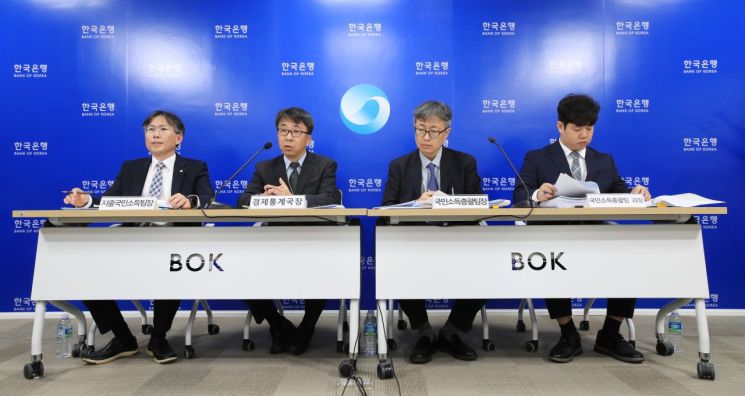 On the morning of the 26th, the 2023 Q3 Real Gross Domestic Product (Preliminary) briefing was held at the Bank of Korea in Jung-gu, Seoul. From the left: In-gyu Lee, Head of the Expenditure National Income Team; Seung-cheol Shin, Director of the Economic Statistics Bureau; Kwan-gyo Lee, Head of the National Income General Team; Ji-hoon Choi, Manager of the National Income General Team. Photo by Bank of Korea
South Korea's economy grew by 0.6% in the third quarter of this year, continuing its growth streak for three consecutive quarters. This was thanks to a rebound in exports centered on semiconductors, along with slight improvements in private consumption and government spending. However, due to the Israel-Hamas war, rising international oil prices, and domestic demand stagnation caused by high interest rates in the fourth quarter, it is expected to be difficult to maintain the growth momentum, making it still challenging to achieve the Bank of Korea's forecasted annual growth rate of 1.4%.
'Exports and Private Consumption Turn Positive... Facility Investment Contracts'
According to the Bank of Korea on the 26th, South Korea's real gross domestic product (GDP, preliminary figure) grew by 0.6% quarter-on-quarter in the third quarter of this year. Quarterly real GDP grew by 0.7%, 0.8%, and 0.2% in the first, second, and third quarters of last year, respectively, but turned negative in the fourth quarter of last year (-0.3%) due to a sharp decline in exports. However, it has grown for three consecutive quarters this year, with 0.3% in the first quarter, 0.6% in the second quarter, and continuing into the third quarter.
Looking at the growth rate by sector in the third quarter, exports (3.5%), private consumption (0.3%), government consumption (0.1%), and construction investment (2.2%) all increased, while facility investment (2.7%) was the only sector to decline. Shin Seung-cheol, head of the Bank of Korea's Economic Statistics Bureau, explained, "Exports and imports increased more than market expectations, and construction performed well compared to recent economic conditions," adding, "Facility investment decreased due to sluggish semiconductor manufacturing equipment."
Exports grew by 4.5% in the first quarter of this year but slowed to -0.9% in the second quarter before recovering again in the third quarter. It appears that export performance has partially recovered, centered on semiconductors and machinery and equipment. Imports also increased by 2.6%, expanding compared to the second quarter (-3.7%).
Private consumption increased by 0.3%, mainly driven by spending on entertainment, culture, food, and accommodation services, while government consumption rose by 0.1% due to increased social security in-kind benefits. Both had been sluggish in the second quarter at -0.1% and -2.1%, respectively, but turned slightly positive in the third quarter. Construction investment grew by 2.2% as both building and civil engineering construction increased. However, facility investment decreased by 2.7%, turning negative after one quarter.
Regarding the decline in facility investment, Shin explained, "The decrease in semiconductor manufacturing equipment suggests that the planned expansion of semiconductor factories this year is somewhat concluding," adding, "However, many plans for semiconductor manufacturing plant expansions are scheduled for next year, so facility investment is expected to increase, especially in the semiconductor and information and communication technology (IT) sectors."
Growth Contribution... Net Exports Fall, Private Consumption Rises
In the second quarter, private consumption, government consumption, and construction investment were all sluggish, but net exports (exports minus imports) increased because imports (-3.7%) fell more sharply than exports (-0.9%), resulting in 'recession-type growth.' However, in the third quarter, exports increased more than imports, and consumption also improved relatively.
Accordingly, the growth contribution of net exports shrank from 1.4 percentage points to 0.4 percentage points, while the growth contribution of domestic demand, including consumption and investment, expanded to 0.3 percentage points compared to -0.8 percentage points in the second quarter. The growth contribution of private consumption turned positive at 0.2 percentage points after one quarter, while government consumption remained flat at 0 percentage points. Investment growth contribution was 0.1 percentage points, with construction investment contributing 0.3 percentage points and facility investment -0.2 percentage points.
By economic activity in the third quarter, manufacturing increased by 1.3%, led by computers, electronics, and optical equipment, marking three consecutive quarters of growth. Agriculture, forestry, and fisheries grew by 1.0%, mainly due to livestock farming, and construction grew by 2.4% with increases in building and civil engineering construction. Services also increased by 0.2%, but electricity, gas, and water supply decreased by 1.4%. Real gross domestic income (GDI) rose by 2.5% compared to the second quarter, outpacing the real GDP growth of 0.6%.
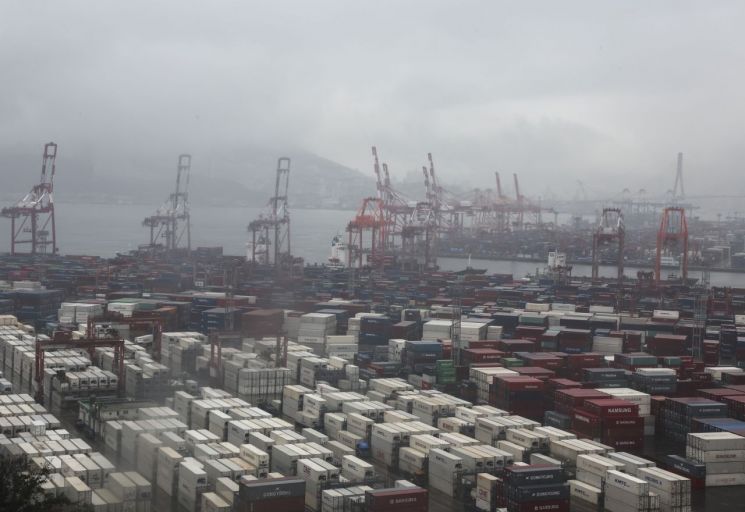
Uncertainty Ahead... Expanding Uncertainty in Private Consumption and Imports
However, due to the recent war between Israel and the Palestinian armed group Hamas, international oil prices are rising, and the tightening monetary policy stance led by the U.S. Federal Reserve (Fed) continues, making it difficult to expect a favorable growth trend in the fourth quarter.
In particular, private consumption shows signs of domestic demand stagnation due to high inflation and high interest rates, increasing uncertainty. The consumer sentiment index, which reflects consumers' perception of the overall economy, was above the baseline of 100 from June to August but has shown a continuous decline in September and October. Shin said, "Card spending continues to show positive growth, and employment indicators are not bad, but consumption sentiment is likely to continue to be affected by the burden of inflation," adding, "Even if private consumption recovers, the pace may be gradual."
Net exports are also likely to falter due to the war and oil price effects. Exports have recently shown improvement in the semiconductor sector, and export values based on customs clearance up to the 20th of this month have turned positive, so growth is expected to continue. However, imports are heavily influenced by international oil prices and winter weather, making them vulnerable. Shin explained, "Imports face significant uncertainties due to geopolitical risks and crude oil price movements," adding, "It is difficult to predict whether net export contributions will remain positive in the fourth quarter."
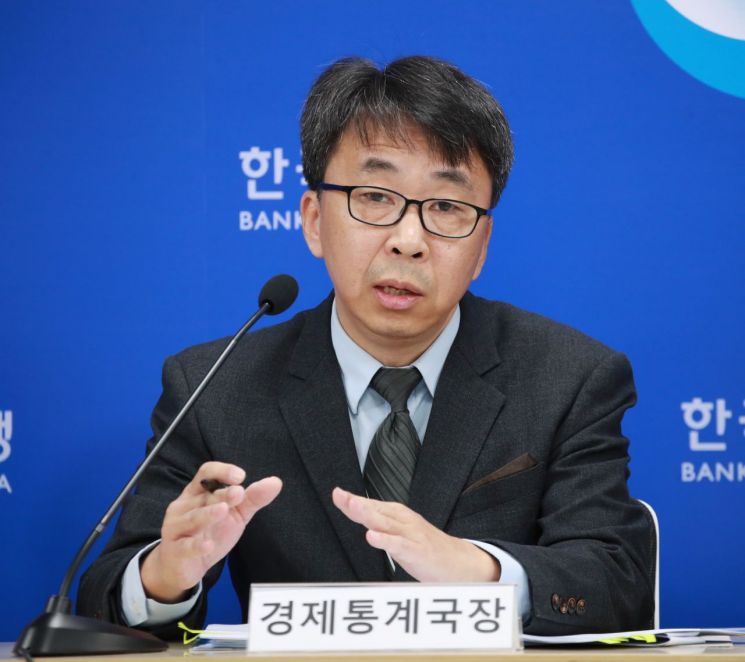 Shin Seung-chul, Director of the Economic Statistics Bureau at the Bank of Korea, is explaining the main features of the real Gross Domestic Product (preliminary) for the third quarter of 2023 on the morning of the 26th at the Bank of Korea in Jung-gu, Seoul. (Photo by Bank of Korea)
0.7% Growth Needed in Q4 to Meet Target... "Not Easy"
The Bank of Korea forecasted in its revised economic outlook last August that South Korea's annual growth rate would reach 1.4% this year. With growth of 0.3% in the first quarter and 0.6% in both the second and third quarters, a growth rate of 0.6-0.7% is required in the fourth quarter to meet the target. Considering the likelihood that the economy in the fourth quarter will be worse than in the third quarter due to war, high interest rates, and high inflation, achieving this is not easy.
Professor Heo Jun-young of Sogang University's Department of Economics said, "The economy is more likely to head in a worse direction than the scenarios considered by the government or the Bank of Korea, so the growth rate may fall short of 1.4% annually," adding, "Factors reflected in the fourth quarter GDP include the Israel-Hamas war that broke out in October and the prolonged high level of U.S. Treasury yields, which could bring unexpected variables to the real and financial markets."
Professor Kwon Nam-hoon of Konkuk University's Department of Economics said, "The fourth quarter GDP does not seem likely to outperform the third quarter," explaining, "Negative factors such as the Middle East crisis and rising U.S. Treasury yields are expected to have a greater impact in the fourth quarter." He added, "It will depend on how effective the anticipated semiconductor market recovery and China's economic stimulus measures are, keeping in mind the 'low in the first half, high in the second half' pattern."
© The Asia Business Daily(www.asiae.co.kr). All rights reserved.

![Clutching a Stolen Dior Bag, Saying "I Hate Being Poor but Real"... The Grotesque Con of a "Human Knockoff" [Slate]](https://cwcontent.asiae.co.kr/asiaresize/183/2026021902243444107_1771435474.jpg)
















