산기평·Battery Association Host '2023 K-Battery R&D Forum'
Over 240 Industry, Academia, and Research Participants Gather... Candid Exchange of Opinions
"An Open Forum for Intense Collaborative Discussion, Will Continue to Be Provided"
“Who should be held responsible if an accident occurs while using reused batteries? Is it the battery manufacturer, the remanufacturing company, or the company that inspected and certified the battery? Please share your opinions.” (Industry participant)
“Although the detailed rules of the Reused Battery Safety Standard (KC 10031) have not been finalized, ultimately, whether it is a new product or remanufactured, the company that made the battery must take responsibility. If the three major battery companies want to avoid liability for safety accidents, they need to provide some battery-related data.” (Representative of a battery remanufacturing company)
At the ‘2023 K-Battery R&D Forum’ held on the 24th at Maison Glad Jeju, hosted by the Korea Institute for Advancement of Technology and the Korea Battery Industry Association, participants engaged in a heated discussion on securing R&D competitiveness for the battery circular economy. About 240 stakeholders from industry, academia, and research gathered, exchanging candid questions and frank answers.
Choi Seong-jin, CEO of startup Poen, which spun off from Hyundai Motor’s in-house venture, responded to a question about liability in case of safety accidents related to battery reuse by saying, “Battery manufacturers likely design batteries with an expected lifespan in mind, so it would be helpful if they could provide guidelines such as ‘the expected lifespan of used batteries is about this much.’ In fact, the three major battery companies are not free from responsibility for the next stage after new products (reuse).”
The questioner replied, “That sounds a bit uncomfortable,” adding, “You’re saying the three major battery companies should be responsible for all consumer usage history, but if manufacturers are already held liable, it will be difficult to do business. We need to find ways to utilize machine learning or artificial intelligence (AI).” CEO Choi responded, “Due to time constraints, I spoke quickly and it came out that way. We are already doing what you mentioned. The remanufacturing companies are preparing to use batteries after inspecting them through R&D processes such as non-destructive testing and EIS (Electrochemical Impedance Spectroscopy) testing.” He added, “The three major battery companies are also sharing some of their experience and know-how with small companies like ours through the Battery Alliance.”
 On the 24th, Masangbok, Vice President of SK Ecoplant, is speaking at the discussion section of the '2023 K-Battery R&D Forum' held at Maison Glad Jeju.
 [Photo by Choi Seoyoon]
Another participant asked, “Among 4,069 scrapped electric vehicles, 86% were exported overseas. There are very few batteries left domestically, so please suggest alternatives for recycling.” Song Jun-seok, Senior Researcher at the Korea Electronics Technology Institute, replied, “I think the Ministry of Environment should answer that.” He pointed out, “Since last year, private sales of used batteries have been allowed, and from the perspective of foreign companies or domestic exporters, it is much more profitable to sell used batteries overseas rather than returning them after electric vehicle scrapping. This is due to loopholes in the law.”
Questions about standardization also arose. One participant said, “Earlier, it was mentioned that battery cell manufacturers do not provide information, but it is also problematic that electric vehicle companies prevent access to data and control information.” Although devices capable of real-time measurement of internal battery information exist, automakers block external companies from accessing the Battery Management System (BMS) that controls these devices. He asked, “What do you think about standardizing battery-related systems by automakers so that related companies can also use them?” Domestic companies such as Hyundai Motor, Kia, and GM Korea submit some BMS information to the Korea Transportation Safety Authority, but imported car companies are reluctant to disclose it externally for security reasons.
CEO Choi said, “The government has now launched a project to develop a so-called ‘universal BMS’ that can operate similarly even without the existing BMS.” He added, “Ideally, automakers would fully disclose information, but since they do not, the Battery Industry Association is continuously requesting at least voltage and current values to be opened. It is still a challenging situation.”
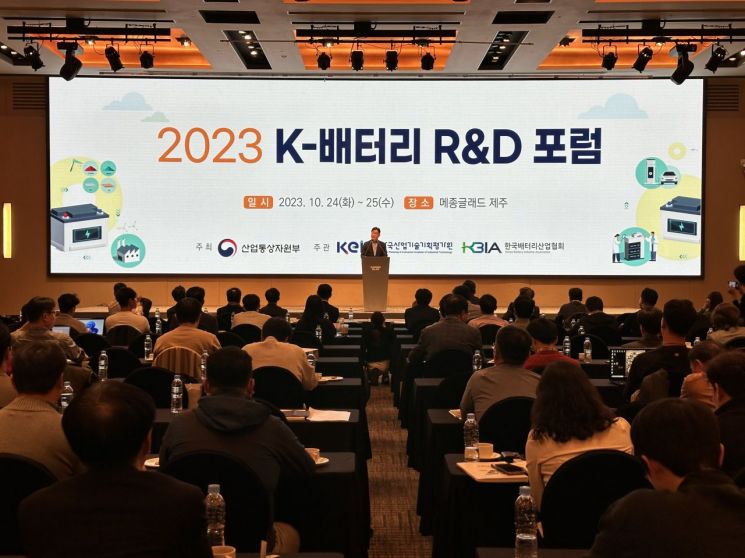 On the 24th, Park Tae-sung, Vice Chairman of the Korea Battery Industry Association, delivered a welcoming speech at the '2023 K-Battery R&D Forum' held at Maison Glad Jeju.
 [Photo by Korea Battery Industry Association]
The issue of severe battery workforce shortages was also mentioned. Professor Kim Han-su of Hanyang University said, “There are about 29,000 battery workers, but supply and demand do not match. The shortage rate is about 13%, which is more than five times higher than other manufacturing sectors.” He added, “The imbalance in battery workforce supply and demand is a global issue shared by Europe, the U.S., and others. We need to prepare in advance before the market for battery recycling, reuse, and remanufacturing grows larger.”
The forum was attended by Song Jun-seok, Senior Researcher at the Korea Electronics Technology Institute (chair), Ma Sang-bok, Vice President of SK Ecoplant, Choi Seong-jin, CEO of Poen, Kim Seong-su, Professor at Chungnam National University, Kim Han-su, Professor at Hanyang University, Lee Jeong-du, Secondary Battery PD at the Korea Institute for Advancement of Technology, and Park Jae-beom, Senior Researcher at POSCO Research Institute.
Park Tae-sung, Vice Chairman of the Korea Battery Industry Association, told reporters immediately after the forum, “This event, which had been held in small groups of researchers, was held on a larger scale for the first time this year. We hoped it would be an open forum to share technology and ideas and engage in intense discussions.” He continued, “The forum had a bolder and more proactive atmosphere than expected, which was good. We will continue to create opportunities for ongoing mutual information exchange.”
© The Asia Business Daily(www.asiae.co.kr). All rights reserved.
![Clutching a Stolen Dior Bag, Saying "I Hate Being Poor but Real"... The Grotesque Con of a "Human Knockoff" [Slate]](https://cwcontent.asiae.co.kr/asiaresize/183/2026021902243444107_1771435474.jpg)

















