Despite Aiming to Prevent Reckless Factory Proliferation
Ichon-si and Others Express Concerns Over "Excessive Overlapping Regulations"
"It needs to be established, but..."
The positions of local governments are divided over the revised enforcement decree of the "National Land Planning and Utilization Act (National Land Planning Act)," set to take effect on January 27 next year. While the purpose is to prevent indiscriminate development caused by the proliferation of individually located factories, some local governments are concerned that it will become an overlapping regulation that further weakens the competitiveness of the already regulated Seoul metropolitan area.
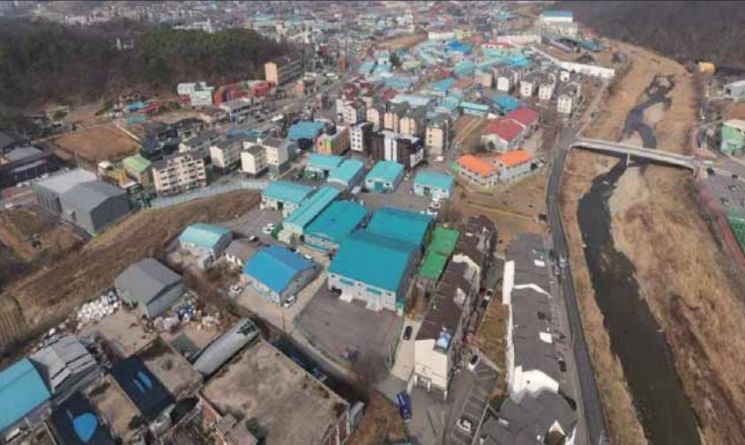
The revised enforcement decree of the National Land Planning Act stipulates that in areas within planned management zones where a "growth management plan" has not been established, the establishment of factories and manufacturing businesses is prohibited. The growth management plan aims to prevent indiscriminate urban development and promote planned development considering regional characteristics. It presents the basic direction of development, such as installation or modification of infrastructure and building usage, targeting areas with high development pressure.
According to local governments on the 26th, each local government has completed public inspection of the growth management plan and is expediting related procedures such as the urban planning committee ahead of the law's enforcement.
Hwaseong City, which completed the public inspection of the growth management plan in early September, plans to finalize the announcement of the growth management plan before the law takes effect. Earlier, since January this year, Hwaseong City restricted development activity permits over a total area of 233.9㎢ to prevent indiscriminate development before establishing the growth management plan. The target areas include planned management zones (163㎢), production management zones (46.3㎢), and existing growth management plan zones (24.6㎢). The restricted permit areas are in the southwestern region, including Bongdam, Ujeong, Hyangnam, Namyang-eup, and Bibong, Mado, Songsan, Seosin, Paltan, Jangan, Yanggam, Jeongnam-myeon. These are relatively slow urbanizing areas.
The city classifies the growth management plan into ▲general management zones ▲industrial management zones ▲priority management zones. Particularly, the areas where factory and manufacturing site restrictions are strengthened are the priority management zones, such as quiet facilities, natural scenic points, and historical cultural facilities.
A Hwaseong City official explained, "Compared to the eastern region where Dongtan New Town is located, the southwestern region is slower in urbanization and has high development pressure," adding, "We are establishing the growth management plan focusing on preventing indiscriminate development caused by the proliferation of individually located factories." The official added, "We plan to complete the announcement procedure within this year after the urban planning committee review by next month."
However, dissatisfaction with the establishment of the growth management plan itself is not insignificant. Icheon City is a representative case.
Icheon City also prepared a growth management plan for 88.9㎢ of planned management zones and completed public inspection early last month. The planned management zones in Icheon City are mainly concentrated in the southern areas such as Seolseong-myeon, Daewol-myeon, and Janghowon-eup. The target area accounts for 26% of the city's total area.
However, Icheon City is concerned that the growth management plan may act as an additional regulation amid the already overlapping regulations that make it difficult to establish large-scale factories. Many areas are already designated as Han River watershed water source protection zones under the Seoul Metropolitan Area Readjustment Planning Act, and military protection zones are also widely distributed.
An Icheon City official said, "The intention to prevent indiscriminate development caused by the proliferation of individually located factories is good, but since large-scale concentrated sites are practically impossible, adding the growth management plan will become a significant obstacle to urban growth," and explained, "Therefore, the growth management plan being established is planned to be prepared while maintaining the current regulations."
© The Asia Business Daily(www.asiae.co.kr). All rights reserved.












