Nearly 2,000 Decrease in 3 Years
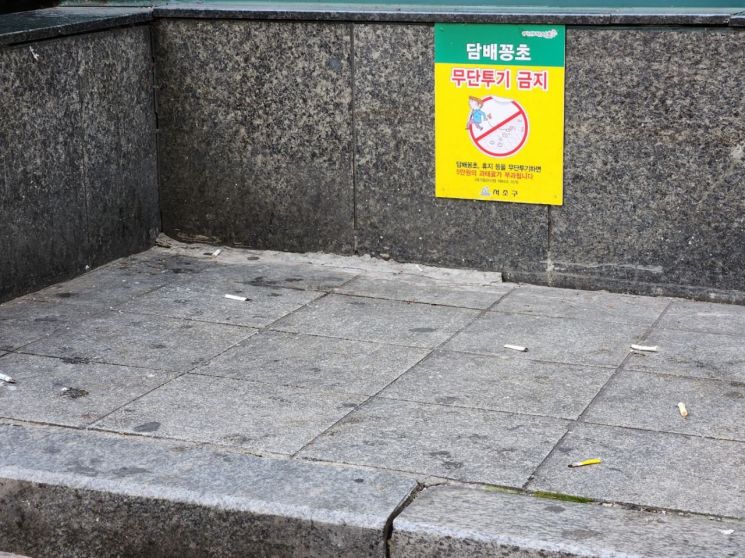
Increase in Littering of Coffee Cups and Cigarette Butts
Gradual Expansion Planned... "Necessity Proven"
Recently, it has become difficult to find public trash bins in downtown Seoul. This is the result of reducing the number of trash bins to prevent illegal dumping of household waste since the full implementation of the volume-based waste fee system in 1995. However, as various trash such as disposable coffee cups and cigarette butts are being carelessly discarded on the streets and complaints about inconvenience pour in, the policy direction is changing back to installing trash bins.
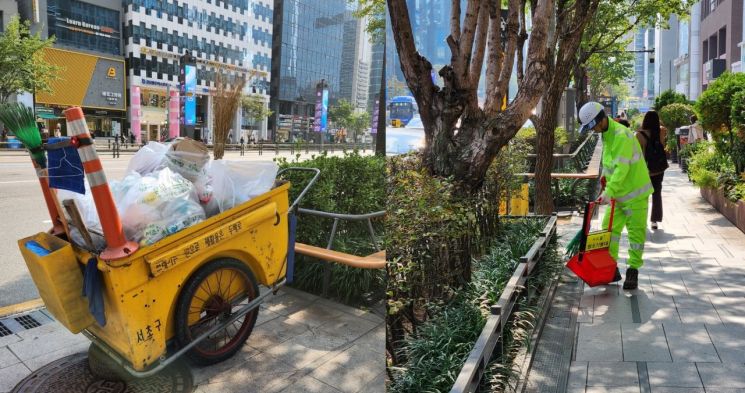 A sanitation worker is cleaning in front of Gangnam Station on Seoul Subway Line 2.
 [Photo by Im Chunhan]
On the afternoon of the 24th, Park (24), whom we met in front of Gangnam Station on Seoul Subway Line 2, said, “I often come to Gangnam because I attend an English academy, but there are not many trash bins on the streets,” and added, “It’s very frustrating when I have to take the bus.” Jung (30) said, “There is no proper place to throw away cigarette butts after smoking,” and frankly admitted, “I just throw them on the ground.” The distance from Exit 10 of Gangnam Station to Exit 7 of Sinnonhyeon Station is about 550 meters. There are 12 bus stops between the two stations. However, there are only three trash bins installed on the sidewalks. Since January 2018, Seoul has revised the city bus safety operation standards ordinance to restrict bringing food into city buses. People who cannot find trash bins are illegally dumping trash in flower beds, under street trees, and in alleys before boarding buses. Even areas with heavy foot traffic that are not bus passengers suffer from trash problems. After street cleaners cleaned up the trash around Gangnam Station once, their carts were filled with various trash, including plastic coffee cups.
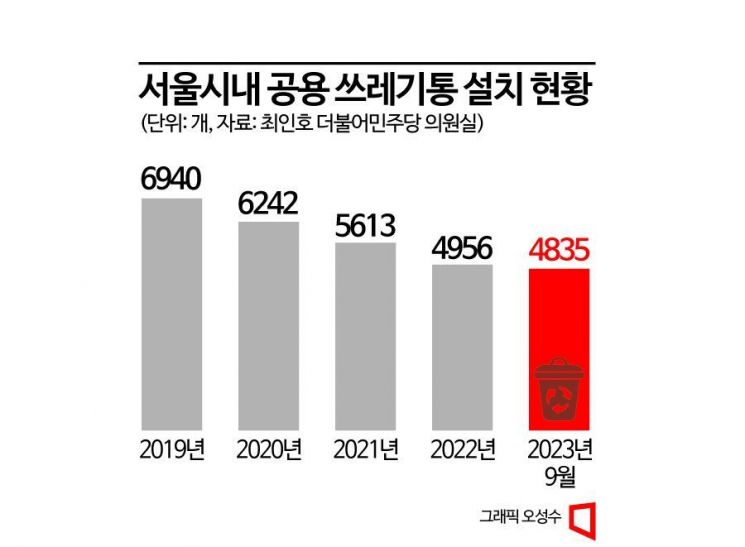
In fact, the number of public trash bins in Seoul has decreased by nearly 2,000 over the past three years. According to data submitted by Seoul City to Choi In-ho, a member of the National Assembly’s Land, Infrastructure and Transport Committee from the Democratic Party of Korea, the number of public trash bins decreased continuously from 6,940 in 2019 to 6,242 in 2020, 5,613 in 2021, and 4,956 in 2022. As of September this year, the number was counted at 4,835, 121 fewer than last year. By location, bus stop bins increased from 1,712 in 2019 to 2,926 in 2020 but decreased again to 2,548 as of September this year. Trash bins at subway station entrances decreased from 853 in 2019 to 373 this year, and roadside bins also dropped from 4,375 to 1,914 during the same period.
The installation of public trash bins has been a controversial issue for some time. In 2012, the neighboring districts of Gangnam-gu and Seocho-gu implemented completely opposite policies. Gangnam-gu installed and maintained trash bins along Gangnam-daero, while Seocho-gu declared a zero trash bin policy. At that time, Seocho-gu argued based on a kind of “broken windows theory” (a criminology theory that suggests that leaving broken windows unrepaired leads to more crime in the area) that trash bins make the roads dirtier, so they removed all trash bins. However, Seocho-gu suffered from illegal dumping and eventually introduced the ‘Seoripul Cup,’ a recycling separation bin, in 2016, four years later. A Seocho-gu official explained, “The spread of coffee takeout culture has significantly changed the environment.”
As the number of public trash bins in Seoul continues to decrease, each autonomous district is experiencing similar problems. As illegal dumping worsens in many places, voices calling for increasing the number of trash bins again are growing. A Gwanak-gu official said, “There are many illegal dumpings in busy areas where many people pass by, causing inconvenience to citizens and continuous complaints,” and added, “It is better for urban aesthetics and cleaning if trash is only thrown around trash bins if they exist.”
In response to this situation, Seoul City plans to expand the number of public trash bins to 5,500 by the end of this year, 6,500 in 2024, and 7,500 by 2025. A Seoul city official said, “Installation and removal of trash bins are carried out by each district office,” and added, “It seems that the number of trash bins has decreased too much as requests for removal from nearby merchants have been reflected.” He continued, “It is judged that trash bins are needed mainly at bus stops and places with heavy foot traffic, and we are requesting cooperation from autonomous districts to gradually expand installations in the future.”
Experts also suggest that public trash bin installation should be expanded from various perspectives, including preventing street littering and convenience for tourists. Nam Ki-beom, a professor of urban sociology at the University of Seoul, said, “There used to be debates for and against in Korea, but now the necessity of public trash bins has been proven,” and added, “One important aspect is tourists. Without trash bins, foreigners do not know where to throw their trash and just discard it on the streets. Globally, public trash bins have long been revived from the perspective of urban aesthetics.”
© The Asia Business Daily(www.asiae.co.kr). All rights reserved.
![Clutching a Stolen Dior Bag, Saying "I Hate Being Poor but Real"... The Grotesque Con of a "Human Knockoff" [Slate]](https://cwcontent.asiae.co.kr/asiaresize/183/2026021902243444107_1771435474.jpg)


















