Last Year Ministry of Land Survey: 3.8 Million Won
Income Down 32% in One Year Despite Working the Same Hours
During the COVID-19 pandemic, the income of delivery workers, which had increased thanks to the boom in contactless services, is reported to have decreased again.
On the 24th, Jin Seong-jun and Han Jun-ho of the Democratic Party of Korea, Kang Seong-hee of the Progressive Party, and others held a "Discussion on the Results of the Survey on the Working Conditions of Delivery Platform Riders and Measures for Their Protection" at the National Assembly, announcing these results.
According to the survey results from these lawmakers' offices, 62.3% of delivery workers who responded experienced a decrease in income after the COVID-19 endemic, and even when working the same hours as before, their income dropped by 32%.
On the other hand, only 6.8% of workers responded that their income had increased. The average monthly income of delivery workers, excluding various expenses, was calculated to be about 2.84 million KRW.
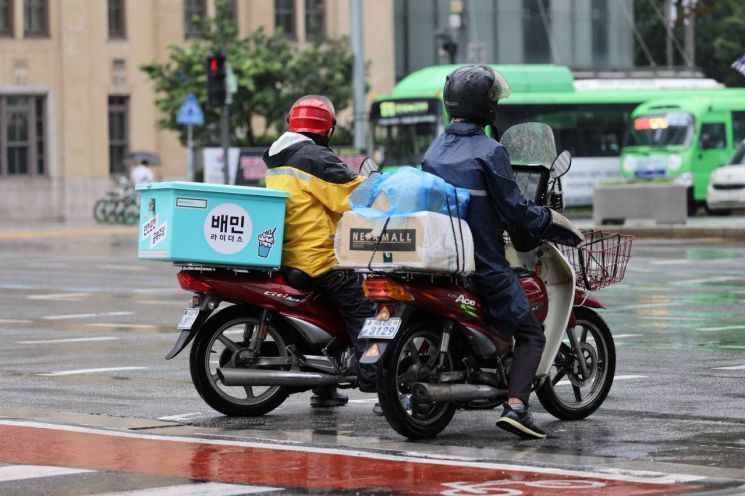
This figure is significantly lower than last year during the COVID-19 endemic period. According to the "Delivery Industry Survey Results" published by the Ministry of Land, Infrastructure and Transport at the end of last year, the average income of delivery workers was 3.81 million KRW per month.
The respondents' desired working hours were 45 hours per week on average. Actual working hours reached 54 hours.
The biggest reason delivery workers engage in risky driving was "to complete events, missions, and promotions" (36.6%). This was followed by "fast delivery, late cooking, compensating for delivery mistakes, and backlog of calls" (32.1%).
When asked about worries and anxiety over income on a 5-point scale, the average score was 3.7. Anxiety about job stability was also high at 3.8. 67.3% of respondents said that the platform company's algorithm (work allocation system) affects delivery tasks.
Additionally, 45.5% expressed distrust in work allocation through algorithms, with higher response rates among those with longer delivery experience and more contracted delivery companies.
This survey was conducted by the Delivery Platform Labor Union and the National Legislative Center over one month from July 24 this year, targeting 1,030 food delivery workers.
Regarding this, Representative Jin emphasized, "There needs to be a social discussion on appropriate delivery fees for livelihood maintenance and the establishment of a social safety net for income reduction."
© The Asia Business Daily(www.asiae.co.kr). All rights reserved.

















