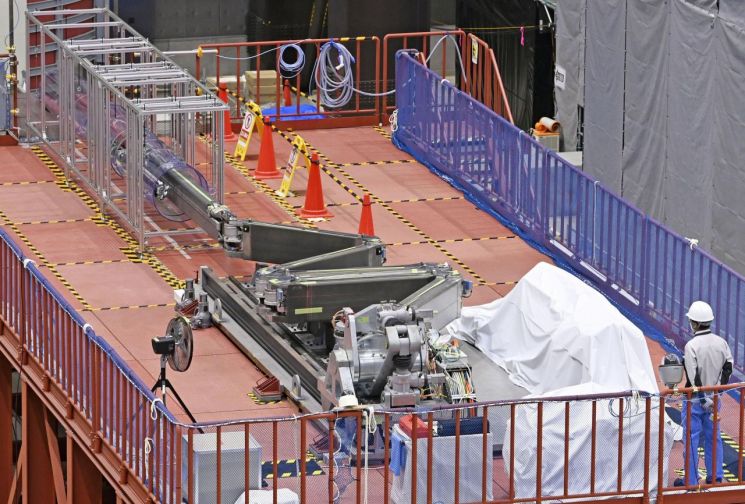
 Robot arm developed for removing nuclear fuel debris from Fukushima Daiichi Nuclear Power Plant.
 [Image source=Yonhap News]
The removal work of nuclear fuel debris remaining in the reactors of the Fukushima Daiichi Nuclear Power Plant is facing unexpected difficulties from the preparation stage, causing delays.
On the 22nd, Tokyo Electric Power Company (TEPCO) reported that they recently confirmed that the cylindrical structure cover, about 55 cm in diameter, connecting the inside and outside of the containment vessel of the reactor at Unit 2 of Fukushima Daiichi Nuclear Power Plant, was filled with gray deposits. The deposits are presumed to have been formed by cables and other materials inside the cylindrical structure melting due to the high heat caused by the accident.
TEPCO planned to start work by inserting a newly manufactured "robotic arm" for removing nuclear fuel debris into the cylindrical structure, which is about 2 meters long, in the second half of this year. The remotely operated robotic arm has been jointly developed by Japanese and British companies since April 2017 and can extend up to 22 meters.
However, the robotic arm is so large that only a 3 cm gap remains when inserted into the cylindrical structure, making insertion impossible if deposits are present. TEPCO is currently considering using high-pressure water to push out the deposits by the end of the year. If the deposits cannot be completely removed, an alternative plan has been established to extract the nuclear fuel debris using a rod about 20 cm in diameter, used like a fishing rod.
However, according to the Tokyo Shimbun, this rod has a narrower working range than the robotic arm, and there is a possibility that workers may be exposed to radiation during the installation process. The Tokyo Shimbun pointed out, "There are concerns that the robotic arm may not be usable on site," and "TEPCO may have to significantly change its existing plans." The schedule for removing nuclear fuel debris from Fukushima Daiichi Nuclear Power Plant continues to be delayed.
Originally, removal was planned to start in 2021, but the development of the robotic arm took longer than expected, delaying the schedule by about two years. Moreover, nuclear fuel debris exists not only in the Unit 2 reactor but also in Units 1 and 3, with a total estimated amount of about 880 tons. It is also pointed out as a problem that the robotic arm can only remove an amount equivalent to what fits in an ear pick at one time.
The Tokyo Shimbun noted, "With this method, it is impossible to remove all the nuclear fuel debris by the target reactor decommissioning year of 2051," and "There is a proposal to fill the entire Unit 3 reactor with water, but it remains at the conceptual stage."
© The Asia Business Daily(www.asiae.co.kr). All rights reserved.

















