Parents' Inquiries Surge in Daechi-dong Academy District
'Medical School Concentration' Accelerated Over Past 10 Years
Experts Warn "No Premature Judgments Until Enrollment Increase Confirmed"
As the government officially announced the expansion of medical school quotas, aftershocks are also hitting university admissions. There are forecasts that the so-called ‘medical school concentration phenomenon’ that has continued for the past decade will accelerate further.
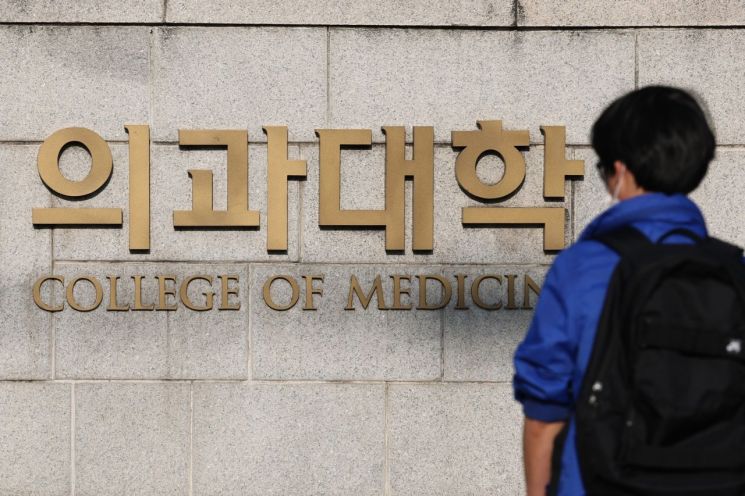 Health and Welfare Minister Cho Kyu-hong stated in his opening remarks at the briefing on the essential medical innovation strategy on the 19th, "The government has been steadily carrying out related tasks with the goal of expanding medical school admissions quotas by 2025."
 [Image source=Yonhap News]
Cho Gyu-hong, Minister of Health and Welfare, stated in his opening remarks at a briefing on the essential medical innovation strategy on the 19th, “The government has been steadily working toward the goal of expanding medical school admission quotas by 2025.”
Minister Cho said, “The expansion of medical school quotas will be swiftly implemented after thoroughly reviewing the field’s capacity for acceptance and educational capabilities,” adding, “We will prepare a package of measures for expanding medical school quotas and supporting regional essential medical care, consult with the medical community, and gather opinions from the public, patient groups, and experts.”
Meanwhile, parents seeking admissions information are becoming restless, and the private education sector is moving quickly by holding urgent briefings to recruit students. The increase in medical school admissions essentially means an increase in departments at top-tier universities, so it is expected that competition rates at other top universities will decrease, lowering the admission cutoff scores.
An official from a medical school admissions academy said, “We plan to further subdivide the classes that taught medical, dental, and Korean medicine aspirants by grades and fields to expand them,” adding, “Since even students from provincial areas want to attend academies in Daechi-dong, we are devising strategies to absorb this demand.”
Another academy director said, “The most frequent inquiries from parents are whether the medical school quota increase is really confirmed,” and added, “Even if only 1,000 spots increase, it means that students who would have gone to Yonsei or Korea University this year can all go to medical schools, which is good news for repeat exam preparation classes.”
 Medical School Entrance Exam Advertisement Slogans in the Academy District of Daechi-dong, Gangnam-gu, Seoul
 Photo by Yonhap News
The phenomenon of examinees flocking to medical schools has already become prominent in the academy scene. According to recent education sector reports, medical school classes for elementary and middle school students are increasing mainly in Gangnam-gu, Seoul. To enter these academies, which operate with fewer than 10 students in elite small groups, students must take exams, and the competition rate is reported to reach up to 10 to 1.
According to an online survey conducted in May by Jongno Academy targeting 1,395 parents?676 of elementary school students and 719 of middle school students?88.2% of parents answered that they hope their children pursue science tracks. Among them, 92.3% of elementary school parents and 84.4% of middle school parents expressed this preference. Among these, the most preferred majors by parents hoping for science tracks were medical fields (medicine, dentistry, pharmacy) at 49.7%, ranking first.
Notably, the preference for medical fields among elementary school parents (52.3%) was higher than that of middle school parents (47.0%). In the case of science tracks, preferred universities included medical schools in provincial areas (44.0%), surpassing Seoul National University’s science and engineering (20.5%) and KAIST (18.8%). This indicates a tendency to prefer provincial medical schools over other majors at Seoul National University.
However, experts believe that an increase in medical school quotas does not necessarily make admission to medical schools easier.
As was the case in the mid-2000s when medical professional graduate schools were established and many university students and working adults challenged the entrance exams, if medical school quotas increase by more than 1,000, it is expected that many current science and engineering personnel will enter medical school admissions.
In fact, last year, 2,131 students dropped out from the so-called ‘SKY’ universities?Seoul National University, Yonsei University, and Korea University. Among the reasons for dropout, the majority (81.4%) were withdrawals. Many of these students withdrew between January and February after attending school and then preparing again for university entrance exams and receiving acceptance notifications. This is the highest number in the past five years and is analyzed as a result of the intensified medical school concentration phenomenon.
Education experts advise, “No assumptions should be made before the exact scale of medical school quota increases is announced,” and caution, “While it is helpful to refer to information provided by private education companies, blind trust should be avoided.”
© The Asia Business Daily(www.asiae.co.kr). All rights reserved.
!["The Woman Who Threw Herself into the Water Clutching a Stolen Dior Bag"...A Grotesque Success Story That Shakes the Korean Psyche [Slate]](https://cwcontent.asiae.co.kr/asiaresize/183/2026021902243444107_1771435474.jpg)

















