A research team at Chung-Ang University has developed a climate-adaptive film material that freely switches between cooling and heating according to temperature changes.
 (Left) Professor Yoo Young-jae, Department of Advanced Materials Engineering, Chung-Ang University (Right) Dr. Kim Yong-seok, Korea Research Institute of Chemical Technology / Photo by Chung-Ang University
On the 21st, Chung-Ang University announced that Professor Youngjae Yoo's research team from the Department of Advanced Materials Engineering and Dr. Yongseok Kim's research team from the Korea Research Institute of Chemical Technology jointly developed a 'film material for passive radiative heat transfer with switchable cooling/heating properties and thermoelectric generation.'
Passive radiative cooling is a technology that lowers surface temperature without external power supply by utilizing the principle that all objects spontaneously emit electromagnetic radiation, releasing heat while reflecting sunlight. It is a technology that achieves energy-saving effects without additional energy input.
Until now, during the daytime or summer with high solar exposure when cooling is needed, the solar radiation energy offset the thermal radiation emitted by the object, making it difficult to achieve the desired effect. Many researchers developed materials using inorganic substances, photonic crystals, and polymers, but commercialization was considered difficult due to limitations such as complex structures, low flexibility, and performance degradation.
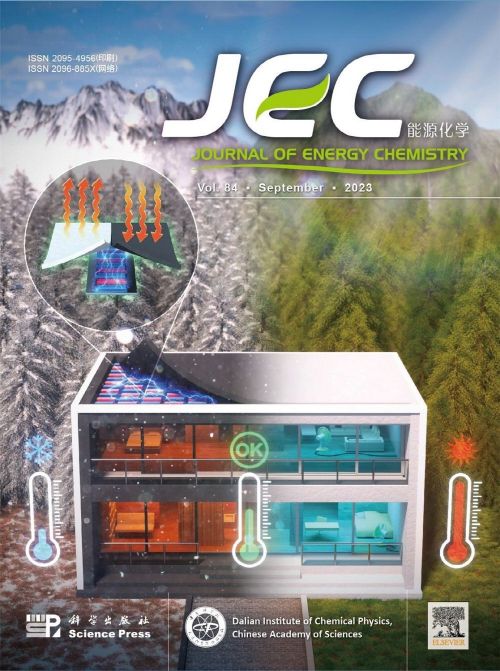 Last month, a joint research paper by Professor Yoo Young-jae and Dr. Kim Yong-seok's research team was selected as the cover paper of the Journal of Energy Chemistry. Photo by JoongAng University
The joint research team solved the problem by creating a film using thermochromic pigments that change color according to temperature and hollow particles. When the temperature is low, the film absorbs solar heat and suppresses mid-infrared emission, whereas when the temperature is high, it induces radiative cooling to lower the temperature compared to the surroundings. By structurally controlling the film to have active and efficient optical properties according to external climate conditions, they demonstrated that it provides sufficient cooling performance even in summer, enabling user-customized temperature control.
The newly developed film also showed significant effects in cold weather. When used together with a thermoelectric generator that produces electricity by utilizing the temperature difference between the film and the surrounding environment, it is expected to greatly improve energy management efficiency.
This research was conducted with support from the Core Technology Development Project for Industrial-Linked Low-Carbon Process Transition, led by the Ministry of Trade, Industry and Energy. The research results were selected as the cover paper last month in the international journal Journal of Energy Chemistry, a top 2.1% journal in the field of applied chemistry with an Impact Factor of 13.1.
Professor Youngjae Yoo said, "The newly developed film is a promising technology for radiative cooling and energy harvesting," adding, "It is expected to revolutionize energy management methods for buildings and transportation devices."
© The Asia Business Daily(www.asiae.co.kr). All rights reserved.
![User Who Sold Erroneously Deposited Bitcoins to Repay Debt and Fund Entertainment... What Did the Supreme Court Decide in 2021? [Legal Issue Check]](https://cwcontent.asiae.co.kr/asiaresize/183/2026020910431234020_1770601391.png)