"Household Debt Unlikely to Spread as Structural Risk"
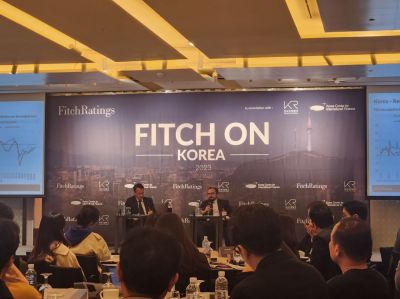
Global credit rating agency Fitch has assessed that South Korea's credit rating, rated at 'AA-', has the capacity to be maintained stably.
Jeremy Zook, Fitch's Asia-Pacific Sovereign Ratings Director, said at the '2023 Fitch on Korea' seminar held on the 20th at the Westin Chosun Hotel in Jung-gu, Seoul, “In the short term, I believe the Korean economy will face headwinds to growth, household debt levels are high, and interest rates have continued to rise, but with various buffers in place, it should be able to respond to structural challenges.”
He added, “There seems to be no possibility of a rating adjustment, either upward or downward, within the next two years,” and said, “To take positive rating actions, what needs to be watched is the reduction of geopolitical risks such as relations with North Korea and fiscal consolidation in the public sector.”
Regarding geopolitical risks, he mentioned that not only relations with North Korea but also the US-China conflict constitute a significant part. Zook said, “In the case of South Korea, China is one of the largest export markets, so it is deeply involved economically,” and added, “The South Korean government will likely need to balance relations between the US and China.”
He identified the biggest medium-term challenge for South Korea as responding to demographic changes caused by aging. Zook said, “In the long term, the burden of demographic changes will inevitably become significant in South Korea,” and “The challenge is how to achieve structural reforms and increase economic productivity.” He evaluated South Korea's current potential growth rate at about 2.1% and forecasted a gradual slowdown due to demographic issues.
He saw the possibility of household debt spreading as a structural risk as minimal. Zook said, “South Korea has one of the highest household debt levels among OECD countries, but it is likely to constrain consumption and growth rather than cause structural risks.” He regarded the risks arising domestically from real estate project financing (PF) and the Legoland incident as short-term and assessed their impact on financial stability as limited.
© The Asia Business Daily(www.asiae.co.kr). All rights reserved.

















