Response at the National Assembly Planning and Finance Committee's National Audit
Deputy Prime Minister and Minister of Economy and Finance Choo Kyung-ho said on the 20th, "Globally, inflation has not been brought under control, so there is a possibility that high interest rates will persist for a long time."
Deputy Prime Minister Choo made this remark in response to a question from Hong Seong-guk, a member of the Democratic Party of Korea, during the National Assembly's Planning and Finance Committee audit in the morning. Hong pointed out that "the U.S. Treasury bond yield has exceeded 5%, and the 30-year mortgage rate has surpassed 8%, indicating a very risky macroeconomic situation." On the 19th (local time), the 10-year U.S. Treasury bond yield exceeded 5%, reaching 5.001% annually.
Deputy Prime Minister Choo explained, "The recent rise in international oil prices is unusual, and the pace of global economic recovery is slow," adding, "The spread of the Middle East crisis is highly uncertain and could have a significant impact on our financial markets, foreign exchange, international oil prices, and the real economy, so we will respond closely through cooperation among relevant agencies."
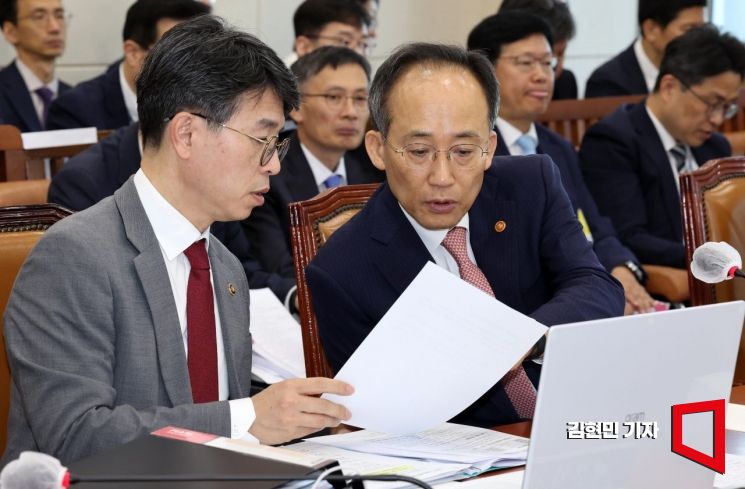 Deputy Prime Minister and Minister of Economy and Finance Choo Kyung-ho is talking with Second Vice Minister Kim Wan-seop during the audit of the Ministry of Economy and Finance held by the National Assembly's Planning and Finance Committee on the 20th. Photo by Hyunmin Kim kimhyun81@
Saemaeul Geumgo Management Innovation Plan to be Announced Within the Year
Deputy Prime Minister Choo mentioned that the Saemaeul Geumgo management innovation plan is expected to be released within the year. Earlier, Representative Hong questioned, "80% of the Saemaeul Geumgo board members are insiders, and it has experienced two bank runs this year," adding, "Given the current volatile interest rates and exchange rates, shouldn't the supervisory authority be transferred from the Ministry of the Interior and Safety to the Financial Services Commission?"
Deputy Prime Minister Choo responded, "Fundamentally, there are issues related to governance, so a management innovation committee has been formed," and "I think the innovation plan will be announced in the near future." He added, "Many problems at Saemaeul Geumgo have been resolved, and currently, there are no issues with soundness or liquidity," and "Rather than focusing on changing the supervisory system framework for Saemaeul Geumgo, discussions are prioritizing market stability."
Regarding concerns about South Korea's foreign exchange reserves being insufficient, he replied, "The International Monetary Fund (IMF) and international credit rating agencies recently assessed that our level of foreign exchange reserves is sufficient to respond to external shocks."
Concerns Over Local Governments' Financial Difficulties: "Efficiency in Spending Through Normal Unused Funds"
Deputy Prime Minister Choo addressed concerns about local governments' financial difficulties due to decreased tax revenues, stating, "There are usually unused portions, and utilizing these means there is no significant problem with fiscal spending, according to our review." This was in response to People Power Party lawmaker Bae Jun-young's remark that "there are difficulties due to reduced local education taxes and education finance grants caused by tax revenue shortages."
Deputy Prime Minister Choo explained, "Since local grants such as local education taxes decrease less due to the reduction in domestic taxes, the Ministry of the Interior and Safety and the Ministry of Education, along with the Ministry of Economy and Finance, are naturally in dialogue," adding, "We are reviewing and communicating with local governments and local education offices, and overall, there is no significant difficulty in execution."
Due to tax revenue shortfalls, local resources linked to national taxes will be cut by 23 trillion won, including 11.6 trillion won in local grants. The Ministry of Economy and Finance has announced plans to utilize 41 trillion won, including a 34 trillion won integrated fiscal stabilization fund (including education offices) and 7 trillion won in global surplus funds, to cover local governments' tax shortfalls.
"Tax Revenue Shortfall Due to Difficult Economic Conditions, Not Tax Reform"
Deputy Prime Minister Choo emphasized the fundamental tax revenue shortfall issue, saying, "It is not that less tax was collected due to tax reform, but rather because the economic situation is difficult."
Earlier, Kim Ju-young of the Democratic Party of Korea pointed out during the audit that "this year's corporate tax revenue shortfall reached 25.4 trillion won, while earned income tax increased by about 1.2 trillion won," and criticized the tax revenue shortfall as being due to tax reforms carried out under the Yoon Seok-yeol administration, stating, "Contrary to the government's intentions, corporations did not increase investments."
In response, Deputy Prime Minister Choo said, "The tax revenue was less than initially projected because the government collected less from the private sector, households, and businesses than it intended," adding, "It is not that tax rates were lowered and thus less tax was collected, but that the economic situation was difficult, resulting in lower tax revenue."
He further explained, "The decrease in corporate and income taxes was due to a much worse-than-expected decline in asset markets and corporate income, causing a tax revenue drop, while earned income tax naturally increased somewhat due to employment growth and slight wage increases." He added, "Last year, the ruling and opposition parties agreed on a tax reform plan that adjusted the tax base to reduce the tax burden in the lower income brackets of income tax."
Difficult Global Economic Situation... Temporary Fiscal Deficit Ratio Set at 3%
Deputy Prime Minister Choo responded to Democratic Party lawmaker Kim Tae-nyeon's criticism that "if additional supplementary budgets (추경) are not to be prepared, at least fiscal rules should be followed," explaining, "Because the economy is difficult, the fiscal deficit ratio for next year was temporarily set higher than 3%."
Kim pointed out, "The fiscal rules promoted by the Deputy Prime Minister aim to manage the deficit ratio of the management fiscal balance within 3%, but the next year's budget shows 3.9%," and criticized, "They are not even following the fiscal rules they set themselves."
Deputy Prime Minister Choo replied, "There was a significant tax revenue shortfall compared to the initial budget this year. Because the decrease occurred retrospectively, it also affects next year, increasing the national tax reduction rate to some extent," adding, "The fiscal deficit ratio in next year's budget is indeed 3.9%. It was prepared after much consideration."
He continued, "If the 3% fiscal deficit management standard had been maintained next year, the budget increase rate would have been negative compared to the original budget," and "Although the fiscal deficit ratio was temporarily set higher than 3% next year, we tightened our belts and prepared a budget that spends where necessary."
Agreement That Inheritance Tax Level is Excessive... Emphasis on Need for Reform
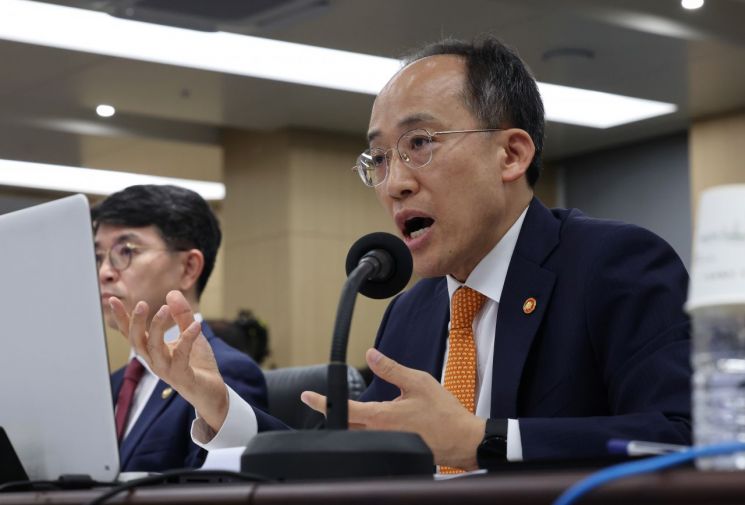
Regarding criticism that South Korea's inheritance tax level is excessive, Deputy Prime Minister Choo expressed agreement but emphasized that social discussion is still needed due to resistance stemming from wealth inheritance.
He made this remark in response to People Power Party lawmaker Joo Ho-young's comment that "South Korea's top inheritance tax rate is 60%, the highest in the world, and is excessive." Joo pointed out, "Many companies go abroad due to inheritance tax, and those companies collapse," adding, "We need to examine what problems arise when small and medium-sized enterprises undergo inheritance, and whether it is better to reduce taxes significantly to continue business management."
Deputy Prime Minister Choo said, "As discussions progress, a kind of resistance to wealth inheritance still exists in our society," adding, "I believe that both the National Assembly and social conditions are not yet ready to accept this issue," and "We need to start with social discussions and fundamentally reconsider the matter."
On Budget Cuts to Local Currency, "Decision for Local Governments"
Deputy Prime Minister Choo emphasized regarding budget cuts to local currency programs, "It is not appropriate for the state to operate subsidies in a cash handout style across the board."
Democratic Party lawmaker Seo Young-kyo criticized, "The Ministry of Economy and Finance cut the entire local currency budget again in next year's budget. Since local currency is a good system favored by the public, shouldn't it continue?"
Deputy Prime Minister Choo responded, "I oppose local currency. Whether local currency helps the region is a matter for local governments to decide," adding, "I oppose operating it with national finances, and if local governments judge it to be helpful, they can operate it themselves."
Regarding concerns about local tax shortfalls due to tax revenue shortages, he said, "National taxes are used to discuss and forecast fiscal issues; local taxes are not forecasted or used for fiscal management."
Tax Revenue Error: "Neglect of Duty Report" vs. "Not a Matter for Audit"
There was also a dispute over the government's tax revenue errors. Democratic Party lawmaker Yang Kyung-sook requested, "Regarding the large-scale tax revenue error issue, the Minister of Economy and Finance should conduct a special audit and report to the National Assembly."
Deputy Prime Minister Choo expressed his stance that there will be no special internal audit regarding this year's tax revenue errors. Earlier, the Ministry of Economy and Finance announced a revised estimate that this year's national tax revenue will be 341.4 trillion won, down 59.1 trillion won from the initial forecast.
Yang said, "We plan to file charges for neglect of duty, dereliction of duty, and accounting fraud against the officials responsible for this situation, including ministers and vice ministers," adding, "We will request a special audit from the Board of Audit and Inspection and even consider criminal investigation."
Deputy Prime Minister Choo responded, "When the Yoon Seok-yeol government took office last year, tax revenue forecasts were revised and turned out to be accurate," adding, "This year, due to various economic conditions, the tax revenue forecast was off, but to put it simply, it's one win and one loss compared to the Moon Jae-in government." He emphasized, "Because the global economic situation is rapidly changing, major advanced countries are also experiencing large errors," and "Although it doesn't mean Korea should have errors just because advanced countries do, it shows the difficulty in accurately forecasting tax revenue in the recent economic environment."
Review of Fuel Tax Reduction Effect
Meanwhile, Deputy Prime Minister Choo responded to Justice Party lawmaker Jang Hye-young's criticism that "the fuel tax reduction policy, which involved a huge budget, was not effective in lowering consumer prices," saying, "We will review whether the fuel tax reduction measure actually had an effect on consumers."
Deputy Prime Minister Choo said, "During the period of rapid oil price increases, as oil prices rise and gas station prices go up, the government believes it is its duty to lower distribution prices by reducing taxes first," adding, "We will check related research and analysis data to verify accuracy and see if anything was overlooked."
© The Asia Business Daily(www.asiae.co.kr). All rights reserved.
![User Who Sold Erroneously Deposited Bitcoins to Repay Debt and Fund Entertainment... What Did the Supreme Court Decide in 2021? [Legal Issue Check]](https://cwcontent.asiae.co.kr/asiaresize/183/2026020910431234020_1770601391.png)

















