Schengen Treaty Gradually Suspended
As armed conflict between Israel and the Palestinian militant group Hamas escalates and terrorist attacks occur in France and Belgium, fear of terrorism is growing, leading to a domino effect of strengthened border controls across Europe.
On the 19th (local time), according to AP News and others, Slovenia, an EU member state, decided to implement border checks starting from the 21st at its borders with neighboring Hungary and Croatia. The border checks are expected to be maintained for about two months until December. Following Italy's announcement the previous day that it would resume border controls with Slovenia for ten days starting on the 21st, Slovenia has taken similar measures against its neighboring countries.
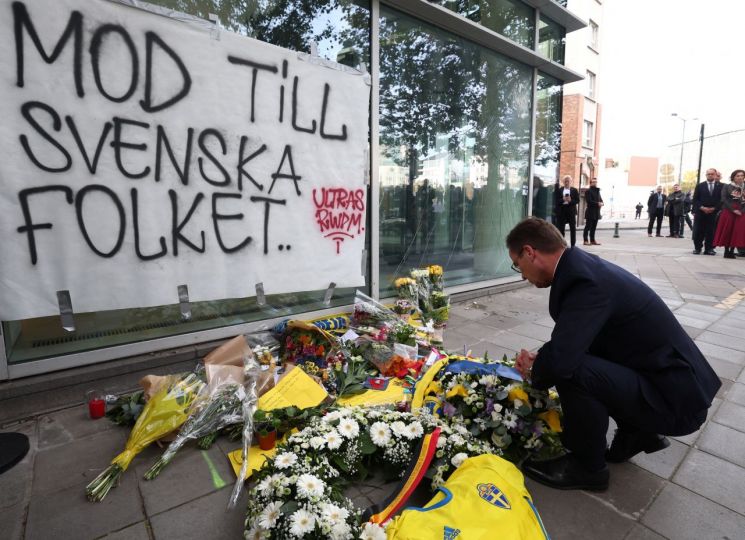 On the 18th (local time), the second day after a shooting terror attack occurred in downtown Brussels, Belgium, Swedish Prime Minister Ulf Kristersson visited the site to pay tribute to his countrymen who died in the shooting. On the 16th, a man fired at least eight shots, killing two Swedes and injuring one. The suspect, an illegal immigrant from Tunisia, targeted Swedish football fans. [Image source=Reuters Yonhap News]
This measure is based on the judgment that the Schengen Agreement, which eliminates passport checks and border controls among the 27 EU member states, has become a significant security loophole. The Schengen Agreement, signed in 1995, guarantees freedom of movement within the EU area but allows temporary border controls in cases of serious threats to public policy or internal security.
Foreign media reported that after the Israel-Palestine conflict, illegal immigrants from the Middle East and Asia have been roaming freely across the continent without internal border controls, increasing the risk of terrorist acts.
Bostjan Poklukar, Slovenia's Minister of the Interior, said, "The risk of terrorism in Europe has increased," adding, "We know what happened in France and Belgium." He emphasized, "We do not want radical individuals or those with terrorist intentions entering through the Western Balkan route." The Western Balkan route refers to the path where Middle Eastern refugees pass through the Balkan Peninsula to enter Hungary and Croatia before dispersing to various European countries.
The Italian government also cited the threat of terrorism as the reason for resuming border controls with Slovenia. In a statement released the previous day, the Italian government explained, "Concerns have grown that violent acts may occur within the region following Israel's attack by Hamas." Prime Minister Giorgia Meloni stated via X, "Suspension of the Schengen Agreement is inevitable." The Italian government plans to control the border with Slovenia for ten days initially and then review whether to extend the measures. It is estimated that 16,000 illegal immigrants entered Italy through the Slovenian border this year.
Since Hamas's surprise attack on the 7th and Israel's subsequent large-scale retaliation, terrorist acts have continued within Europe. On the 13th, the fifth day after the outbreak of the conflict, a teacher was killed by a 20-year-old Chechen-origin Islamic extremist wielding a knife at a high school in France.
On the 16th in Brussels, Belgium, two people were killed in a shooting by a man in his 40s from Tunisia who claimed affiliation with the Islamic State (IS), heightening fears of terrorism. This Tunisian man was found to have traveled across Europe, including Italy, Sweden, and Belgium, preparing and carrying out the shooting, which has increased calls for stronger border controls.
© The Asia Business Daily(www.asiae.co.kr). All rights reserved.
![User Who Sold Erroneously Deposited Bitcoins to Repay Debt and Fund Entertainment... What Did the Supreme Court Decide in 2021? [Legal Issue Check]](https://cwcontent.asiae.co.kr/asiaresize/183/2026020910431234020_1770601391.png)















