Bank of Korea Monetary Policy Board to Decide Policy Direction on 19th
Economic Uncertainty and US Monetary Policy Uncertainty Persist
Israel-Palestine War and Oil Price Variables
 Lee Chang-yong, Governor of the Bank of Korea, is striking the gavel at the Monetary Policy Committee meeting held on the 19th at the Bank of Korea in Jung-gu, Seoul. Photo by Joint Press Corps
Amid growing concerns over an economic downturn, the Bank of Korea (BOK) decided on the 19th at the Monetary Policy Committee meeting to keep the base interest rate steady at 3.5% per annum for the sixth consecutive time. Given the unexpected variable of the Israel-Palestine war and ongoing uncertainties in U.S. monetary policy, the BOK intends to maintain the current rate and observe future trends.
Although there are concerns about the widening interest rate gap between South Korea and the U.S., the significant uncertainty surrounding domestic economic recovery and the risk of increasing financial instability due to higher financial interest burdens have made it difficult to implement further rate hikes. Contrary to the government's 'low in the first half, high in the second half' economic outlook, the recovery strength of the Korean economy has not been clear since the fourth quarter, and the ongoing impact of China's economic slowdown has reduced the necessity for additional tightening.
The BOK's Monetary Policy Committee held a monetary policy direction meeting on the 19th and decided to keep the base interest rate at 3.50% per annum. In February, the committee halted the rate hike streak that had lasted for one and a half years since August 2021, and this marks the sixth consecutive freeze following the previous August. With the BOK maintaining the base rate, the interest rate gap with the U.S. (5.25?5.50%) remains at a record high upper limit of 2.00 percentage points.
Core Inflation Trending Downward... Future International Oil Prices a Variable
One reason the BOK decided to hold rates this month is that although inflation has recently rebounded, it has not significantly deviated from the BOK’s projections in the broader trend. The consumer price inflation rate in September (year-on-year) rose to 3.7%, but the core consumer price index, which reflects the effect of monetary policy, has remained at a similar level for three consecutive months, showing a downward trend. This indicates that the current base rate is sufficiently tight. However, the rapidly evolving Israel-Palestine war has intensified volatility in international oil prices, raising concerns that inflation could be stimulated again. Additionally, with U.S. monetary policy uncertainties not fully resolved and domestic economic instability continuing, the BOK’s stance is to keep the base rate steady and monitor future inflation trajectories.
Another reason cited for the freeze is the recent sharp increase in financial interest burdens, which raises concerns about worsening household debt defaults. Professor Seok Byung-hoon of Ewha Womans University’s Department of Economics stated, "Although household and corporate debt delinquency rates are still low, the delinquency rate for all loans is increasing very rapidly, which is problematic." He added, "The delinquency rate for real estate project financing (PF) is also rising quickly, so if the base rate is raised further, the burden of principal and interest repayments will increase, leading to higher delinquency rates and potentially exacerbating financial instability." This could simultaneously reduce consumption and investment, further deepening the economic downturn.
Recession-type Growth... Recovery of Growth Rate in the Second Half is Key
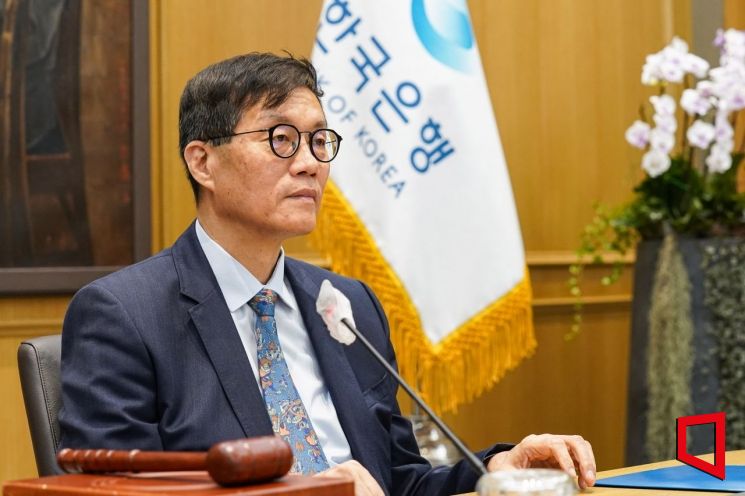 Lee Chang-yong, Governor of the Bank of Korea, is presiding over the Monetary Policy Committee plenary meeting held on the 19th at the Bank of Korea in Jung-gu, Seoul. Photo by Joint Press Corps
One of the important variables for the BOK’s future monetary policy operation is the economic trend. South Korea’s economic growth rate (quarter-on-quarter) contracted by 0.3% in the fourth quarter of last year, then slightly improved to 0.3% in the first quarter and 0.6% in the second quarter of this year. However, it is difficult to predict whether this trend will continue. The recent growth recovery is largely characterized as 'recession-type growth,' occurring amid declines in both exports and imports, with imports falling more sharply. There is no sign yet that this situation will be resolved. For a clear recovery in growth rate, exports and consumption need to revive, but recent geopolitical risks in the Middle East, rising international oil prices, and increasing household debt have heightened uncertainties.
In particular, the recent rise in international oil prices acts as a negative factor causing both inflation and economic recession simultaneously. Professor Seok pointed out, "If oil prices rise due to the Israel-Palestine war, production costs for companies increase, which partly gets passed on as higher prices, but it does not end with inflation. Companies reduce some production to minimize profit losses due to higher production costs." He added, "Since South Korea imports all its energy, an increase in energy import costs reduces net exports and worsens the trade balance, inevitably lowering the gross domestic product (GDP) growth rate."
Exports, a core component of the Korean economy, have declined year-on-year for 12 consecutive months through August this year, mainly in petroleum products and semiconductors. The BOK expects export recovery to begin in the second half of the year, but there are forecasts that the U.S. economy, which has been a major support for Korean exports instead of China, may slow down starting next year. Additionally, rising international oil prices could push import prices upward, so the rebound is expected to be limited.
Weak Consumption Amid High Interest Rates... Semiconductor Recovery Uncertain
Experts have also raised concerns that consumption weakness will continue after the second half of the year. Private consumption increased by 1.6% in the third quarter of last year but then declined by 0.5% in the fourth quarter, rose by 0.6% in the first quarter, and fell by 0.1% in the second quarter this year, showing a sluggish trend. Consequently, the contribution of domestic demand growth, considering consumption and investment, is -0.8%, dragging down overall growth. Given South Korea’s high household debt and over 4 million multiple debtors, it is difficult for households to increase consumption under the current high interest rate environment.
Uncertainty also remains in the semiconductor market, a key export sector for South Korea. Semiconductor exports last month recovered to $9.99 billion, the highest level this year, and the spot prices, a leading indicator for semiconductors, have bottomed out and are gradually rising. However, recent U.S. export restrictions on low-spec artificial intelligence (AI) chips to China have expanded risks surrounding the semiconductor market. Although the immediate impact of the U.S.’s tightened export controls on China may be limited for Korean industries, the possibility of market contraction cannot be ruled out.
On the positive side, China’s economy is gradually recovering, which is favorable for exports. The previous day, China’s National Bureau of Statistics announced that the third-quarter economic growth rate was 4.9% year-on-year, significantly exceeding market expectations of 4.4%. Other economic indicators released the same day, such as industrial production (4.5%), retail sales (5.5%), and unemployment rate (5.0%), also showed improvement. If China’s economy recovers, exports to China will increase, accelerating growth and potentially easing the BOK’s monetary policy burden.
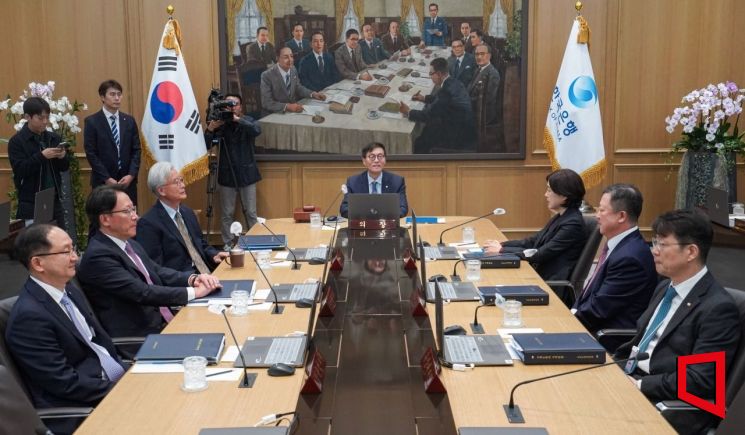 Lee Chang-yong, Governor of the Bank of Korea, is presiding over the Monetary Policy Committee plenary meeting held on the 19th at the Bank of Korea in Jung-gu, Seoul. Photo by Joint Press Corps
Rising International Oil Prices, Increasing Household Debt... Tightening Factors
The flow of international oil prices due to the war between Israel and the Palestinian armed group Hamas is also an important consideration for the BOK’s monetary policy. Following a hospital explosion in the Gaza Strip causing hundreds of deaths, concerns have grown that the Israel-Palestine conflict could escalate into a broader Middle East war, leading to a roughly 2% surge in international oil prices on the day. Brent crude, the international oil price benchmark, closed at $91.5 per barrel, and some forecasts continue to predict a breakthrough of $100 per barrel. If oil prices rise and increase inflationary pressure, the BOK will have no choice but to delay the timing of rate cuts.
The excessively high household debt ratio relative to GDP is also likely to exert upward pressure on the BOK’s base interest rate. Considering that household loans continue to increase even with the base rate at 3.5%, if the BOK officially signals a 'pivot' (policy shift), expectations for rising housing prices could grow again, causing household debt to surge. This would be a factor that lowers consumption and growth rates in the medium to long term.
While the BOK kept the base rate unchanged, it also left open the possibility of further hikes depending on the U.S. Federal Reserve’s monetary policy direction. However, if the economy performs worse than expected in the second half, it is unlikely that the BOK will proceed with actual rate hikes. Hyun-gi Chae, a researcher at Heungkuk Securities, said, "Considering the weak domestic economic recovery and financial market instability such as exchange rates, it seems difficult for the BOK to change its current monetary policy stance."
© The Asia Business Daily(www.asiae.co.kr). All rights reserved.
!["I'd Rather Live as a Glamorous Fake Than as a Poor Real Me"...A Grotesque Success Story Shaking the Korean Psyche [Slate]](https://cwcontent.asiae.co.kr/asiaresize/183/2026021902243444107_1771435474.jpg)


















