Two Companies' Shareholder Return Policies Almost Identical
Dividend Yield Expected at 5-6%... Higher Than Deposit Interest Rates
KT, which has been facing shareholder complaints due to sluggish stock performance, has decided to strengthen its shareholder return policy. Despite strong quarterly earnings, the stock price did not rise as expected, prompting the company to finally offer incentives. Hyundai Motor Company, which recently posted record quarterly earnings but has been suffering from stock undervaluation, also announced an enhancement of its shareholder return policy not long ago.
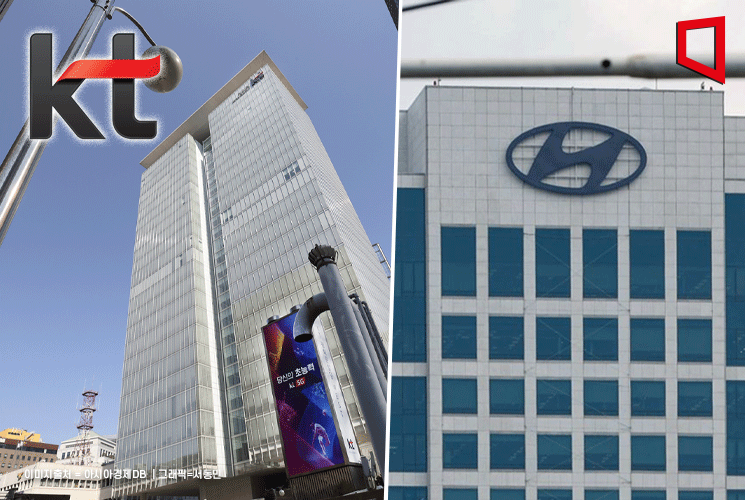
Examining KT's recently disclosed shareholder return policy on the 19th reveals that it is very similar to Hyundai Motor's dividend policy announced in the first quarter.
First, the dividend payout ratio. The dividend payout ratio is the value obtained by dividing the dividend amount for the year by the net income. KT has guaranteed a minimum dividend of 1,960 KRW until 2025 and decided to return 50% of net income to shareholders. This means KT plans to continue maintaining the high dividend payout ratio of around 50% that it has upheld since 2017.
Hyundai Motor also changed its policy from using 30-50% of free cash flow (FCF) for shareholder returns to paying dividends of at least 25% of net income (based on consolidated controlling shareholders). FCF refers to the cash remaining after deducting taxes, operating expenses, and other costs from the money a company earns. Since net income minus increases in fixed assets is used, dividends based on net income are more beneficial for shareholders.
Both companies also chose to repurchase and retire treasury shares. KT announced it would buy back and retire treasury shares, while Hyundai Motor stated it would retire 1% of issued shares (2,115,000 shares) over three years from its treasury stock. Reducing the number of shares increases the value of each share.
Additionally, both KT and Hyundai Motor decided to introduce quarterly dividends, leading to an assessment that the two companies have employed virtually all available means to implement shareholder-friendly policies.
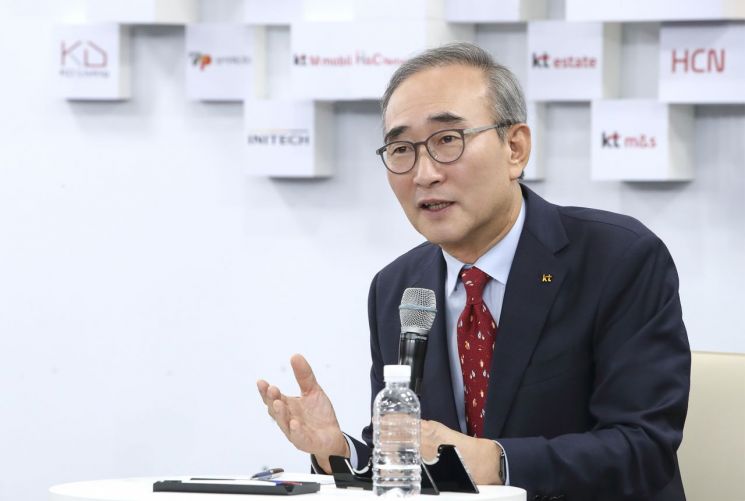
So, how much difference is there in the dividend yields of the two companies that have taken similar paths? Assuming KT’s minimum dividend of 1,960 KRW, the dividend yield based on the closing price on the 18th is about 5.8%. Securities firms forecast this year’s dividend per share (DPS) at 2,000 KRW, expecting to maintain last year’s dividend yield level of 6%.
Kim Hoe-jae, a researcher at Daishin Securities, said, "KT’s strong fundamentals and steady earnings improvement suggest that the DPS will be 2,000 KRW this year based on the 50% policy."
Hyundai Motor’s dividend yield, which was only 3.69% last year, is also expected to rise significantly this year. Yuanta Securities forecasts Hyundai Motor’s dividend yield to increase to 5.54% this year, while Hi Investment & Securities expects it to reach 5.9%.
If you invest 2 million KRW each in KT and Hyundai Motor (based on the closing price on the 18th), according to securities firms’ forecasts (KT 6%, Hyundai Motor 5.9%), KT (59 shares) would yield a dividend income of 116,091 KRW, and Hyundai Motor (10 shares) would yield 113,162 KRW. The difference is less than 3,000 KRW, making them roughly equivalent.
If the forecasts hold true, investing in these two companies could be more effective than opening a bank fixed deposit. According to the Bankers Association consumer portal, the deposit interest rates at the five major banks (KB Kookmin, Shinhan, Woori, Hana, and NH Nonghyup Bank) are all in the 4% range annually.
© The Asia Business Daily(www.asiae.co.kr). All rights reserved.


















