1 in 2 People Say "I Don't Feel Like an Adult"
Being an Adult Means 'Consideration,' Not 'Age'
Economic Uncertainty and More Lead to Rising 'Kidults'
As economic difficulties such as rising real estate prices and instability in the job market intensify, many people, especially younger age groups, are reported to feel fear about becoming adults.
According to a 'Perception Survey on Adults' conducted by market research specialist Embrain Trend Monitor on 1,000 men and women aged 19 to 59 nationwide, only 3 out of 10 respondents (28.4%) believed that one naturally becomes an adult over time regardless of experience and knowledge, and it was rare for people to define adulthood by a specific age.
In fact, 1 in 2 respondents (53.3%) evaluated themselves as not yet adults, and more than half (51.6%) agreed that they consider themselves "Eoreuni" (a blend of adult and child). This agreement was especially high among younger age groups. By age group, the rates were ▲20s (65.6%) ▲30s (63.6%) ▲40s (45.2%) ▲50s (32.0%), showing a clear attitude that even legal adults do not necessarily see themselves as adults and that age is not the standard for adulthood.
Furthermore, the criteria for adulthood were generally perceived not by age but by whether one is raising children (59.6%) or married (47.2%), and a considerable proportion also recognized those who have started working (44.7%) as adults.
The perception has shifted from the traditional view that one naturally becomes an adult with age to the idea that adulthood is achieved through various life stages, highlighting the importance of life experiences.
The 'Real Adult' Is Not One Who Achieves Social Success or Wealth, But One Who Is Intellectual and Gives Advice
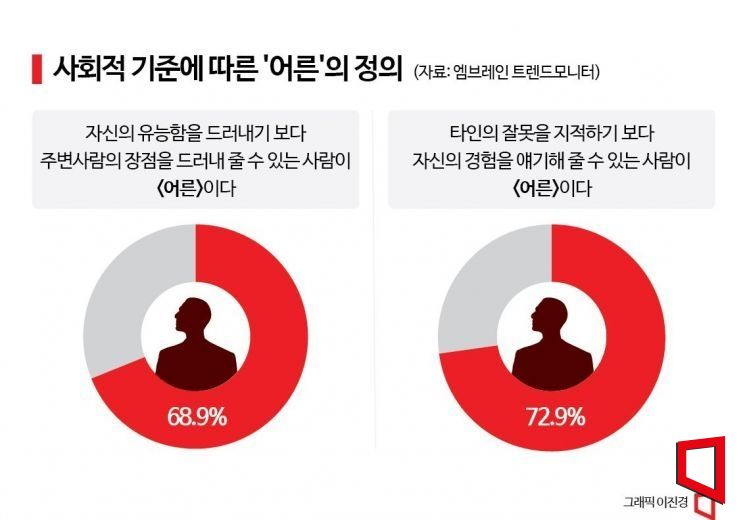
Regarding the definition of 'adult,' there was a high level of agreement across all ages that an adult is "a person with altruism and consideration."
Few people regarded those who are socially successful (15.4%) or economically wealthy (10.7%) as adults. Instead, there was a clear tendency to view adults as those who find the roles needed in situations without showing off themselves (73.1%) and who can highlight the strengths of those around them (68.9%).
Seven out of ten respondents (65.7%) considered "an adult as someone who can speak and act for the public good beyond their own interests," showing that adults with 'altruism' and 'consideration' are accepted as true adults.
Additionally, 72.9% of all respondents agreed that adults are people who share their own experiences rather than pointing out others' mistakes, confirming that sincere communication and advice-giving ability are also evaluated as criteria for adulthood.
Young Adults in Their 20s and 30s Feel Great Burden About Becoming Adults... "There Are No Adults Worth Respecting"
In response to the question "I feel afraid of becoming an adult," ▲20s (40.0%) ▲30s (36.4%) ▲40s (25.6%) ▲50s (17.6%) answered "yes." Contrary to expectations of a 'true adult,' younger age groups feel a significant burden about becoming adults.
This is a result of economic and social independence being difficult to achieve in Korean society, where it is not easy for the younger generation to become self-reliant. In fact, only 40.0% of people in their 20s live financially independent from their parents, and only 45.6% are psychologically independent from their parents, both low figures.
Also, when asked if "there are adults worth respecting in Korean society," ▲20s (38.4%) ▲30s (40.0%) ▲40s (40.0%) ▲50s (44.8%) answered "yes." This question did not receive majority positive agreement in any age group.
The fear of becoming adults among younger generations has led to the emergence of new terms like "Kidult." Kidult is a portmanteau of Kid and Adult, referring to adults who have the sensibilities and tastes of children.
Kidults reflect a psychological tendency to reject becoming adults due to growing future anxieties and harsh realities, seeking comfort in nostalgic childhood memories. Toy companies, facing a deteriorating market environment due to declining birth rates, have begun actively entering the Kidult market, which has emerged as a new 'blue ocean.'
Embrain stated, "The younger generation feels a strong absence of 'good adults' who offer sincere advice rather than criticism," and expressed concern that "the younger generation, having not seen good adults, may lose the opportunity to grow into good adults themselves."
© The Asia Business Daily(www.asiae.co.kr). All rights reserved.



















