Overcoming Independence Controversy at Launch Seems Difficult
One Member Is Chairman, Advisor Is Yoon's Close Associate
Lack of Internal Control Bodies Besides Ethics Committee Also a Weakness
There are mixed opinions about the launch of the Korea Economic Association (Korea Economicin Hyuphoe) Ethics Committee on the 17th. While the direction is considered appropriate, there are doubts about whether the committee can truly fulfill its role. Establishing a body to control the use of member companies' fees for business expenses to prevent entanglement with political circles is commendable, but concerns arise over whether the committee can maintain independence, given that Kim Chang-beom, the full-time vice president of Korea Economicin Hyuphoe, who is a former bureaucrat and considered a close aide to the chairman, is also a member.
Vice President Kim began his career as a diplomat after passing the foreign service exam. He served as the protocol secretary at the Blue House during the Lee Myung-bak administration. Until recently, he was the government representative responsible for the Pacific Island countries, assisting in the Busan Expo bid, a project the current government is vigorously pursuing.
Unlike companies that operate multiple internal control bodies such as boards of directors, audit committees, and compliance committees to create double or triple checks, Korea Economicin Hyuphoe operates only the Ethics Committee. This raises concerns that having a former bureaucrat as an internal member on the Ethics Committee could lead to controversies regarding its independence and effectiveness.
The Korea Economicin Hyuphoe Ethics Committee consists of five members: four external members and one internal member. The external members are Mok Young-jun, former Constitutional Court justice (chairman), Kim Hak-ja, president of the Korean Women Lawyers Association, Kim Hyo-sun, professor of business administration at Chung-Ang University and president of the Korean Society for Business Ethics, and Park Kwang-woo, professor at KAIST College of Business. The internal member is Vice President Kim. There are no businesspeople, politicians, labor unions, or civic groups represented. Two of the five members (40%) are women.
When the committee was launched at the end of August, Korea Economicin Hyuphoe announced the creation of an internal control body to eradicate collusion between politics and business. It was said that the Ethics Committee would focus strictly on 'eradicating collusion between politics and business' rather than on international trade or economic lobbying capabilities, and members would be selected accordingly. There were no reports of a candidate recommendation committee, such as one for outside directors, being formed to select the four external members. Rather, it is said that Chairman Ryu carefully oversaw the composition of the Ethics Committee members more than the secretariat (the working organization) did.
The selection process involved forming a pool of suitable candidates and then choosing four members. A Korea Economicin Hyuphoe official stated, "Rather than focusing on the members' areas of expertise or political ideology, we considered whether they could make important decisions free from external influences such as political circles." The official added, "Selecting two female members reflects the recent social awareness of gender issues."
The business community evaluated the external members as individuals with rich experience in ESG (Environmental, Social, and Governance) management. Chairman Mok previously served as the ethics committee chairman of Hanjin KAL, which was involved in the 'nut rage' and 'water cup power abuse' incidents, and as an ESG advisory committee chairman for CJ. Member Kim Hak-ja is associated with Mirae Asset Life Insurance, and Park Kwang-woo is an outside director at Maeil Dairies.
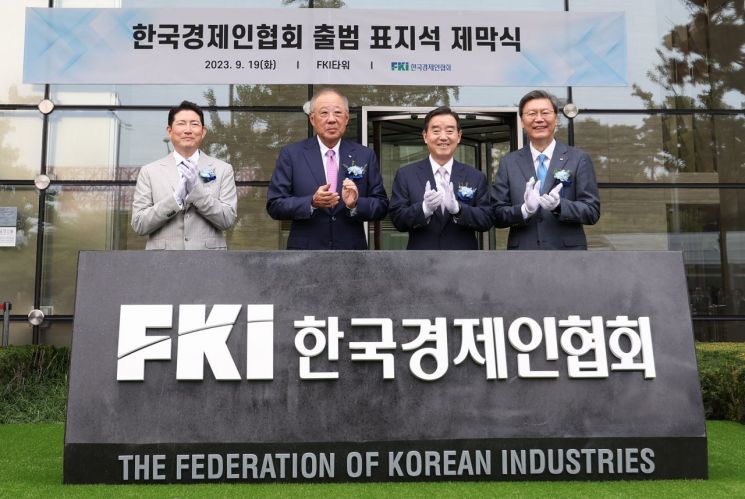 The Federation of Korean Industries (FKI) officially changed its name to the Korea Economic Association (KEA) and launched under the new name. On the morning of the 19th, at the cornerstone unveiling ceremony held at the FKI Tower in Yeongdeungpo-gu, Seoul, Ryu Jin, KEA chairman, and guests shouted "Fighting" and took a commemorative photo. From the left: Cho Hyun-joon, Chairman of Hyosung; Ryu Jin, KEA Chairman; Kim Yoon, Chairman of Samyang Holdings; Kim Chang-beom, KEA Executive Vice Chairman.
 [Photo by Yonhap News]
The issue is whether the ethics committee members can make independent judgments and act accordingly. Vice President Kim, an internal member, is on the committee, and behind him stands Advisor Kim Byung-jun. Advisor Kim, who has served as the standing election committee chairman for the People Power Party, is considered a close aide to President Yoon Seok-yeol. Although his acting chairman term ended at the end of August, he has not stepped down and continues to participate in Korea Economicin Hyuphoe activities as an advisor, raising questions about whether Korea Economicin Hyuphoe can maintain independence from political power.
Another weakness of the Ethics Committee is the absence of other monitoring or control bodies within Korea Economicin Hyuphoe to check the committee. Kim Kyung-jun, CEO of CEO Score, said, "Establishing an ethics committee to repel improper external requests and manage Korea Economicin Hyuphoe transparently is the right direction," adding, "To be recognized by member companies such as the top four conglomerates as having eradicated collusion between politics and business, the Ethics Committee's independence from the chairman and political circles must be strictly maintained."
In the future, the Ethics Committee is expected to discuss introducing a system requiring its approval when the secretariat spends 'a certain amount or more' of member companies' fees during project execution. If the business expenses are judged to have potential for collusion between politics and business, the committee plans to convene meetings at any time. The committee will also thoroughly verify the content of projects. For example, participation in programs like the K-Sports and Mir Foundation contributions will be restricted after the Ethics Committee verifies the project's validity, even if the amount is less than the 'certain amount.'
The Ethics Committee plans to hold its first regular meeting next month. Regular meetings will be held quarterly, but extraordinary meetings will be convened if issues requiring review arise. Meetings will proceed by passing agendas if a quorum (majority of members present) and majority approval are met. The members' term lasts until the Korea Economicin Hyuphoe regular general meeting in February 2025. Although the official term is two years, the six months from February to August when Kim Byung-jun served as acting chairman (now advisor) will be excluded.
© The Asia Business Daily(www.asiae.co.kr). All rights reserved.

















