President of the Medical Policy Research Institute of the Medical Association, MBC Interview
"Government's Medical School Quota Expansion Plan Unilateral... Trust Broken"
"Regional Doctor System? 1975 Taiwan Failure Precedent"
As the medical community has announced a tough response to the government's push to increase medical school quotas, Woo Bong-sik, head of the Medical Policy Research Institute of the Korean Medical Association, said on the 18th, "Every choice has a cost," adding, "The increased number of doctors may competitively engage in excessive medical treatment to survive."
In an interview with MBC Radio's 'Kim Jong-bae's Focus,' Woo said, "If the government insists on going ahead, there is no choice," but added, "The government may decide to significantly increase the number of doctors, but it will have to pay the price for that later."
Woo claimed, "We have held meetings up to the 14th session in the Medical Issues Consultative Body, but we have never specifically discussed the actual medical school quotas within it." This is an assertion that the government's recent announcement is unilateral.
Woo said, "Within the consultative body, since the essential medical fields are moving so urgently, we mainly focused on how to handle this and how to make these fields essential medical areas," adding, "The Medical-Doctor Agreement clearly states that unilateral enforcement of medical school quota notifications without discussion in the consultative body is a breach of trust."
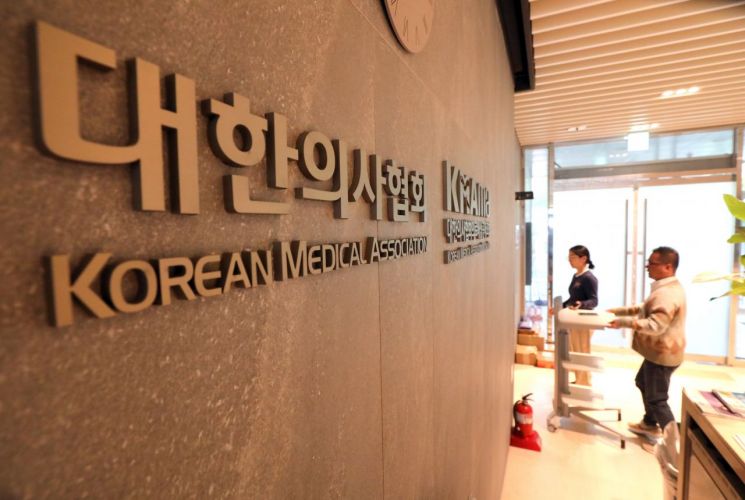 Photo taken on the morning of the 17th at the Korean Medical Association building in Yongsan-gu, Seoul. [Image source=Yonhap News]
Regarding the regional doctor system, which requires doctors to work in certain areas for a set period, Woo countered, "The idea sounds plausible, but our constitution guarantees freedom of residence and freedom to choose one's occupation," adding, "There is difficulty in including content that might be unconstitutional to that extent."
In 2020, the government promoted the establishment of public medical schools and a 'regional doctor system' that required doctors selected through a separate screening process to work mandatorily for a certain period in areas lacking hospitals and clinics, but it was derailed due to opposition from the medical community. Currently, the Democratic Party of Korea believes that the government should introduce the regional doctor system alongside the expansion of medical school quotas.
When the host pointed out, "Isn't it possible to have a system where the government provides scholarships or benefits but imposes conditions requiring work in this field for several years?" Woo replied, "In reality, it is not easy."
Woo explained, "In 1975, Taiwan established two medical schools and implemented such a system by providing scholarships, but later, students gradually stopped applying, and eventually, all students became self-funded," adding, "After some time, it was found that only 6% of the 6,557 graduates worked in vulnerable areas."
© The Asia Business Daily(www.asiae.co.kr). All rights reserved.
![User Who Sold Erroneously Deposited Bitcoins to Repay Debt and Fund Entertainment... What Did the Supreme Court Decide in 2021? [Legal Issue Check]](https://cwcontent.asiae.co.kr/asiaresize/183/2026020910431234020_1770601391.png)
















