International Recognition for Disaster and Climate Change Response Capability
26th Among 1,612 Cities Worldwide, 2nd in Korea
Ulsan City has been recognized by the international community as a city equipped with disaster response capabilities.
Ulsan City received the 'Resilience Hub' certification from the United Nations Office for Disaster Risk Reduction (UNDRR). It is the 26th city among 1,612 cities worldwide and the second in South Korea after Incheon.
Despite having the largest petrochemical complex in the country and a concentration of nuclear power plants, which pose geographical challenges for disaster response, Ulsan has been acknowledged by the UN as one of the safest cities.
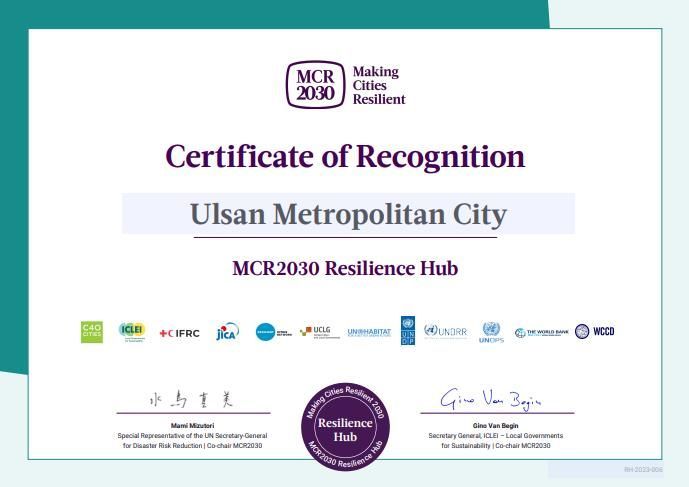
To obtain the UN Resilience Hub certification, Ulsan City has established and implemented various disaster safety policies.
Since joining the 'Making Cities Resilient 2030 (MCR2030)' international partnership to strengthen regional disaster resilience in June 2021, the city has strived to become a disaster-resilient city that meets international standards.
Additionally, to reduce disaster risks and enhance resilience, Ulsan has implemented several disaster safety policies, including the establishment of a region-specific disaster response system tailored to its nuclear power plants and industrial complexes, an information and communication technology (ICT) system, a comprehensive plan for earthquake prevention and industrial complex safety management, proactive flood and wind disaster prevention projects, and strengthened domestic and international cooperation (such as the Typhoon Committee, policy forums, and participation in international conferences), all of which have received high evaluations.
To commemorate this certification, Ulsan City plans to hold a certificate presentation and plaque ceremony at 3 p.m. on the 18th in the first-floor Citizen Hall of the City Council, followed by a disaster safety policy forum, and will conduct intensive promotion of the Resilience Hub certification for one month.
The event will be attended by Seo Jeong-wook, Deputy Mayor of Ulsan City; Andy McElroy, Head of the MCR2030 at the UN Office for Disaster Risk Reduction; Lee Seong-ryong, Vice Chairman of the Ulsan City Council; Lee Jong-seop, Chairman of the Administrative Safety Committee; and Kim Seong-ho, former Head of the Disaster Safety Headquarters at the Ministry of the Interior and Safety.
Kim Du-gyeom, Mayor of Ulsan City, stated, “Ulsan’s disaster response capability and resilience have become a model for cities worldwide,” adding, “The lives and safety of citizens are our top priority, and we will build a city resilient to climate change and disasters where people can live with peace of mind.”
The Resilience Hub certification is an international system that certifies cities as models in reducing disaster risks and restoring damage among 1,612 cities in 83 countries that have joined the United Nations’ 'Making Cities Resilient 2030 (MCR2030)' partnership to strengthen regional disaster resilience.
© The Asia Business Daily(www.asiae.co.kr). All rights reserved.

















