Cabbage Prices Up Over 20% Compared to a Month Ago
Price Increase Due to Poor Harvest and Rising Demand
Government Supplies Reserves to Stabilize Prices
Ample Supply of Autumn Cabbage Expected
Yoon Jeong-hee (57), a self-employed resident of Yangcheon-gu, Seoul, was startled by the soaring price of napa cabbage when she stopped by a large supermarket for early kimchi-making this year. Yoon said, "I had planned to make kimchi earlier than usual, but after seeing the price of napa cabbage, I changed my mind," adding, "Not only the napa cabbage but also the cost of kimchi ingredients has risen, so I think I will have to reduce the amount of kimchi to fit the budget, and thus postponed it."
As the kimchi-making season approaches, the prices of ingredients such as napa cabbage, red pepper powder, green onions, and garlic are rising one after another. However, the government plans to supply reserved stocks to temporarily alleviate the shortage of napa cabbage supply before the full-scale production of autumn napa cabbage, so the supply of autumn napa cabbage for kimchi this year is expected to be sufficient.
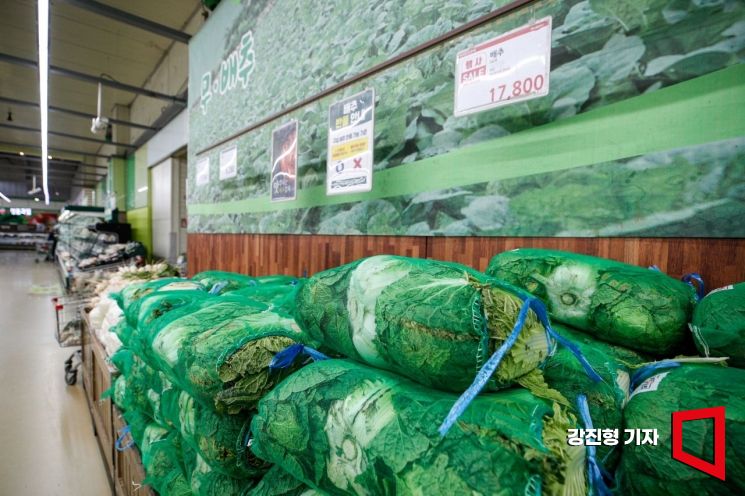 Ahead of the kimchi-making season, cabbages are displayed at the sales counter of Hanaro Mart Yangjae Branch in Seocho-gu, Seoul, where cabbage prices are rising on the 18th. Photo by Jinhyung Kang aymsdream@
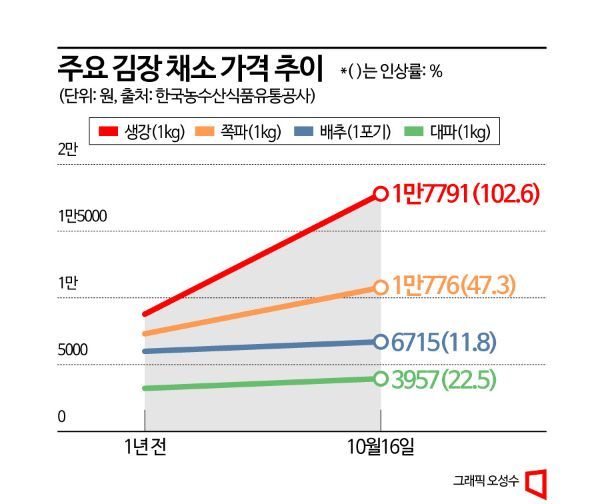
According to the Agricultural Products Distribution Information (KAMIS) of the Korea Agro-Fisheries & Food Trade Corporation (aT) on the 18th, the average retail price of one head of napa cabbage was 6,715 won as of the 16th. This is a 22.6% increase from a month ago (5,476 won) and significantly exceeds the average price (5,505 won). Besides napa cabbage, the price of red pepper powder also rose to 3,345 won per kg, up 34.7% compared to the average (2,482 won).
Prices of other ingredients used in kimchi seasoning have also jumped sharply. Domestic red pepper powder (1kg) was priced at 35,824 won, up 16.0% from a year ago (30,884 won), and during the same period, the prices of green onions (3,957 won) and scallions (10,776 won) increased by 22.5% and 47.3% per kg, respectively. Additionally, ginger (1kg) soared to 17,791 won, up 73.2% compared to the average (10,274 won), and prices of onions and peeled garlic also rose by 7.3% and 17.7% respectively compared to a month ago.
The price increase of salt, an essential ingredient for kimchi-making, is also significant. According to Statistics Korea, the inflation rate for salt last month was 17.3%, marking the highest level in one year and one month since August last year (20.9%). The rate of increase has grown from 6.5% in June, 7.2% in July, 12.4% in August, to even higher last month.
Recently, the rise in prices of napa cabbage and other vegetables has been greatly influenced by poor crop yields caused by abnormal weather conditions such as heavy rains and typhoons this summer. Furthermore, the sharp drop in temperature since this month has slowed the decline in vegetable prices, increasing uncertainty in agricultural product prices. On top of that, the issue of Japan’s Fukushima contaminated water discharge has caused a surge in demand for salt, further driving up prices.
As the cost of kimchi ingredients rises, demand for relatively cheaper imported kimchi is also increasing. According to export-import statistics from the Korea Customs Service, the cumulative domestic kimchi import volume in September this year was 212,495 tons, a 13.0% (24,494 tons) increase compared to the same period last year (188,001 tons). Although the import volume increased, the import value decreased from 124.5 million USD (approximately 168.3 billion won) to 122.15 million USD (approximately 165.2 billion won) during the same period, indicating that consumers are turning to cheaper Chinese imported kimchi.
With the onset of the full-scale kimchi-making season next month and the emergence of supply shortages, the government is also making an all-out effort to stabilize prices. Deputy Prime Minister and Minister of Economy and Finance Choo Kyung-ho held a ‘Ministerial Meeting on Stabilizing Living Costs’ yesterday and announced plans to supply a total of 2,200 tons of napa cabbage intensively over two weeks starting this week, and from the end of this month, to supply 1,000 tons of solar salt at a 50% discount. Additionally, the government plans to provide up to 30% discount support for 12 agricultural products with unstable prices, including napa cabbage, green onions, and apples. The government will also prepare for possible growth inhibition due to low temperatures by offering free technical guidance and support for pesticides and nutrients.
However, this price increase is attributed to a temporary shortage of napa cabbage supply before the full-scale production of autumn napa cabbage, and the supply of autumn napa cabbage for kimchi this year is expected to be sufficient. The Korea Rural Economic Institute forecasts that the autumn napa cabbage cultivation area this year will be about 13,856 hectares, 2.6% more than the average, indicating sufficient supply. Accordingly, the supply and demand of napa cabbage, which peaks next month during the kimchi-making season, is expected to be stable. Autumn napa cabbage is typically produced from mid-October to December, with about 70% of the total shipment concentrated in November.
© The Asia Business Daily(www.asiae.co.kr). All rights reserved.


















