Sudden Worsening of Liver Failure Leads to Consideration of Liver Transplant
Capillaria Discovered During Examination, Dramatic Improvement
Precautions Needed When Consuming Raw Liver and Dirt-Contaminated Vegetables
A patient in her 50s who nearly underwent a liver transplant due to liver abscess and liver failure was found to be infected with parasites.
 Anthelmintic. The photo is not directly related to the content of the article. [Image source=Yonhap News]
On the 16th, Professor Seong Pil-su (Gastroenterology), Clinical Instructor Jo Moon-young (Gastroenterology), and Professor Lee Seong-hak (Pathology) from the Catholic University Seoul St. Mary's Hospital research team announced that such a case was confirmed in the June online issue and the October print issue of Gastroenterology.
The 51-year-old female patient, who had no underlying diseases, suddenly experienced a high fever of 39 degrees Celsius and pain in the right abdomen. Tests revealed increased white blood cells and eosinophils along with a severe liver abscess, and she was initially hospitalized at another hospital.
Liver abscess is a condition where pus forms in the liver due to weakened immune function or bacterial invasion of the liver. However, this patient’s condition was so severe that she did not respond to liver abscess treatment, and liver failure progressed. Eventually, a liver transplant surgery was discussed, and she was transferred to Seoul St. Mary's Hospital earlier this year.
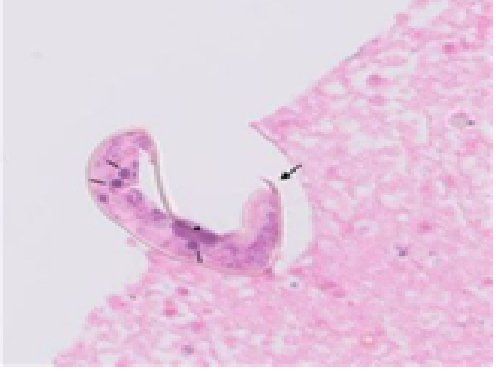
Then, when Professor Seong’s team performed a liver tissue biopsy, larvae of the parasite Capillaria were found in the patient’s liver.
After synthesizing various test results, the patient was diagnosed with liver abscess and hepatic artery pseudoaneurysm hemorrhage caused by Capillariasis. The hospital explained that the patient, who had been considered for a liver transplant, dramatically improved after taking antiparasitic medication (deworming drugs) and steroid treatment to reduce inflammation, and was discharged. They also reported that she has been living healthily without major sequelae since then.
Although there have been previous reports of liver abscess and complications caused by Capillariasis, cases where the parasite was clearly identified and severe inflammation and bleeding were dramatically improved, as in this case, are extremely rare worldwide.
Capillariasis is an infection caused by the roundworm that uses dogs as definitive hosts, and in humans, infection typically occurs through consumption of raw beef liver or similar products.
With the improvement of healthcare and hygiene standards in Korea, liver abscess caused by parasites has become rare recently. However, consuming raw meat, raw liver, or vegetables contaminated with soil can cause inflammatory reactions in the liver, lungs, eyes, brain, and other organs, potentially leading to serious outcomes.
Professor Seong said, "A blood test (antibody test) conducted to check for parasitic infection and latency in Koreans reported that up to 50% showed markers of Capillaria infection. If a person with a history of overseas travel or raw food consumption shows fever, abdominal pain, or abnormal liver function, it is necessary to consider parasitic infections such as Capillariasis and actively perform tests and treatment."
© The Asia Business Daily(www.asiae.co.kr). All rights reserved.


















