Leading the Consecutive Passage of Livelihood Bills in the National Assembly Plenary Session
Representative So Byeong-cheol of the National Assembly took the lead in advancing the "Road Traffic Act Amendment," which he originally proposed, as it was passed as an alternative in the plenary session of the National Assembly on the 6th. In addition, he actively engaged in addressing livelihood-related bills by mediating differences between committee members and government departments as the chair of the first subcommittee on legislation, leading the passage of the "Act on Disclosure of Personal Information of Suspects in Certain Serious Crimes" (commonly known as the Mugshot Act?referring to photographic records of criminals' appearances), which had been pending in the National Assembly and was jointly proposed by 17 lawmakers from both ruling and opposition parties.
The alternative version of the Road Traffic Act amendment, which includes the mandatory installation of alcohol ignition interlock devices proposed by Representative So in July 2021, applies to individuals caught driving under the influence two or more times within five years. To drive again, they must obtain a conditional driver's license.
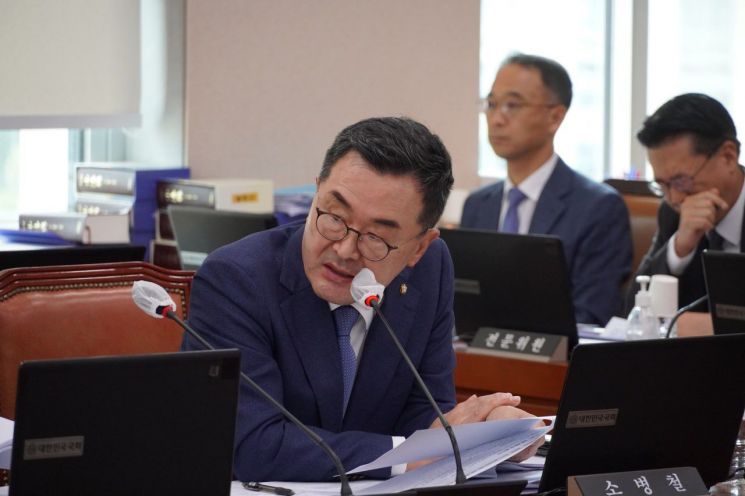 On the 21st of last month, Assemblyman So Byeong-cheol, who is participating in the bill review at the full meeting of the Legislation and Judiciary Committee [Photo by Suncheon City]
A conditional driver's license refers to a license that allows driving only vehicles equipped with an alcohol ignition interlock device. Installation is mandatory for the same period as the disqualification period for obtaining a driver's license due to DUI violations.
Specific penalties have been newly established for violations such as proxy testing, unregistered or uninstalled devices, unauthorized removal, or tampering. Violators may face severe punishments, including fines up to 30 million KRW or imprisonment for up to one year, depending on the case.
Representative So Byeong-cheol stated, "Under the amended Road Traffic Act, individuals issued a conditional driver's license must install the alcohol ignition interlock device, register it with the National Police Agency, and submit driving records at least twice a year to drive again." He added, "With strengthened regulations for preventing and deterring DUI, we expect to reduce tragic fatalities caused by drunk driving and the resulting social costs." The amendment will take effect one year after promulgation.
On the same day, the plenary session of the National Assembly also saw the passage of the "Act on Disclosure of Personal Information of Suspects in Certain Serious Crimes" (commonly called the "Mugshot Act"), jointly proposed by 17 lawmakers from both ruling and opposition parties.
The Mugshot Act concerns the disclosure of personal information of suspects or defendants involved in certain serious crimes that cause significant harm to the state, society, or individuals. The term "mugshot" originates from the slang for photographs taken of arrested criminals.
The serious crimes covered by the newly passed Mugshot Act include organized crime, murder and other violent crimes, sexual offenses, certain sexual crimes against children and adolescents, and some drug-related offenses.
The faces of suspects or defendants in these crimes will be disclosed as they appeared within 30 days before or after the disclosure decision, unless there are special circumstances. The act will take effect three months after promulgation.
Previously, the faces of suspects in serious crimes were disclosed based on decisions by the Personal Information Disclosure Review Committee. However, there were criticisms that the disclosed images often did not match the current appearance, undermining the purpose of the disclosure system. Additionally, the scope of disclosed information was limited, and it applied only to suspects before indictment, which was considered unreasonable.
The passage of the Mugshot Act was actively led by Representative So Byeong-cheol of the Democratic Party, who serves as the chair of the first subcommittee on legislation under the Legislation and Judiciary Committee.
Since 2022, 17 lawmakers from both ruling and opposition parties have jointly proposed 17 bills (with 197 co-sponsors, including duplicates) to address the shortcomings of the current personal information disclosure system, all of which had been pending in the National Assembly.
On the 12th of last month, Representative So, as the subcommittee chair, actively mediated differences among committee members and government departments during the first subcommittee meeting of the Legislation and Judiciary Committee.
It is said that due to growing public anxiety over violent crimes such as indiscriminate knife attacks, there was a strong desire to pass the bill as soon as possible.
Under Representative So's leadership, the 17 bills were passed as a committee alternative, approved by the full Legislation and Judiciary Committee on the 21st of last month, and subsequently passed in the plenary session on the 6th.
Representative So said, "According to public opinion polls, 98% agree that mugshots of heinous criminals should be disclosed to ensure the effectiveness of personal information disclosure." He added, "As chair of the first subcommittee on legislation, I made every effort to consolidate the 17 bills into one and pass it. I will do my best to guarantee the public's right to know and to create a safer society through crime prevention."
Suncheon = Asia Economy Honam Reporting Headquarters, Reporter Lee Yeon-gyeong hss79@asiae.co.kr
© The Asia Business Daily(www.asiae.co.kr). All rights reserved.
![A Woman Who Jumps Holding a Stolen Dior Bag... The Mind-Shaking, Bizarre Con of a "Human Knockoff" [Slate]](https://cwcontent.asiae.co.kr/asiaresize/183/2026021902243444107_1771435474.jpg)
















