1999 SKC's First Entry and Connection with Korean Companies
Emerging North American Production Hub for Electric Vehicles and Batteries
Investment Attraction through Site Selection Support and Tax Benefits
Linked to Regional Community Growth through Population Increase
The city with the longest direct flight distance from Korea is Atlanta, Georgia. It crosses the North Pacific and the U.S. mainland, covering a distance of 12,547 km and taking 13 hours and 50 minutes of flight time. Located in the southeastern United States, Georgia is nicknamed the "Peach State," literally meaning "the state of peaches." Known for its high-quality peaches, it has gained fame across the U.S. and become a symbol representing the state. Peaches are even depicted on the state's license plates.
We may soon have to call this distant and sweet peach homeland the "home ground of K-manufacturing." This is because our advanced industry companies in electric vehicles, batteries, solar power, and semiconductor materials are increasingly choosing Georgia as a strategic base for their North American operations.
Korean companies have invested $23 billion in Georgia over the past decade, amounting to about 32 trillion won. This accounts for nearly 15% of the total U.S. investment of $156 billion during the same period. The investment scale is expected to grow further. Hyundai Motor plans to invest $5.5 billion by 2025 in Georgia’s first dedicated electric vehicle manufacturing facility. Additionally, SK On and LG Energy Solution will invest 6.5 trillion won and 2.65 trillion won respectively, in joint battery manufacturing plants with Hyundai Motor.
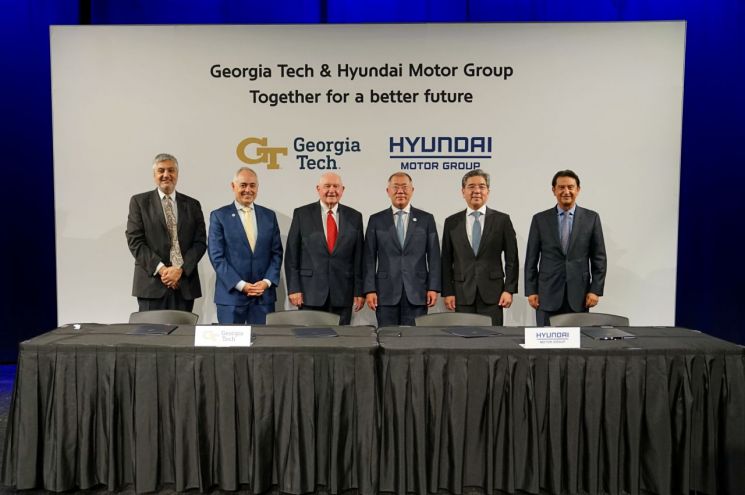 Chawki Abdalla, Senior Vice President for Research at Georgia Institute of Technology (from left), ?ngel Cabrera, President of Georgia Institute of Technology, Sonny Perdue, Chairman of the University System of Georgia, Chung Eui-sun, Chairman of Hyundai Motor Group, Jang Jae-hoon, President of Hyundai Motor Company, and Jos? Mu?oz, President of Hyundai Motor Company, are posing for a commemorative photo at the signing ceremony of the industry-academia cooperation memorandum of understanding. (Photo by Hyundai Motor Group)
The Peach Region Has Become the Heart of K-Manufacturing
The relationship between Georgia and Korean companies began in 1999 when SKC built a videotape factory (now a PET film factory) in Georgia. Currently, SKC is constructing a semiconductor glass substrate factory there, scheduled to start operations within the year. SKC and its semiconductor glass substrate subsidiary Absolics have invested $240 million (370 billion won) in Georgia.
Korean companies began to enter Georgia in earnest after Kia Motors established a plant in 2009. As local production of parts and materials became important, partner companies also entered the market, followed by large corporations such as Kumho Tire (2016) and Hyundai Mobis (2022) establishing production facilities locally. Currently, about 140 companies have entered the market.
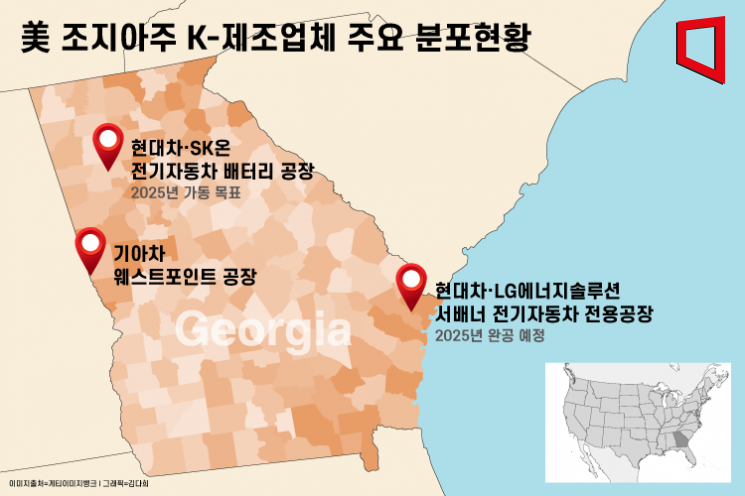
Recently, Georgia has emerged as a key hub for Korean electric vehicle and battery production in the U.S. Many leading Korean advanced industry companies have started to establish themselves in the southeastern U.S.
According to the Georgia state government’s recent report on electric vehicle industry development, facilities include SK On’s battery plant, electrolyte facilities by battery material company Enchem, battery module and energy storage system facilities by Deokyang Industry, and even investment in used battery recycling facilities by Sungil Hightech. Korean companies are building a supply chain covering electric vehicles and batteries. Georgia is expected to become a hub for the U.S. electric vehicle industry once the supply chain is completed.
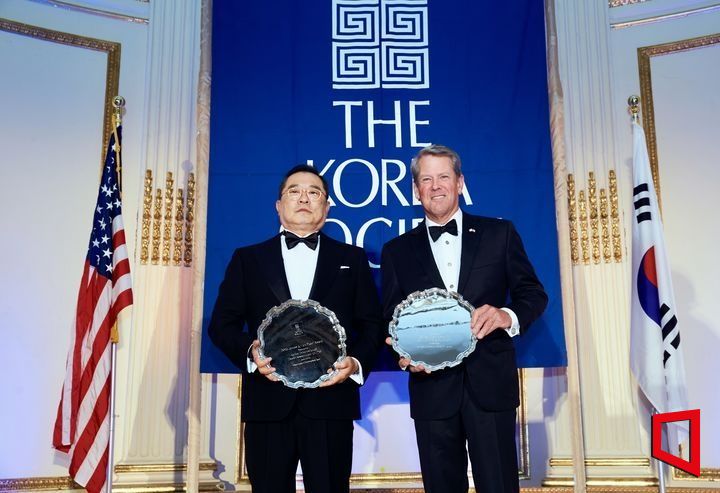 The Georgia Department of Economic Development received the Van Fleet Award jointly with the Korea International Trade Association at the Korea Society Annual Dinner held at the Plaza Hotel in New York on September 20 (local time). Brian Kemp, Governor of Georgia (right), and Koo Ja-yeol, Chairman of the Korea International Trade Association, pose for a commemorative photo after the award ceremony. (Photo by Korea International Trade Association)
On the 20th of last month (local time), Georgia received the "Ben Fleet Award" for its contribution to the development of Korea-U.S. relations. The Ben Fleet Award was established in 1995 to honor General James Van Fleet, who commanded the U.S. 8th Army during the Korean War and founded the Korea Society in 1957.
Brian Kemp, Governor of Georgia, said, "The strong and enduring partnership between Georgia and Korea is rooted in shared values of innovation and hard work," adding, "Especially over the past three years, Korean companies have created more jobs in Georgia than any other foreign direct investment."
Ranked #1 State for Business for 10 Consecutive Years
The Georgia Department of Economic Development (GDEcD) announced on the 3rd that Georgia has ranked first overall for 10 consecutive years since 2014 in the "Best State for Business" rankings by the U.S. investment location magazine Area Development. Georgia received the highest scores compared to other regions in seven categories, including business costs, competitive labor environment, workforce development programs, available real estate, and state government cooperation.
Thanks to these advantages, Georgia has become the third-largest region in the U.S. for Fortune 500 company headquarters, with 18 of these companies headquartered in Atlanta, the state capital.
This is due not only to the natural environment but also to various support programs provided by the state government. The Georgia government offers packages that include site selection, business permits, connections with infrastructure companies, and investment incentives.
 The Georgia Department of Economic Development (GDEcD) announced on the 3rd (local time) that it has achieved an unprecedented milestone by being ranked number one in the business sector for 10 consecutive years by Area Development magazine for excellence in business over the past decade. (Photo by Georgia Department of Economic Development)
A representative program is the "Georgia Ready for Accelerated Development (GRAD)" program, which helps with rapid site selection.
It provides information on industrial sites where factories or offices can be established according to the company’s desired schedule. Essential preliminary investigations such as environmental assessments and surveys of cultural assets and endangered species are conducted in advance, and sites are approved by an expert operations committee, eliminating the need for additional investigations. Georgia is divided into 12 grid-like zones, each with a regional project manager assigned to closely support incoming companies.
Tax incentives for attracting investment are also attractive. Job creation tax benefits include employment tax credits and superior employment tax credits. Additionally, companies using Georgia ports or developing new products and services in Georgia receive separate tax credits related to regional economic development.
Active corporate investment attraction has led to regional community growth. Over the past decade (2010?2020), Georgia’s average population growth rate was 10.6%, surpassing the U.S. average of 7.4%. As of 2021, 460,000 people moved to Georgia in the past five years. The average age is 36.4 years, which is 4% younger than the U.S. average. As the city becomes younger, the local community thrives. This serves as a good example for Korea, where population decline and regional extinction are ongoing issues.
© The Asia Business Daily(www.asiae.co.kr). All rights reserved.














