A Record High of 6 Expected This Year... PoscoDX, HLB, and L&F Begin Transfer
KOSDAQ Struggles with Short Selling... KOSPI Benefits from Large Passive Funds for Stock Price Management
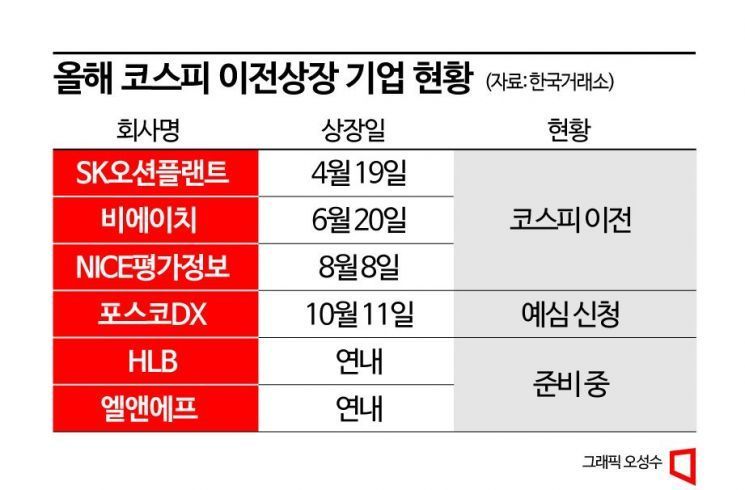
This year, the number of KOSDAQ companies transferring their listings to KOSPI is expected to reach an all-time high. As the scale of KOSDAQ-listed companies grows, there is a clear trend of moving to KOSPI for more stable stock price management. Unlike KOSDAQ, where individual investors account for about 70%, the KOSPI market, where institutional and foreign investors make up 50%, offers more favorable conditions for fundraising.
According to the Korea Exchange, companies that completed their transfer listing from KOSDAQ to KOSPI this year include SK Ocean Plant (April 19), BH (June 20), and NICE Information Service (August 8). Including Posco DX, which has applied for preliminary review for transfer listing, and HLB and L&F, which are preparing for transfer listing, the total is expected to rise to six.
A Korea Exchange official explained, "This year has the highest number of transfer listings ever," adding, "For stable stock price management, passive funds need to flow in, which is why companies are moving to KOSPI, where institutional and foreign investor proportions are high."
The reasons KOSDAQ companies cite for transfer listing ultimately boil down to 'stock price.' The main reasons for leaving KOSDAQ are 'short selling' and 'institutional funds.' HLB, which has completed the selection of its transfer listing underwriter, is a representative case. An HLB official stated, "From a corporate value perspective, we judged KOSPI to be better than KOSDAQ," explaining, "The proportion of short selling is quite large in KOSDAQ, which was burdensome, and it is somewhat disadvantageous to secure institutional funds."
HLB, preparing for transfer listing, ranks 7th in KOSDAQ market capitalization. Among biotech stocks, it is the second largest after Celltrion Healthcare. L&F ranks 5th in market capitalization. Currently, short selling is only allowed on KOSDAQ150 and KOSPI200 stocks. Both companies are considered to have large short selling volumes in KOSDAQ. If they transfer to KOSPI, short selling will be prohibited until they are included in KOSPI200.
The relative ease of securing institutional and foreign investment funds is another reason encouraging the transfer. As of October, individual investors account for 76.50% of KOSDAQ, while institutions and foreigners account for 5.50% and 17.17%, respectively. This is the lowest individual investor proportion since 1999. For sectors like biotech and batteries, securing funds from institutional investors is crucial, but realistically difficult in the KOSDAQ market.
The proportion of individual investors in KOSPI is 44.41%, less than half of all investors. Institutional and foreign investors account for 21.76% and 33.08%, respectively. Despite the possibility of short selling due to inclusion in KOSPI200, it is advantageous. The size of index-tracking funds is growing, which can increase the inflow of passive funds.
A securities firm official said, "Strong demands from shareholders also influenced the transfer listing," explaining, "As companies grow in size, the importance of stock price management increases, and from the perspective of companies that need to continuously attract investment funds, being listed on KOSPI is considered advantageous."
© The Asia Business Daily(www.asiae.co.kr). All rights reserved.
![Clutching a Stolen Dior Bag, Saying "I Hate Being Poor but Real"... The Grotesque Con of a "Human Knockoff" [Slate]](https://cwcontent.asiae.co.kr/asiaresize/183/2026021902243444107_1771435474.jpg)
















