Stock Prices of Korea Petroleum and Heungkuk Petroleum Soar 40-70% in Days
Domestic Petroleum Retailers and City Gas-Related Stocks Show Low Profit Volatility
Exercise Caution When Trading Amid Speculative Capital Driving Sharp Price Rises
In the domestic stock market, while leading stocks have disappeared, one-off theme stocks are gaining prominence. Since the Palestinian armed faction Hamas attacked Israel, the stock prices of petroleum retail and wholesale companies and city gas companies have surged in the domestic market. This is a result of renewed tensions in the "powder keg of the Middle East," raising global concerns over disruptions in crude oil supply. However, market experts advise carefully examining whether there are actual benefits from the Israel-Palestine war. This is because it is difficult to predict whether other countries in the Middle East will join the conflict, and there have been cases where listed companies with little connection to the war have been included as theme stocks and surged.
Petroleum Stocks Spotlighted During Wars
According to the Korea Exchange on the 12th, Heungkuk Petroleum's stock price rose about 70% over three trading days starting from the 10th. The stock price soared vertically after news broke on the 7th that Hamas had launched a surprise attack on Israel. Korea Petroleum's stock price also rose 36% over three days.
On the 9th (local time), the November delivery West Texas Intermediate (WTI) crude oil price on the New York Mercantile Exchange closed at $86.38 per barrel, up 4.34% from the previous trading day. This has raised concerns about a sharp rise in international oil prices, reminiscent of the October 1973 Yom Kippur War that triggered the "first oil shock."
Heungkuk Petroleum and Korea Petroleum have experienced high stock price volatility whenever geopolitical reasons caused international oil prices to fluctuate. The situation in February last year, when Heungkuk Petroleum's stock price surged, was not much different from the current one. In February last year, concerns about Russia invading Ukraine caused international oil prices to soar. Heungkuk Petroleum's stock price rose more than 50% in four days.
On February 25 last year, Heungkuk Petroleum's stock price once rose to 11,600 KRW during trading but fell to 4,620 KRW by July. The stock price dropped more than 60% in one year and five months. Although the Russia-Ukraine war that triggered the stock price rise continues, the stock price has declined. A financial investment industry official explained, "Even if international oil prices rise sharply, the profit structure for companies distributing petroleum products domestically does not increase significantly," adding, "Most theme stocks that do not lead to improved earnings return to their original levels."
Profit Fluctuations Are Not Large Even If International Oil Prices Rise
Founded in December 1966, Heungkuk Petroleum is a petroleum retail and wholesale company that purchases petroleum products such as gasoline, kerosene, and diesel from GS Caltex and sells them in the Daegu and Gyeongbuk regions. According to the Korea Petroleum Distribution Association, as of the end of last year, Daesung Industrial holds the highest market share in Daegu and Gyeongbuk at 28.3%, while Heungkuk Petroleum accounts for 12.3%.
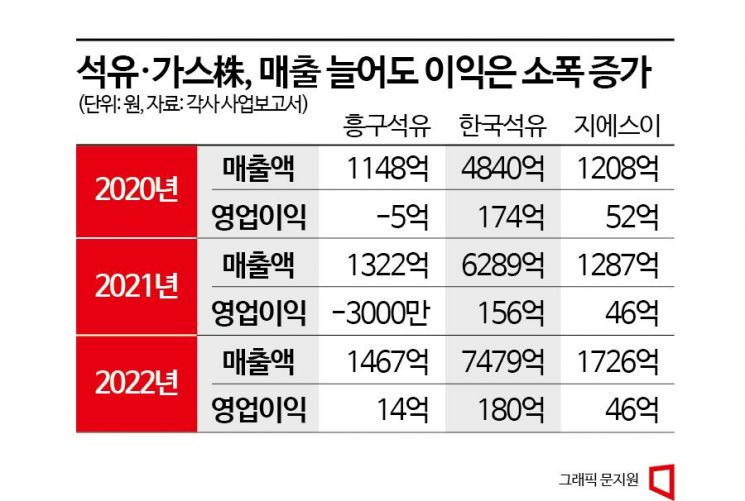
Heungkuk Petroleum's sales steadily increased from 114.8 billion KRW in 2020 to 132.2 billion KRW in 2021 and 146.7 billion KRW in 2022. With rising sales, it recorded an operating profit of 1.4 billion KRW last year, turning profitable. Last year's earnings per share were 183 KRW, up 90.6% from 96 KRW the previous year. Cash dividends also increased from 100 KRW per share to 150 KRW. The stock price closed at 7,160 KRW and 5,680 KRW at the end of 2021 and 2022, respectively.
The sales price changes according to crude oil prices and exchange rate fluctuations. However, when crude oil prices surge, purchase prices also rise, so the gross profit margin does not change significantly. If sales prices rise, demand may decrease. The gross profit margin was 5.2% in 2020, 4.9% in 2021, and 5.5% in 2022. Although Heungkuk Petroleum succeeded in turning profitable last year, it returned to a loss in the first half of this year. It recorded sales of 61.8 billion KRW and an operating loss of 400 million KRW in the first half. The gross profit margin fell to 4.7%.
Korea Petroleum consists of three business divisions: asphalt, synthetic resin, and chemical. Although the company name includes "Petroleum" like Heungkuk Petroleum, its business scope is relatively broader. On a consolidated basis, sales steadily increased from 484 billion KRW in 2020 to 628.9 billion KRW in 2021 and 747.9 billion KRW in 2022. Despite rising sales, operating profit remained flat, recording 17.4 billion KRW, 15.6 billion KRW, and 18 billion KRW during the same period. Asphalt and synthetic resin account for a large portion of sales. Since raw materials are supplied by domestic refiners and petrochemical companies, the company is affected by international oil prices.
When Heungkuk Petroleum and Korea Petroleum surged on the 10th, the stock price of city gas supplier GSE also rose 27%. Expectations of rising natural gas prices stimulated investor sentiment. GSE supplies natural gas received from Korea Gas Corporation to Jinju, Sacheon, Hamyang, Geochang, Hadong, Sancheong, and Hapcheon in Gyeongsangnam-do. It profits from the difference between the supply price and the selling price to households. Wholesale rates are approved by the central government, and retail rates by local governments. If natural gas prices rise, sales volume may increase, but the impact on profit size is not significant. Sales volume has a greater effect on profit size than sales price. GSE has achieved operating profits of around 5 billion KRW annually from 2020 to 2022. Profits increase as the city gas supply rate in the serviced areas rises.
Naminsik, a researcher at SK Securities, said, "After the Russia-Ukraine war early last year, natural gas prices rose but have been falling since early this year," adding, "There was almost no improvement in the performance of city gas-related stocks last year." Hwang Seong-hyun, a researcher at Eugene Investment & Securities, analyzed, "City gas companies have regional closed markets and low industry growth rates, so annual operating profit changes are not significant," adding, "Due to limited profit growth, cash dividends are paid at the same scale." He added, "Since there are no industrial changes, they are stable and can be expected to pay dividends of the same scale, making them similar to bonds in many ways."
This shows that theme stock prices fluctuated according to interest regardless of profit size. When attention was focused, stock prices surged, but when the situation calmed down, prices returned to pre-surge levels. A financial investment industry official explained, "In the case of theme stocks, stock prices often experience rapid ups and downs in a short period despite little change in performance," adding, "It is necessary to carefully consider whether to trade when speculative funds drive stock prices up."
© The Asia Business Daily(www.asiae.co.kr). All rights reserved.

















