Chinese Tourists Visiting Korea Boost Myeongdong Area Sales by 800%
In Economic Downturn, 'High-End' Duty-Free Shops < 'Mid-Range' Olive Young
"IPO Valued at 5 Trillion Won... Key to Securing Succession Funds"
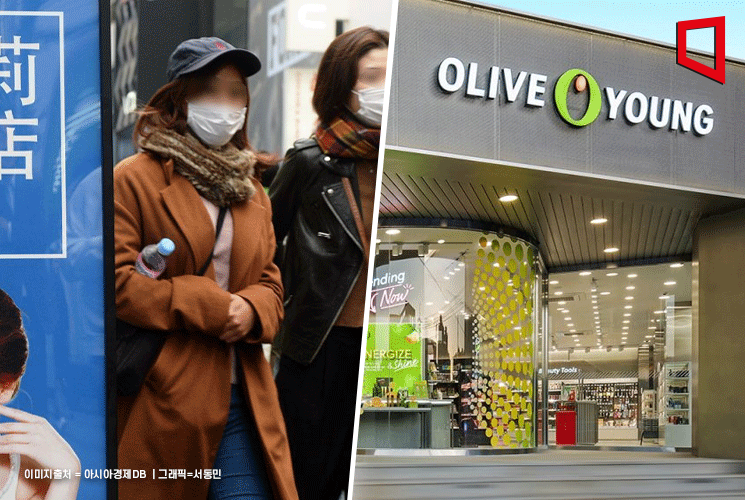
CJ Olive Young is establishing itself as the premier destination for 'K-beauty' shopping. Riding the wave of the K-content boom, interest in K-beauty has surged, and CJ Olive Young is absorbing most of the shopping demand from foreigners. Chinese group tourists (Youke) are also choosing CJ Olive Young, which offers a wide range of mid-priced products, over duty-free shops filled with high-end cosmetics. CJ Olive Young is a key part of CJ Group's succession plan. It is expected to secure succession funds through an initial public offering (IPO), and as the company grows larger, the CJ owner family's pockets are likely to become even fuller.
Can sales surpass 3 trillion won riding on foreign tourists?
According to CJ Olive Young on the 13th, from August 10, when visits by Youke to Korea were permitted, until the end of last month, sales to Chinese customers at six stores located in Myeongdong, Jung-gu, Seoul, increased by 882% compared to the same period last year, and total foreign sales grew by 500%. The influx of individual tourists alongside Youke visits caused explosive sales growth. In contrast, duty-free shops saw a decline in Chinese sales due to reduced sales from daigou (personal shoppers) following the normalization of customer referral fees, but CJ Olive Young's situation is quite different.
The reason CJ Olive Young is more popular among Chinese tourists is that they can purchase a variety of products at lower prices. In a weak consumer economy, it is benefiting from the 'lipstick effect,' where low-priced beauty products sell well. Looking at the Chinese economic situation, consumption capacity has decreased due to a downturn in the real estate market. A CJ Olive Young official explained, "In the first half of the year, there were many customers from Japan and North America, but recently, the influx of Chinese customers has become prominent," adding, "It seems to be absorbing existing duty-free demand due to the consumption downturn."
Having solidified its dominance in the domestic health and beauty (H&B) market, CJ Olive Young is expected to exceed 3 trillion won in annual sales with the addition of foreign sales. It earned 1.7966 trillion won in the first half alone, which is 65% of last year's sales (2.78 trillion won). Since achieving '2 trillion won in annual sales' in 2021, joining the '3 trillion club' within about two years is considered certain.

CJ Olive Young as the 'Succession Funding Source'
As CJ Olive Young grows larger, CJ Group's succession process is expected to gain momentum. Under the principle of eldest son succession, Lee Sun-ho, the eldest son, is leading new business initiatives as the head of the Food Growth Promotion Office at CJ CheilJedang.
The completion of the succession process involves expanding control through securing shares. According to the semi-annual report, CJ Group's holding company CJ is owned nearly half by Chairman Lee Jae-hyun with 42%, followed by management leader Lee Sun-ho (3.2%), his sister Lee Kyung-hoo, CJ ENM management leader (1.47%), the Nanum Foundation (0.56%), and the Cultural Foundation (0.43%).
To secure holding company shares, it is common to utilize unlisted companies with significant shareholdings. This is why CJ Olive Young is considered a leverage point for succession. Currently, management leader Lee holds 11.04% of CJ Olive Young shares. The largest shareholder is CJ (51.5%), followed by financial investor Korea F&B Holdings (22.56%), Lee Kyung-hoo (4.21%), and Lee Jae-hwan, former CJ vice chairman and brother of Chairman Lee (4.64%).
There are two scenarios for utilizing CJ Olive Young shares. One is to purchase shares directly through selling existing shares (secondary sale) during CJ Olive Young's listing or to receive a gift of shares from the chairman and pay gift tax. When CJ Olive Young prepared for its domestic stock market debut through a pre-IPO in 2020, securities firms valued the company at about 2 trillion won. Quarterly sales per store were around 200 million won. Three years later, CJ Olive Young's sales per store are breaking records every quarter. In the second quarter of this year, sales per store reached 550 million won, expected to approach 2 billion won annually.
Kim Soo-hyun, a researcher at DS Investment & Securities, said, "The effects of new store openings and increased sales per store at CJ Olive Young will peak in the second half of 2024," adding, "All changes needed for the IPO and succession are expected to be completed by then, and the corporate value could be valued between 4 trillion and up to 5 trillion won."
There is also a merger scenario with CJ. This would involve a comprehensive stock swap between CJ Olive Young and CJ. For example, assuming CJ Group's market capitalization (based on the closing price on the 12th of 80,200 won) is 2.4 trillion won and CJ Olive Young's value is calculated at 5 trillion won, the value of management leader Lee's 11% stake would be about 550 billion won. Simply put, this could secure an additional 23% stake in CJ for Lee. Combined with existing shares, Lee could hold over 25% of CJ's common stock.

CJ Group for Management Leader Lee Sun-ho
However, CJ Olive Young's listing is not viewed entirely positively, as it is seen as a means to secure succession funds for the owner family. CJ Group has long engaged in attaching and detaching unlisted subsidiaries to enable management leader Lee to secure CJ shares through share exchanges. The Olive Young IPO is also evaluated as focusing more on short-term private gains for Lee through secondary sales rather than raising investment funds for the company.
CJ's recent move to increase dividends is also essentially aimed at succession. While dividend increases are typically positive shareholder return policies, CJ faces criticism that this policy is intended to secure succession funds. An activist fund official noted, "CJ has not shown much interest in enhancing shareholder value and has been a company with a reputation for undervaluation, which has been widely discussed in the industry."
At the end of last year, CJ paid dividends of 2,500 won per common share, 2,550 won per preferred share, and 2,500 won per new preferred share (CJ4W). Although CJ had been cynical about dividend policies, it paid dividends last year despite a 15% decrease in net profit compared to the previous year. Accordingly, management leader Lee, who holds 3% of CJ common shares and 29% of new preferred shares, is estimated to have received about 5.4 billion won in dividends last year alone. Although new preferred shares currently have no voting rights, they can be converted to common shares after 10 years, which is positive for securing cash and strengthening control in the future.
Kim Kwang-jung, a lawyer at Han-gyeol Law Firm, said, "In an IPO, new shares issued benefit the company, while secondary sales benefit the shareholders holding the shares," adding, "If a company that needs to raise funds gives up new share issuance and increases the proportion of secondary sales, there must be clear grounds that this action benefits the company more."
© The Asia Business Daily(www.asiae.co.kr). All rights reserved.
!["I'd Rather Live as a Glamorous Fake Than as a Poor Real Me"...A Grotesque Success Story Shaking the Korean Psyche [Slate]](https://cwcontent.asiae.co.kr/asiaresize/183/2026021902243444107_1771435474.jpg)


















