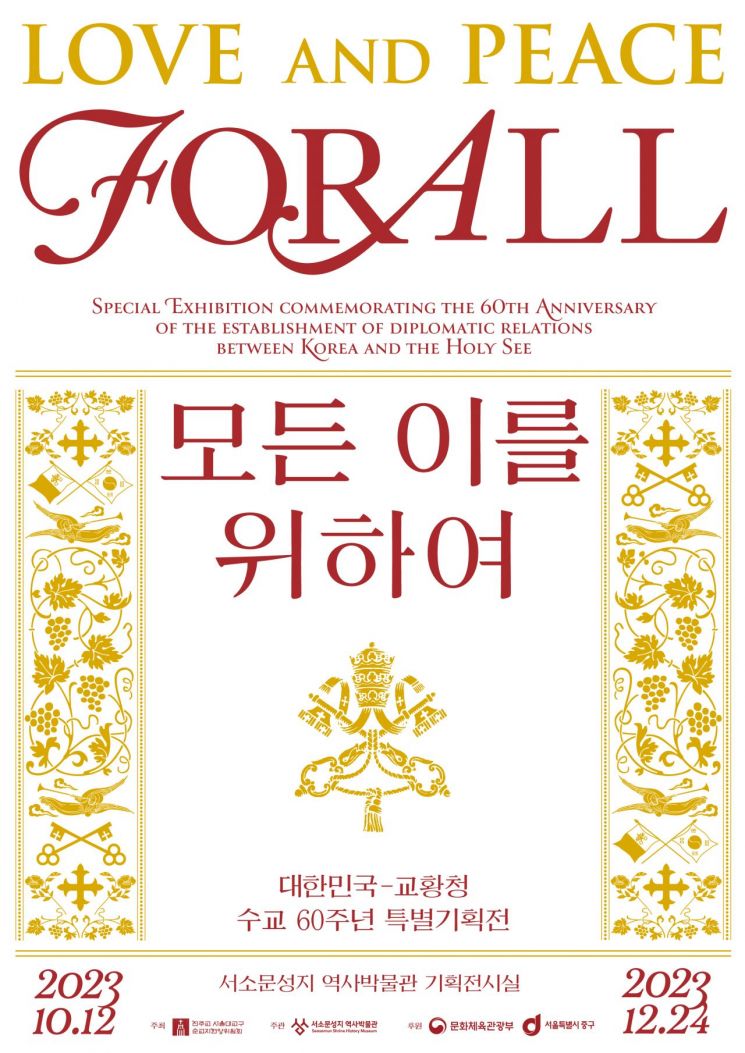
The Seosomun Shrine History Museum (Director Won Jong-hyun) will hold a special exhibition commemorating the 60th anniversary of diplomatic relations between the Republic of Korea and the Holy See, titled "For All," from the 12th of this month until December 24th in the special exhibition hall. This exhibition was planned to commemorate the 60th anniversary of diplomatic ties between the two countries, to review the history of their relationship, and to provide an opportunity to reflect on the common good that should be pursued "for all."
The exhibition features newly discovered documents from the Holy See that have not been previously open to the public, allowing visitors to closely examine the records contained within. Artifacts and materials are exhibited with cooperation from domestic and international institutions including the Secretariat of State's Historical Archives of the Holy See, the Congregation for the Evangelization of Peoples' Historical Archives, the Paris Foreign Missions Society, the Maryknoll Fathers and Brothers, and the Moon Seok-jang Memorial Social Enterprise. Notably, visitors can see the first Republic of Korea diplomatic passport held by Jang Myeon, who was dispatched as the chief representative to the 3rd United Nations General Assembly in 1948, the voting results of the UN General Assembly in December 1948 regarding the recognition of the Republic of Korea, and Jang Myeon's notebook.
The exhibition is divided into four sections. Part 1, "The World of the Holy See," introduces the unique characteristics of the Holy See. Part 2, "Connected by Letters: Joseon and the Holy See," presents the history of the relationship between the Korean Catholic Church and the Holy See, beginning with letters and the establishment of the Apostolic Vicariate of Joseon in 1831, marking Joseon's emergence as a member of the universal church.
Part 3, "Continuous Communication: Korea and the Holy See during the Japanese Colonial Period," examines the relationship between the two countries, which maintained constant communication despite the dark historical period of Japanese occupation. Part 4, "The Republic of Korea and the Holy See after Liberation," serves as the central space of the exhibition, exploring the relationship through artifacts that show the Holy See's interest in Korea during the chaotic situation on the Korean Peninsula after liberation. In particular, it highlights the Holy See's attention and support for the Republic of Korea government established in 1948 as it took its place in the international community.
This exhibition includes a Q&A format in the exhibition leaflet to help visitors better immerse themselves by explaining church terminology and various background stories unfamiliar to the general public. The exhibition and experiential programs are free of charge. This exhibition is sponsored by the Ministry of Culture, Sports and Tourism and Jung-gu, Seoul.
© The Asia Business Daily(www.asiae.co.kr). All rights reserved.

















