KT SAT announced on the 11th that it shared the achievements prepared to provide 'Multi-orbit Satellite Services' at the APSCC 2023 Conference of the Asia-Pacific Satellite Communications Council.
The APSCC 2023 Conference, held over three days starting from the 10th, is the largest satellite space international conference in Asia. This event, held in Malaysia, was attended by numerous global satellite companies, research institutions, and university students. KT SAT sought opportunities to discover joint projects in areas such as the Southeast Asia USO (Universal Service Obligation) project and large-capacity HTS (High Throughput Satellite) satellite projects through meetings with various operators in the satellite and space sectors.
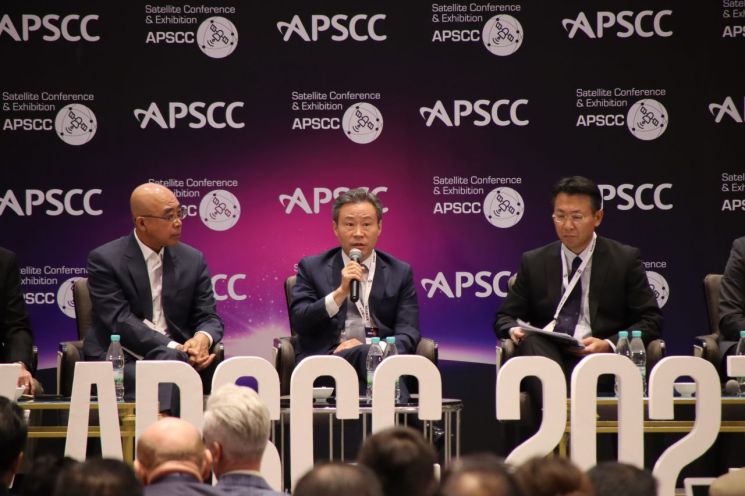 Song Kyung-min, CEO of KT SAT (center), is sharing the achievements in preparing multi-orbit satellite services at the APSCC 2023 event. [Photo by KT SAT]
On the first day of the event, the 10th, Song Kyung-min, CEO of KT SAT, participated in a panel discussion on the topic of 'Survival Strategies of Regional Satellite Operators in a Rapidly Changing Market Environment Due to the Introduction of Non-Geostationary Orbit Services.' He held discussions with executives from major satellite companies such as Thaicom, JSAT, and APT Satellite. The panelists discussed business strategy measures for regional satellite operators in response to the recent full-scale market entry of low Earth orbit satellite services.
CEO Song stated, “KT SAT is preparing multi-orbit services as a new business strategy to face the space competition era,” adding, “Currently, we have secured capacity for geostationary, medium Earth orbit, and low Earth orbit satellites, establishing the entire service foundation, and we plan to continue pursuing additional cooperation.”
Recently, there has been growing interest in non-geostationary orbit satellites, which refer to low Earth orbit and medium Earth orbit satellites, across the satellite market. However, in the case of low Earth orbit, thousands to tens of thousands of satellites must be launched to achieve global coverage, making it difficult to secure business profitability. To address this challenge, KT SAT has prepared to promote business through partnerships with global low Earth orbit satellite operators and has secured infrastructure for all orbits this year. KT SAT plans to introduce low Earth orbit services in addition to the existing geostationary orbit from next year and apply medium Earth orbit services in 2027.
CEO Song said, “The reason KT SAT can survive amid fierce market competition is because it possesses unique service capabilities and customer experience,” and added, “KT SAT will maximize customer satisfaction with differentiated service value based on three key capabilities important in the new space era: multi-orbit (GEO, MEO, LEO) satellite infrastructure, managed services, and multi-network integration technology (hybrid solutions).”
© The Asia Business Daily(www.asiae.co.kr). All rights reserved.

















