Average National Birth Cost in 2002: 3.07 Million KRW, Seoul: 4.10 Million KRW
Limited Impact Despite Increased Childbirth Support Funds
Rising Birth Costs Due to Low Birthrate Effects
The cost of postpartum care centers is soaring. Amid an unprecedented low birthrate era, there has been a surge in the closure of postpartum care centers, and there are criticisms that the government's postpartum care cost support policy is fueling price increases.
According to the Ministry of Health and Welfare on the 10th, the national average usage fee for postpartum care centers (based on 2 weeks in a standard room) rose 27.4% from 2.41 million KRW in 2017 to 3.07 million KRW in 2022. In Seoul, the fee jumped by nearly 1 million KRW from 3.17 million KRW in 2017 to 4.10 million KRW last year.
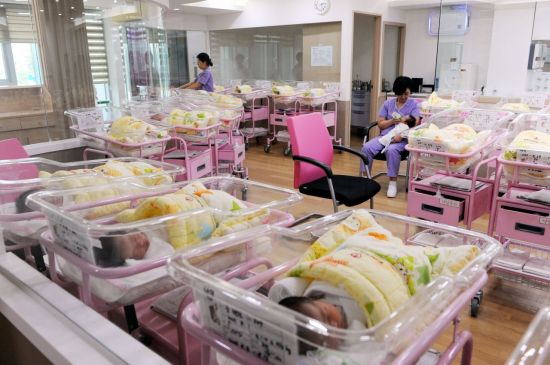 A scene of a postpartum care center
Also, the price gap between public postpartum care centers operated by local governments and private postpartum care centers has been widening every year. The gap, which was 1.61 times in 2019, increased to 1.64 times in 2020, 1.68 times in 2021, 1.82 times last year, and 1.90 times in the first half of this year. The average 2-week fee for private postpartum care centers in the first half of this year was 3.26 million KRW, while public postpartum care centers charged about 1.71 million KRW.
The problem is that relatively affordable public postpartum care centers number only 18 nationwide (3.8% of the total 469 centers). As a result, there are criticisms that the number of pregnant women benefiting from public postpartum care centers is absurdly low.
In particular, for private postpartum care centers, costs varied even more depending on the location of the center. One postpartum care center located in Gangnam-gu, Seoul, charged nearly 38 million KRW for a 2-week special room.
The usage fee for postpartum care centers is identified as a major lump-sum expense after childbirth. However, since there are no separate standards for pricing, prices at privately operated postpartum care centers continue to rise.
The decrease in postpartum care centers due to the low birthrate also greatly affects the cost burden. According to the Ministry of Health and Welfare, as of the end of last year, the number of postpartum care centers nationwide was 475, a 20.5% decrease compared to 598 centers in 2017. By the end of June this year, six more centers had closed. It is analyzed that the tendency to increase profitability per customer due to the declining number of births also played a role.
Moreover, there are criticisms that the government's postpartum care cost support policy is encouraging price increases at postpartum care centers. Since September, Seoul City has been providing a postpartum care voucher of 1 million KRW per child regardless of income. If the mother does not wish to use a postpartum care center, the voucher can be used for postpartum health management excluding the center.
However, if the center separately registers and operates a massage business, massage fees can be paid with the voucher. This is why some argue that cash payments would be better.
The trend toward cesarean sections rather than natural births is also leading to increased cost burdens. This is because cesarean surgery costs are higher. Although the out-of-pocket rate for cesarean sections was reduced from 20% to 5% since 2016, the cost burden is still greater than for natural births. In obstetrics clinics, natural births typically cost in the 500,000 KRW range, while cesarean sections are in the 1 million KRW range, reportedly more than twice the difference.
© The Asia Business Daily(www.asiae.co.kr). All rights reserved.
















